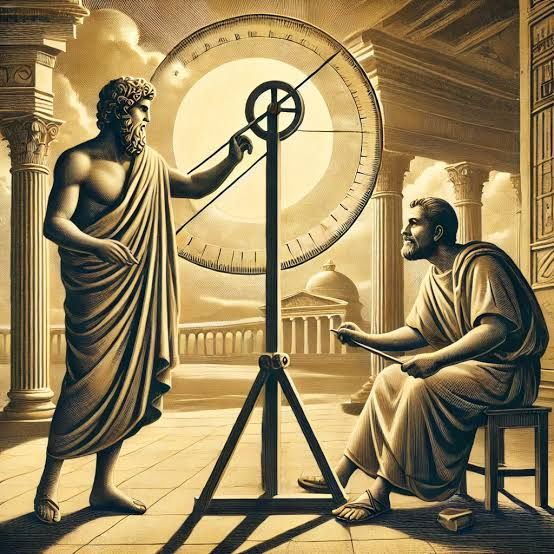
The trajectory of ancient Greek science is often remembered as a triumph of abstract thought, mathematical proofs, and pure philosophical deduction. However, the foundational engine driving their greatest breakthroughs was a deep commitment to systematic observation (historia or autopsia).
Rather than merely sitting in contemplation, Greek scientists closely watched the natural world—tracking the shadows cast by the sun, mapping the migrations of marine life, and monitoring the seasonal behaviors of disease. By pairing deliberate sensory observation with rigorous logic, they transformed science from mythological storytelling into an empirical investigation of cause and effect.
1. Astronomy: Shadows, Eclipses, and the Earth's Curvature
Long before the invention of the telescope, Greek astronomers used simple, precise physical observations of the sky and earth to calculate monumental cosmic realities.
Anaxagoras and the Nature of Eclipses
In the 5th century BCE, Anaxagoras closely observed solar and lunar eclipses. He noticed that during a lunar eclipse, the shadow creeping across the face of the moon was always perfectly curved.
By pairing this visual observation with geometry, he correctly deduced that the moon does not produce its own light but reflects the sun, and that a lunar eclipse is caused by the physical body of the round Earth passing directly between the sun and the moon.
Eratosthenes and the Size of the Earth
In the 3rd century BCE, Eratosthenes used a single, brilliant observation to calculate the circumference of the Earth. He learned that at noon on the summer solstice in Syene (modern Aswan, Egypt), the sun shone directly down a deep well, casting no shadow. At the exact same day and time in Alexandria, he observed that a vertical rod did cast a distinct shadow.
Recognizing that this difference could only happen if the Earth's surface was curved, he measured the angle of the Alexandria shadow (roughly 7.2 degrees). Using the physical distance between the two cities as a geometric scale, he calculated the Earth's circumference to within a staggering 1% to 10% of its actual modern value.
2. Medicine: The Hippocratic Art of Prognosis
The birth of clinical medicine under Hippocrates was entirely built upon the clinical observation of patients. Before this era, sickness was viewed as a demonic curse or divine punishment. Hippocratic physicians replaced this with the Prognosis—a detailed, written record of a disease's timeline.
Doctors were instructed to sit by the patient's bed and observe them using all five senses:
Visual Signs: They watched the shifting color of the skin, the texture of the tongue, and the expression of the face (coining the term Facies Hippocratica to describe the distinct facial collapse of a dying patient).
Auditory Signs: They placed their ears directly against the patient's chest to listen to the lungs, discovering the physical fluid sounds of pleurisy (known today as "Hippocratic succussion").
Tactile and Olfactory Signs: They monitored the rising temperature of fevers by touch and smelled the patient's sweat, breath, and urine to track chemical changes in the bodily humors.
By organizing these day-by-day sensory notes, they realized that diseases followed predictable, natural life cycles, allowing them to anticipate when a fever would hit its critical turning point (krisis).
3. Biology: Aristotle and Marine Taxonomy
While Aristotle is famous for his abstract metaphysics, he was also the ancient world's most prolific field biologist. He spent two years on the island of Lesbos, wading into the coastal lagoons and interviewing local fishermen to record the anatomy and behaviors of hundreds of animal species.
Aristotle’s observations were remarkably advanced. By dissecting sharks, he observed that some species develop embryos inside their bodies attached to a placenta-like structure, mimicking mammals—a discovery that modern marine biologists did not fully confirm until the 19th century.
He also closely watched the behavior of octopuses, correctly identifying how they used a specialized arm (hectocotylus) for reproductive purposes. By compiling these direct observations, Aristotle created the world's first systematic taxonomy (Historia Animalium), grouping animals by shared physical traits, habitats, and reproductive methods.
4. The Structural Crisis: Observation vs. Logic
Despite these spectacular achievements, the role of observation in Greek science faced a profound internal conflict. The Greeks divided knowledge into two categories:
Empiricism (Empeiria): Gathering practical knowledge through sensory observation and experience.
Rationalism (Logos): Unlocking absolute, universal truths through pure mathematical and deductive logic.
Many elite Greek thinkers deeply distrusted the human senses. They pointed out that our eyes are easily fooled by optical illusions, our ears misjudge distances, and our skin misinterprets temperatures.
Plato famously argued that relying on observation was like studying shadows on a cave wall. As a result, when a direct physical observation clashed with a beautiful, symmetrical mathematical theory, Greek scientists would frequently reject the observation in favor of the logic. For instance, astronomers noticed that planets occasionally altered their brightness and sped up across the night sky, suggesting irregular orbits. However, because Greek logic dictated that heaven must be perfect, they insisted for centuries that planets could only move in perfect, uniform circles.
5. Summary of Empirical Methodologies
Astronomy: Utilized macro-observations of shadows, planetary positions, and celestial alignments, pairing them with Euclidean geometry to deduce cosmic architecture.
Medicine: Relied on bed-side clinical observation of physical symptoms, using sensory data to track the natural lifecycles of diseases.
Biology: Pioneered fieldwork, structural dissections, and environmental tracking to categorize the animal kingdom based on physical structures.
The Epistemological Boundary: Observation was highly valued as a starting point, but it was routinely subordinated to deductive logic and geometric symmetry when theories conflicted.
The legacy of ancient Greek science proves that observation was the vital spark that brought natural philosophy to life. While they lacked the advanced instrumentation of modern laboratories, their sensory clarity allowed them to accurately map the heart's valves, calculate the shape of the globe, and identify the natural cycles of disease. By taking the crucial first step of looking at nature with clear, unblinking eyes, they demonstrated that our physical universe is a rational, predictable mechanism that can be observed, measured, and ultimately understood.