The intellectual landscape of Classical Athens was permanently redefined by the establishment of its two greatest institutional powerhouses: The Academy, founded by Plato around 387 BCE, and The Lyceum, founded by his most brilliant student, Aristotle, in 335 BCE.
Before these institutions, Greek learning was highly fragmented, relying on itinerant Sophists who charged exorbitant fees for private lessons in rhetoric. The Academy and the Lyceum introduced the Western world's first structured, permanent centers of higher research, library curation, and philosophical debate. While they shared a geographical home in the olive groves of Athens, their contrasting pedagogical methods, architectural layouts, and intellectual missions mirrored the foundational divide between philosophical idealism and empirical science.
1. Plato’s Academy: The Sanctuary of Idealism
Located roughly a mile outside the dipylon gate of Athens, the Academy was established in a public grove that had traditionally been dedicated to the local hero Hekademos. The site was renowned for its sacred olive trees, running tracks, and shaded walking paths.
The Architectural and Spiritual Layout
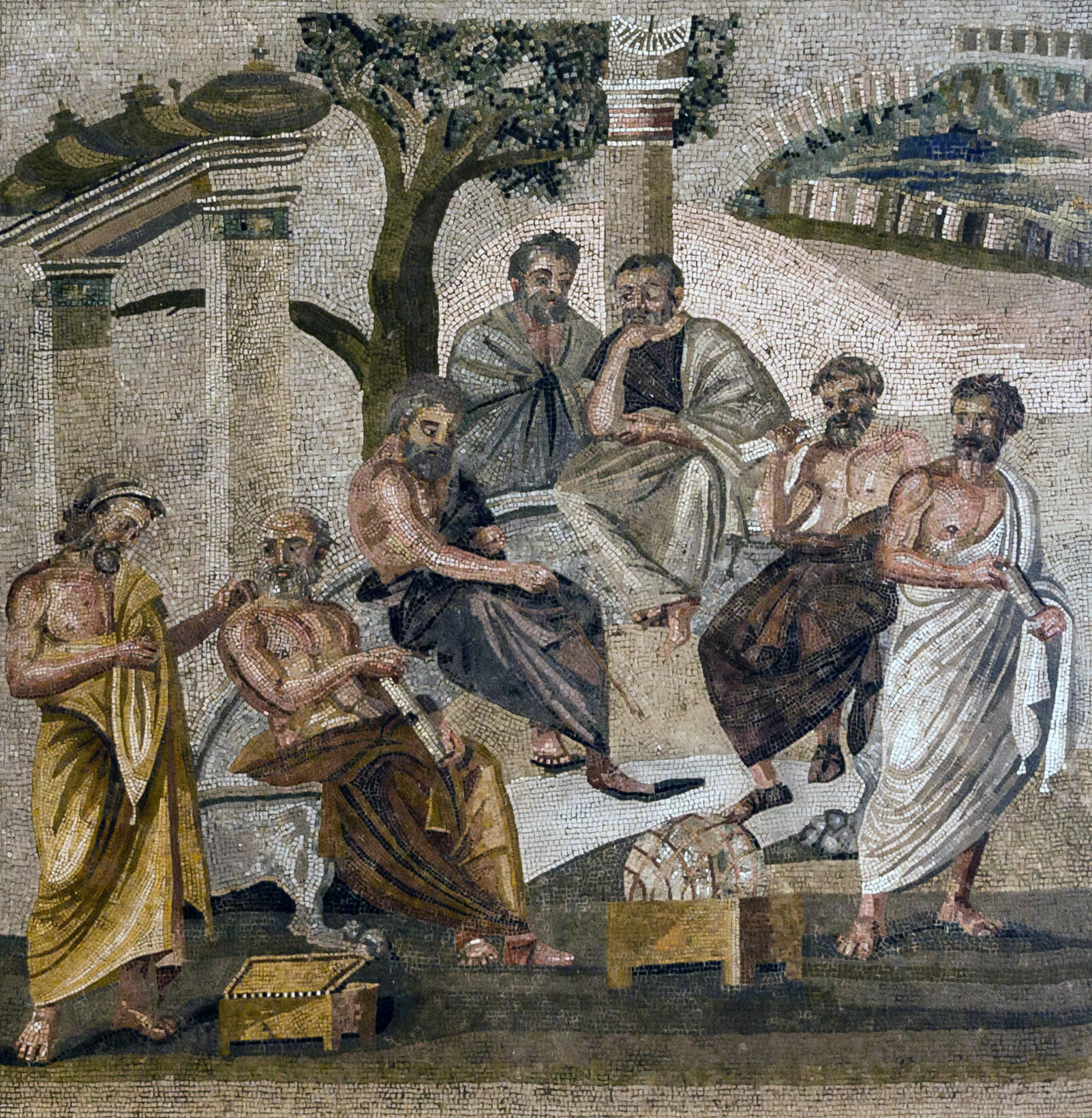
The Academy was not a unified campus with closed classrooms. It was an open-air intellectual commune where students and masters lived, ate, and debated together.
The site featured a central gymnasium, a small shrine to the Muses (Mouseion), and private cottages where Plato lived and worked. To secure the institution’s longevity, Plato organized the Academy as a religious cooperative (thiasos), meaning the property was legally protected under Athenian law as sacred ground dedicated to the cultivation of the human soul.
The Curriculum: Math as the Gatekeeper
Plato’s educational philosophy was deeply rooted in his Theory of Forms. He believed that the physical world was an imperfect illusion and that the ultimate goal of education was to train the human mind to grasp immaterial, eternal truths.
To break students away from their reliance on sensory perception, the Academy prioritized abstract, deductive reasoning. According to historical tradition, engraved above the entrance to the Academy was a strict warning:
"Let no one ignorant of geometry enter here."
Students at the Academy did not jump straight into ethics or politics. Instead, they spent years mastering the mathematical arts: geometry, astronomy, harmonics, and arithmetic. These disciplines were viewed as the essential cognitive scaffolding required to ascend to the highest level of learning: Dialectic—the rigorous, conversational cross-examination of concepts to arrive at absolute definition.
2. Aristotle’s Lyceum: The Laboratory of Empiricism
After spending twenty years at the Academy, Aristotle departed Athens, eventually returning in 335 BCE to establish his own rival institution: the Lyceum. Located on the opposite side of Athens, the Lyceum was situated in a grove dedicated to Apollo Lykeios (Apollo the Wolf-God), which had long been used as a military training ground.
The Peripatetic Method
While Plato’s students sat in quiet contemplation or gathered in fixed discussion circles, Aristotle and his disciples were constantly on the move. They became universally known as the Peripatetics (derived from peripatos, meaning the covered colonnades or walking paths of the Lyceum).
Aristotle delivered his highly advanced, deeply technical lectures on metaphysics, physics, and logic in the early morning while pacing briskly up and down the shaded paths with his advanced students, believing that physical movement stimulated sharper analytical thought. In the afternoons, he delivered broader lectures on rhetoric and politics to the general public.
The Curatorial Revolution
Reflecting Aristotle’s passion for physical observation and classification (Hylomorphism), the Lyceum transformed into the ancient world's first great research laboratory. Rather than focusing exclusively on geometry, the Lyceum functioned as an empirical repository:
The World's First Great Library: Aristotle systematically collected hundreds of manuscripts, maps, and historical documents, creating a massive private library that later served as the direct structural blueprint for the Great Library of Alexandria.
The Natural History Museum: Utilizing his connections to his former pupil, Alexander the Great, Aristotle ordered military expeditions across Asia to collect rare plants, animal specimens, and geological samples, which were shipped back to the Lyceum for systematic dissection, classification, and study.
The Constitutional Archive: Students at the Lyceum performed a monumental political research project, collecting and analyzing the unique political constitutions of 158 distinct Greek city-states to deduce the practical mechanics of stable governance.
3. Structural Paradigms of Ancient Learning
The differences between the two institutions can be traced across their core academic structures:
Plato's Academy: Focuses on abstract, deductive reasoning, utilizing geometry and mathematics to transcend the physical world and glimpse the eternal Forms.
Aristotle's Lyceum: Focuses on concrete, inductive reasoning, utilizing biological observation, textual collection, and classification to understand the mechanics of the material universe.
Academy Pedagogy: Dialectical conversation, deep meditation, and communal dining geared toward political and spiritual transformation.
Lyceum Pedagogy: Peripatetic lectures, empirical dissection, and systematic archiving geared toward natural science and political categorization.
4. The Enduring Legacy of the Groves
The Academy and the Lyceum survived long after their founders passed away, operating for centuries as the dual intellectual capitals of the Mediterranean world. The Academy endured in various iterations until it was finally dissolved by the Byzantine Emperor Justinian in 529 CE, who viewed its pagan philosophy as a threat to Christian orthodoxy.
Despite their physical closure, the structural blueprints forged in those Athenian groves became permanent. Every time a modern university student steps onto a campus quadrangle, attends an advanced research seminar, checks out a volume from a curated research library, or synthesizes abstract theory with empirical data, they are participating in an institutional lineage that began when Plato and Aristotle walked beneath the olive branches, arguing over the true path to human understanding.