The final act of the House of Atreus marks a massive turning point in the history of Greek myth, charting a painful evolution from primitive, personal vengeance to the rule of institutional law.
Below is the generational breakdown of the family's cyclical horrors, mapped out from its rotten roots down to its legal resolution.
The Cycle of Retribution
1. The Root: Tantalus
The Crime: Infanticide and a cannibalistic feast. Driven by hubris and a desire to test the gods' omniscience, Tantalus slaughtered his own son, Pelops, cooked his flesh into a stew, and served it to the deities at a banquet.
The Punishment: The gods instantly recognized the horror and threw Tantalus into the deepest pits of Tartarus, where he was condemned to eternal hunger and thirst.
2. The Foundation: Pelops
The Crime: Murder and betrayal. After being resurrected by the gods, Pelops sought the hand of Hippodamia. He won her by bribing the royal charioteer, Myrtilus, to sabotage her father’s chariot with melting beeswax linchpins. Instead of paying the reward, Pelops cast Myrtilus off a high cliff into the sea.
The Punishment: As Myrtilus fell to his death, he called upon his father Hermes, casting a devastating, multi-generational death curse upon Pelops and his entire lineage.
3. The Feud: Atreus
The Crime: Horrific cannibalistic revenge. Pelops's sons, Atreus and Thyestes, fought bitterly for the throne of Mycenae. After Thyestes seduced Atreus's wife and stole the golden-fleeced ram symbolizing royalty, Atreus feigned peace. He captured Thyestes's young sons, slaughtered them, and served them to their father at a reconciliation banquet.
The Punishment: Thyestes cursed the lineage and fled. An oracle prophesied that an incestuous union with his daughter would produce a son, Aegisthus, who would grow up with the sole purpose of murdering Atreus.
4. The Ambition: Agamemnon
The Crime: Ritualistic child sacrifice. Atreus's son, Agamemnon, inherited the crown of Mycenae and led the Greek forces against Troy. When the goddess Artemis stalled his fleet at the port of Aulis with absolute calm winds, Agamemnon chose military ambition over his family, sacrificing his eldest daughter, Iphigenia, upon the altar.
The Punishment: This act completely alienated his wife, Clytemnestra, who spent the next ten years plotting his destruction.
5. The Revenge: Clytemnestra
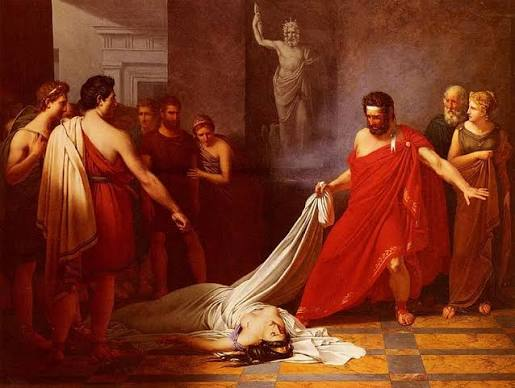
The Crime: Regicide and husband murder. When Agamemnon returned home victorious from Troy, Clytemnestra—who had taken Thyestes's avenging son, Aegisthus, as her lover—ensnared her husband in a heavy, tangled net while he was relaxing in the bath. She brutally struck him down with three blows of a double-bitted battle axe.
The Punishment: Her actions forced her remaining children, Orestes and Electra, into an impossible moral dilemma regarding the duty of avenging their father.
6. The Climax: Orestes
The Crime: Matricide. Commanded by a strict mandate from the god Apollo to avenge his father’s murder, Orestes returned to Mycenae in disguise and executed both Aegisthus and his own mother, Clytemnestra.
The Punishment: The moment Clytemnestra's blood touched the earth, the Furies (Erinyes)—ancient, serpentine deities of chthonic vengeance—manifested from the underworld to hound Orestes into screaming madness for spilling maternal blood.
7. The Resolution: The State
The Innovation: Legal trial and arbitration. Driven to despair, Orestes fled to Athens and sought the protection of the goddess Athena. Recognizing that an endless blood feud would eventually wipe out humanity, Athena established the very first courtroom trial at the Court of the Areopagus, assembling twelve elite citizens to act as a jury.
The Outcome: Apollo defended Orestes, while the Furies prosecuted for Clytemnestra. When the mortal jury delivered a split tie, Athena cast the decisive ballot to acquit Orestes, breaking the curse. She then pacified the Furies by renaming them the Eumenides ("The Kindly Ones"), transitioning their cosmic role from blind, tribal eye-for-an-eye retaliation to reasoned, institutional justice.