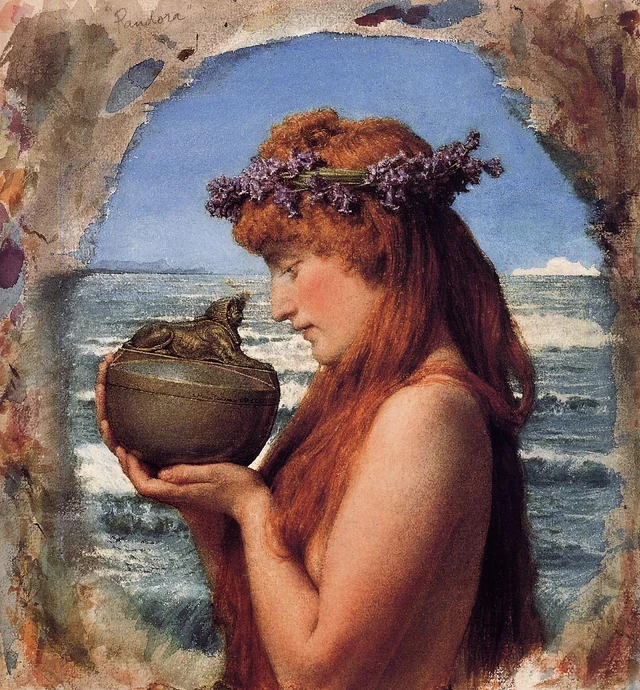
The story of Pandora’s Box is one of the most famous metaphors in human history, universally understood as a warning about the dangers of unchecked curiosity and the irreversible release of evil into the world.
There is just one glaring problem: Pandora never owned a box. The concept of the "box" is the result of a massive, multi-century translation blunder that permanently altered Western folklore. In the original ancient Greek texts, Pandora’s famous container was a pithos—a massive, immovable earthenware storage jar. This linguistic mix-up did not just change the object's shape; it completely distorted the deep structural, economic, and misogynistic metaphors the ancient Greeks originally intended.
1. Hesiod’s Original Tech-Noir: The Pithos
The myth of Pandora first appears in the 8th century BCE in the works of the poet Hesiod (Theogony and Works and Days). In Hesiod’s worldview, Pandora was not an innocent, curious woman who made a mistake; she was engineered from the start by Zeus as a weapon of weaponized deception to punish humanity after Prometheus stole fire.
Hesiod explicitly states that Pandora brought with her a pithos ($\pi \text{ί}\theta \text{o}\varsigma$).
What is a Pithos? A pithos was a colossal, heavy ceramic storage jar, often standing as tall as a human being. These jars were the backbone of the ancient Mediterranean economy. They were not delicate, decorative jewelry boxes held in a woman's palm; they were massive, coarse utilitarian vessels used to store bulk agricultural goods like olive oil, wine, grain, and salted fish.
The Domestic Burying: Because these jars were so large and heavy, they were typically partially buried deep into the dirt floors of a home’s subterranean storage cellar (andreion) to keep the contents cool and stable.
To the ancient Greek listener, telling a story about Pandora opening a pithos carried a specific domestic meaning: she was going deep into the structural storage core of the household and breaking open a heavy, sealed vault.
2. The Mistranslation: How a Jar Became a Box
The transformation of this massive storage jar into a dainty handheld box is traced back to a single man: Erasmus of Rotterdam, the brilliant Dutch humanist and scholar of the Northern Renaissance.
   [ ANCIENT GREEK TEXT ] ──► Pithos (Colossal Earthenware Storage Jar)
                                     │
                        (Erasmus's 16th-Century Translation)
                                     │
                                     ▼
   [ LATIN VULGATE TEXT ] ──► Pyxis (Handheld Box / Jewelry Casket)
In the early 16th century, Erasmus was translating Hesiod’s Greek text into Latin. While working on the passage, he confused the Greek word pithos (jar) with the Greek word pyxis ($\pi \nu \xi \text{ί}\varsigma$).
A pyxis was a small, decorative, flat-bottomed box or casket, usually carved out of boxwood, ivory, or precious metals, used by wealthy Greco-Roman women to store cosmetics, ointments, or fine jewelry.
Erasmus translated the vessel into Latin as pyxis. Because Erasmus's Latin translations were the foundational texts studied by European elites, artists, and writers throughout the Renaissance, the image of the "box" became permanently locked into Western literature, painting, and popular vocabulary, completely erasing the massive clay jar from the collective imagination.
3. The Lost Metaphors: Why the Jar Matters
Erasmus's translation error was not just a harmless vocabulary slip; it fundamentally stripped the myth of its layered, ancient cultural subtext. Returning the jar to the story restores three critical metaphors that Hesiod originally constructed:
1. The Architectural Palindrome: Hope and the Womb
In ancient Greek thought, the shape of the pithos was explicitly tied to fertility, storage, and anatomy. The curving, bulbous shape of the earthenware jar was viewed as an architectural analogue for the human womb.
When Pandora removes the heavy lid (pōma) of the jar, she unleashes the horrors of disease, labor, and death upon humanity, which had previously lived in a paradise free from suffering. However, Hesiod notes that Elpis (Hope) remains trapped inside, caught right beneath the rim before the lid is slammed shut.
   [ THE OPENING ] ───► Evils, Disease, and Death Fly Out into the World
                                 ▲
                    (The Shape of the Vessel)
                                 ▼
   [ THE INTERIOR ] ──► Elpis (Hope) Remains Trapped at the Base of the Womb
By framing the container as a storage jar/womb, the myth delivers a bittersweet biological paradox: the female womb is the source of all human suffering and mortality (because to be born is to be destined to die), yet it is also the unique container that holds the "hope" of future generations and the continuation of the human race.
2. The Trap of Agriculture and Marriage
To Hesiod, agriculture and marriage were necessary evils forced upon men by the gods. Before Pandora, the earth naturally provided food without human sweat.
A pithos required intensive manual labor to fill, and it could be easily emptied by a wasteful or unfaithful partner. By opening the storage jar, Pandora permanently introduced scarcity. Man was now forced to perform brutal agricultural labor to fill his jars with grain, and forced to marry a woman to manage those jars and produce legitimate heirs—trapping humanity in an endless loop of labor and domestic survival.
3. The Jar of Blessings vs. the Jar of Evils
By using a pithos, Hesiod was playing with an older Homeric metaphor. In the Iliad, Homer states that Zeus has two massive pithoi sitting on the floor of his heavenly palace: one filled with evil fortunes, and the other filled with good blessings. Zeus mixes the contents of these jars to distribute fate to mortals.
By giving Pandora her own pithos, the myth aligns her directly with the grand cosmic scales of destiny. She is not a curious girl opening a forbidden jewelry box; she is an agent of cosmic balance, unsealing an earthly jar of woes that permanently alters the spiritual geology of human existence.
4. Summary of the Container Paradox
The Original Object: A Pithos—a colossal, immovable clay storage vessel used for staple agricultural goods, historically buried in the floors of ancient Greek homes.
The Error (16th Century): Erasmus of Rotterdam mistranslated the Greek pithos into the Latin pyxis (a small, decorative cosmetic or jewelry box).
The Visual Shift: Renaissance art and literature adopted the handheld box model, permanently obscuring the heavy, industrial agricultural context of the original myth.
The Philosophical Loss: Changing the jar to a box broke the ancient symbolic link between the vessel's interior and the human womb, erasing Hesiod’s complex critique of agricultural scarcity, labor, and generational hope.
The myth of Pandora’s Jar serves as a stark reminder of how easily the physical architecture of our stories can be warped by a single scratch of a translator’s pen. While the phrase "Pandora’s Box" is likely a permanent fixture of modern language, understanding the reality of the pithos transforms our perspective of the narrative. Pandora was not an accidental voyeur holding a forbidden trinket; she was the architect of a new human condition, tipping over a massive vault of raw, volcanic reality that permanently spilled out across the floor of the ancient world.