The myth of Narcissus and Echo is one of the most haunting and poetically layered stories found in Ovid’s Metamorphoses. Far more than a simple moral warning against vanity, this classical Roman tragedy is a brilliant psychological exploration of the failure of human communication.
It traces the parallel downfalls of two individuals trapped in opposite, yet symmetrical, curses of isolation: one who cannot speak for herself, and one who cannot love anyone but himself.
1. The Curse of Echo: The Fragmented Voice
Before she became a disembodied sound, Echo was a beautiful, famously talkative mountain nymph (oread). She spent her days roaming the forests, but she frequently used her sharp wit and endless chatter for a deceptive political purpose: covering up the romantic affairs of Zeus.
Whenever Hera, the queen of the gods, came down to earth to catch her unfaithful husband, Echo would intentionally intercept her. She would trap Hera in long, winding, hypnotic conversations, giving the other nymphs enough time to scatter and escape unnoticed.
Eventually, Hera realized she was being manipulated. Her retribution was swift and custom-tailored to Echo’s crime:
"You shall still have the use of that tongue with which you have cheated me," Hera declared, "but only for a lesser purpose. You shall have the briefest power of speech."
Hera stripped Echo of her independent voice. From that moment on, Echo was condemned to a state of absolute linguistic passivity: she could no longer initiate a conversation, nor could she alter the words spoken to her. She could only seize the final, dying words of another person's sentence and throw them back.
2. The Prophecy of Narcissus: The Danger of Self-Knowledge
While Echo lived in linguistic isolation, a young hunter named Narcissus was growing up in the same woods. The son of the river god Cephissus and the nymph Liriope, Narcissus possessed a striking, otherworldly beauty that captivated everyone who looked at him.
When Narcissus was an infant, his worried mother consulted Tiresias, the famous blind seer of Thebes, asking if her exceptionally beautiful boy would live to see a long, ripe old age. Tiresias delivered a cryptic, chilling paradox:
"He will live to be old, so long as he never knows himself."
In the ancient Greco-Roman world, "Know thyself" (gnothi seauton) was regarded as the highest philosophical virtue. Tiresias was warning that for Narcissus, self-awareness would be a fatal trap.
As Narcissus grew into his late teens, his beauty deepened, but it was matched by a cold, impenetrable pride (hubris). He rejected the love of every youth, maiden, and nymph who pursued him, viewing them all as beneath his station, completely indifferent to the emotional devastation he left in his wake.
3. The Encounter: A Symphony of Misunderstanding
The tragic paths of the two figures finally crossed during a deer hunt in the dense forests of Boeotia. Echo saw Narcissus tracking game through the trees and was instantly inflamed with deep passion.
Because of her curse, she could not step forward and confess her love. Instead, she slunk quietly through the undergrowth, stalking him through the shadows, waiting desperately for him to speak so she could use his own words to reveal her heart.
   [ NARCISSUS ] ───► "Is anyone here?" ───────────────────────────────┐
                                                                       ▼
   [ ECHO ]      ◄─── "Here!" ◄── (Seizes and echoes the last word) ───┘
The forest grew dense, and Narcissus became separated from his hunting party. Hearing rustling leaves, he called out into the woods:
Narcissus: "Is anyone here?"
Echo (hidden): "...Here!"
Narcissus (confused, looking around): "Come!"
Echo: "...Come!"
Narcissus (shouting into the silence): "Why do you run from me? Let us join together here!"
Echo (overjoyed, taking the invitation literally): "...Let us join together here!"
Mistaking his words for a genuine invitation of love, Echo rushed out from the shadows of the trees, her arms outstretched, ready to fling them around Narcissus’s neck.
Narcissus recoiled in disgust. Stepping back, he harshly shouted, "Hands off! I would rather die than let you have power over me!"
Echo, utterly rejected and devastated, could only repeat his final cruel words: "...have power over me." Shamed and brokenhearted, she fled back into the deep caverns and lonely mountain ridges. She hid herself away, refusing to eat or sleep, letting her grief consume her body until her bones turned to stone and nothing remained of her but her repeating voice—an echo drifting forever across the landscape.
4. The Nemesis Retribution: The Pool of Mirages
Narcissus’s cruelty to Echo was the final straw. One of his rejected male suitors knelt down, lifted his hands to the heavens, and prayed for cosmic justice: "May he himself love this way, and may he waste away, unable to possess the object of his love!"
The goddess of divine retribution, Nemesis, heard the prayer and deemed it a just punishment.
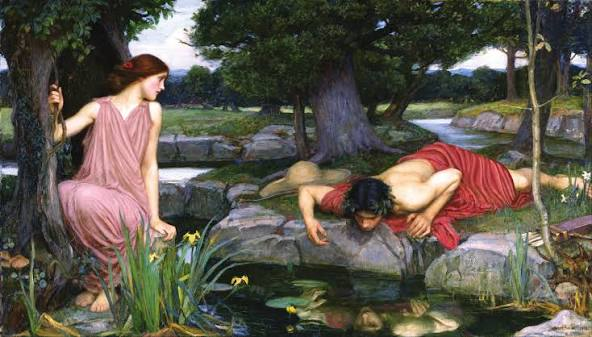
She guided Narcissus to a hidden, pristine pool deep in the woods. The water was crystalline and completely undisturbed by wind, wild animals, or falling leaves; its surface acted as a perfect, flawless mirror.
Exhausted from the heat of the hunt, Narcissus knelt down by the bank to drink. As he leaned over the water, he saw a vision of unparalleled beauty staring back at him—deep, luminous eyes, flowing curls, and a perfect, ivory complexion.
Narcissus did not realize he was looking at his own reflection. He fell instantly, hopelessly in love with the image.
5. The Metamorphosis: The Final Illusion
The tragedy of Narcissus mirrors the curse of Echo; he is trapped in his own loop of impossible communication.
Whenever he leaned down to kiss the beautiful youth, his lips met only cold, wet water. Whenever he plunged his arms into the pool to embrace the form, the water rippled, and the image shattered into pieces, disappearing from his grasp. He was completely enslaved by an illusion that could never love him back.
   [ THE TRAGIC REVERSAL ]

   * ECHO      ──► Trapped in an auditory loop (Can only repeat others)
   * NARCISSUS ──► Trapped in a visual loop     (Can only love himself)
Remembering the words of Tiresias, Narcissus finally realized the horrific truth as he watched his own reflection weep: "I am he! I have felt it, my own image does not deceive me! I burn with love for myself; I move the fire that I suffer."
Unable to tear himself away from the pool, Narcissus slowly wasted away from hunger and sorrow. Echo, still lingering nearby in the trees, watched his slow demise with pity. When Narcissus took his final breath, crying out to the water, "Alas, in vain, beloved youth!", Echo’s distant voice cast back his final words: "...beloved youth!"
As his spirit crossed the river Styx into the underworld, he leaned over the edge of Charon's ferry boat, trying to catch one last glimpse of his reflection in the dark waters of death. On earth, where his body had lay, the nymphs found no corpse. In its place, they found a unique white flower with a golden heart, its face bent downward toward the earth—the Narcissus, blooming permanently at the edge of the water.
6. Summary of the Communication Failure
Echo's Linguistic Void: Stripped of independent expression by Hera, she represents the tragic inability to project one's internal thoughts onto the outer world.
Narcissus's Visual Trap: Cursed by Nemesis to fall in love with his own reflection, he represents the toxic inability to see beyond oneself or absorb the reality of the outer world.
The Symbiotic Downfall: Both figures are destroyed because they cannot establish an authentic connection; Echo can only mimic others, while Narcissus can only obsess over himself.
The Mythological Legacy: The tragedy gave rise to two foundational modern concepts: the auditory "echo" of physical acoustics, and the psychological diagnosis of "narcissism" (severe, destructive self-absorption).