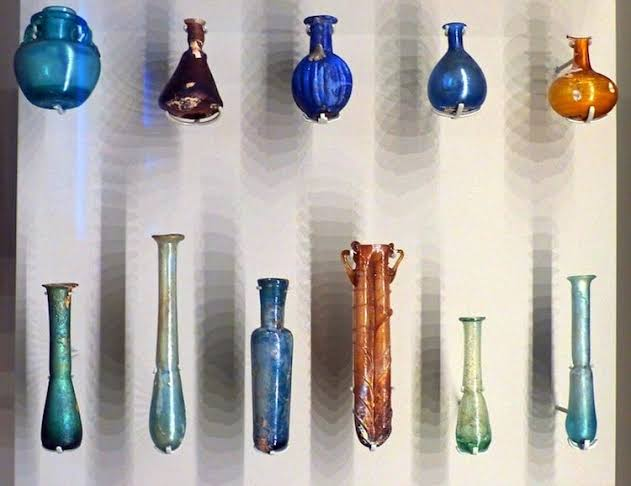
For much of Greek history, glass was not a cheap, utilitarian material used for window panes or drinking cups; it was an exotic, luxury gemstone-alternative valued for its vibrant, semi-translucent colors.
Core-Forming Technology: Prior to the revolutionary invention of glassblowing in the 1st century BCE, Classical Greek artisans created glass vessels using the arduous core-forming technique. A core made of a removable mixture of clay and animal dung was sculpted around a metal rod. Molten glass was then drawn out into thin threads and wound repeatedly around this clay core.
Trailing and Marvering: To decorate the vessel, wires of contrasting colored glass (often bright yellow or opaque white) were wrapped around the main blue or green body. While still hot, the vessel was rolled flat against a smooth stone slab (marver), and a metal hook was used to comb the lines into wavy zig-zag patterns. Once cooled, the internal clay core was scraped out, leaving a small, beautiful flask used exclusively to hold luxury oils and cosmetics.
Cast Glass Luxury: During the Hellenistic period, workshop centers like Alexandria and Rhodes developed advanced casting techniques, utilizing open molds to produce stunning monochrome bowls and mosaic "millifiori" (thousand flowers) glass vessels, which commanded astronomical prices among the Mediterranean elite.