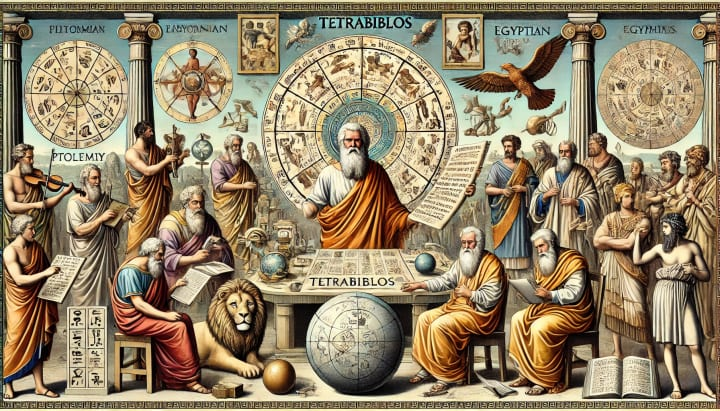
While the Classical Greeks relied heavily on localized civic oracles like Delphi, the expansion of the Greek world under Alexander the Great in the 4th century BCE brought them into direct, permanent contact with Babylonian and Persian science, initiating a massive revolution in how decisions were made through astrology (astrologia).
The Fusion of Math and Fate: The Greeks took the raw observational data of Babylonian star-gazers and synthesized it with their own advanced geometry and natural philosophy. By the Hellenistic period, the cosmos was viewed as a highly rational, clockwork mechanism where the movements of the planets (planētes, meaning "wanderers") exerted a physical, mathematical influence on the earthly sphere.
Katarchic Astrology: For rulers, generals, and wealthy merchants, katarchic astrology became an indispensable tool for strategic decision-making. This branch of the science was used to calculate the absolute most auspicious moment (kairos) to initiate a major project. Generals regularly delayed military campaigns or the crossing of borders until court astrologers analyzed the planetary alignments, ensuring that Mars or Jupiter occupied favorable houses in the zodiac before committing troops to battle.
The Birth Chart (Genethlialogy): Individual life decisions were guided by the natal chart. Utilizing complex geometric instruments like the astrolabe, astrologers mapped the exact position of the horizon and stars at the precise second of an individual's birth to determine their inherent character, physical vulnerabilities, and ultimate fate (moira). This mathematical approach to destiny heavily influenced elite philosophical schools like Stoicism, which argued that understanding the cosmic order allowed a person to align their personal decisions with the inexorable laws of nature.