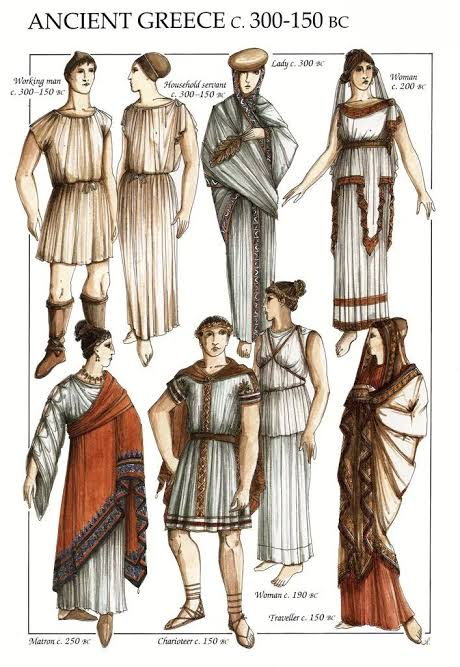
In the democratic but fiercely class-conscious environment of the Greek polis, clothing was far more than functional coverage or a casual fashion choice. Because the basic cut of garments was highly standardized across all classes, social distinction depended entirely on material quality, dye complexity, and the precise physical manner in which the fabric was draped.
The Anatomy of the Tunic: The fundamental pieces of Greek clothing were rectangles of uncut fabric woven directly on domestic looms. Men and women wore the chiton (a lightweight linen tunic fastened at the shoulders) or the peplos (a heavier, woolen garment wrapped around the body and pinned). Over this, citizens draped the himation, a large cloak that required significant physical poise to keep in place without pins.
The Language of Draping: How a citizen carried their himation was an instantaneous public signal of their social status, education, and moral character. A sophisticated, upper-class gentleman draped his cloak tightly around his body, keeping his right arm completely bound within the fabric to demonstrate civic restraint (sophrosyne). Allowing one’s cloak to drag on the floor, draping it over the left shoulder incorrectly, or moving too quickly so the fabric unraveled was mocked in public assemblies as a sign of vulgarity, low birth, or an undisciplined mind.
Dyes and Marginalization: Color was a powerful indicator of wealth. The poorest laborers and slaves wore raw, unbleached wool or dull brown and grey garments treated with cheap vegetable dyes, often cut into a single-shouldered tunic (exomis) to allow for manual labor. Elite citizens flaunted bright, expensive colors like saffron yellow, sea-green, and highly prized Tyrian purple extracted from thousands of murex sea snails. Slaves were legally barred from mimicking these elite styles, reinforcing the rigid civic hierarchy through a visual uniform.