The financial architecture of the ancient Greek city-state was remarkably sophisticated, managing complex networks of civic expenditures, maritime trade investments, and state revenue collection without the aid of modern central banking institutions. Because maintaining public infrastructure, staging religious festivals, and funding standing navies required massive capital, states like classical Athens had to develop rigorous bureaucratic systems to track public funds, implement taxes, and leverage the personal wealth of their richest citizens to ensure economic stability.
The primary repository for public funds was the state treasury, frequently housed within the secure inner chambers of the city's patron temple, such as the Opisthodomos behind the Parthenon. Public finances were overseen by elected or chosen citizens known as tamiai (treasurers), who served strict, non-renewable terms to prevent corruption. These officials meticulously recorded all incoming revenues and outlays on monumental stone slabs called stelai, which were erected in public spaces like the agora. This practice of stone accounting allowed any literate citizen to audit the state’s financial health, establishing transparency as a core civic virtue.
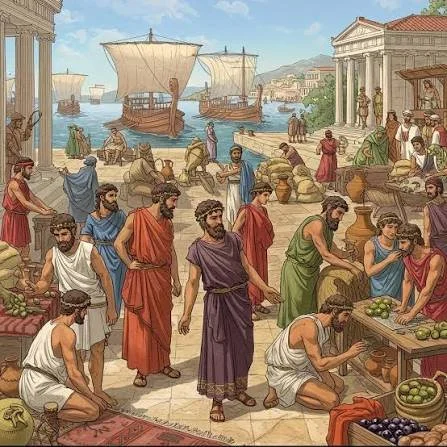
Greek taxation models heavily favored indirect levies over direct income taxes, which were culturally viewed as degrading to the freedom of a citizen. Instead, the state generated massive income through harbor customs duties—such as the famous two-percent tax levied on all goods entering or leaving the port of the Piraeus—and licensing fees for mining concessions, particularly the state-owned silver mines at Laurium. In times of extreme military crisis, the state could implement the eisphora, an emergency direct property tax levied on the wealthy elite, which was voted on directly by the popular assembly and repealed as soon as the conflict ended.
The most unique element of Greek public finance was the system of leitourgiai (liturgies), which legally mandated the wealthiest citizens to directly fund public services out of their own pockets. Under this system, a rich individual might be appointed as a trierarch, requiring him to personally pay for the maintenance, crew wages, and equipment of a naval warship for an entire year. Others were tasked with the choregia, funding the training, costumes, and production costs of the choruses for the city’s dramatic festivals. This brilliant fiscal mechanism transformed private wealth into public luxury and military power, avoiding the need for a massive state tax bureaucracy.