The military supremacy of the Greek hoplite phalanx was fundamentally forged in the intense heat of the blacksmith’s workshop. The production of protection systems and close-quarters weapons—such as the iconic xiphos sword, the heavy kopis slashing blade, and bronze muscle cuirasses—represented a highly sophisticated intersection of pyrotechnology, geology, and mechanical engineering. Blacksmiths were elite, revered craftsmen who manipulated raw elemental matter to transform soft minerals into lethal, highly durable instruments of war.
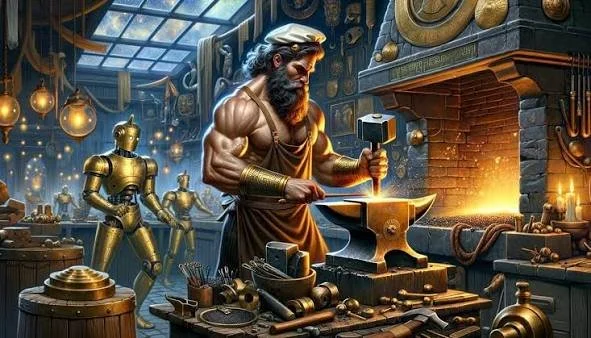
The forging of an iron sword like the xiphos began with the refinement of raw iron ore within a charcoal-fired bloomery furnace. Blacksmiths used bellows to pump continuous streams of oxygen into the clay structure, driving temperatures past twelve hundred degrees Celsius to produce a spongy mass of iron and slag known as a bloom. The smith retrieved this glowing mass with heavy iron tongs, placing it onto a stone or iron anvil. Through relentless, rhythmic strikes with heavy sledges, the smith manually squeezed out the glassy slag impurities, folding the iron back onto itself multiple times to create a dense, layered composite structure with consistent carbon distribution.
To shape the characteristic leaf-shaped blade of the xiphos, which was designed to widen near the point to maximize the force of a thrust, the smith carefully managed the thermal cycle of the iron. Once the final profile was hammered out, the blade underwent the critical process of quenching. The smith plunged the red-hot iron into a trough of cold spring water or oil, rapidly cooling the metal to lock the carbon atoms into a hard, brittle crystalline structure known as martensite. To prevent the sword from shattering upon impact against armor, the smith performed tempering, gently reheating the blade to a lower temperature to restore structural elasticity and toughness.
Conversely, defensive armor—such as the Corinthian helmet and the anatomically detailed muscle cuirass—was primarily manufactured from bronze, an alloy of roughly nine parts copper to one part tin. Bronze smiths poured molten alloy into flat stone molds to create sheets, which were then cold-hammered over specialized iron stakes and anvil shapes to contour the metal to the human body. Cold-hammering bronze naturally compressed its molecular structure, drastically increasing its hardness without requiring quenching. The resulting armor was polished to a mirror-like finish using pumice and oil, ensuring that a Greek warrior was encased in a gleaming, structurally sound shell designed to deflect the violent impacts of ancient combat.