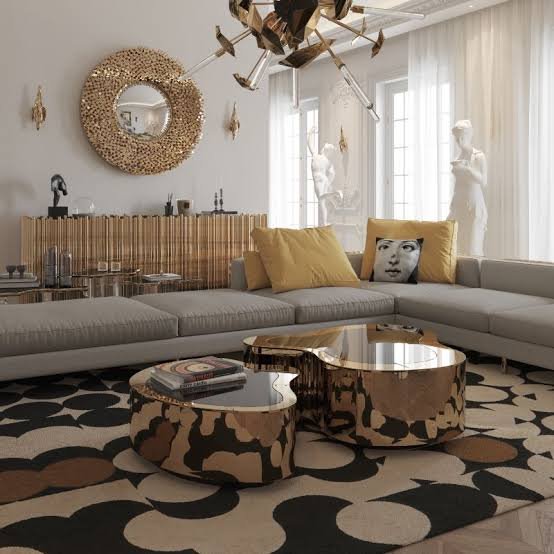
The architectural motifs of ancient Greece have never truly faded from human spaces; instead, they have undergone a continuous process of rebirth, firmly embedding themselves as hallmarks of modern interior design. From high-end minimalist apartments to classic suburban estates, contemporary designers routinely utilize ancestral Greek patterns to establish a sense of structural balance, rhythm, and timeless sophistication. These motifs, originally carved into monumental marble temples or painted on clay vessels, function in the modern home as powerful visual anchors that instantly elevate interior architecture.
The most ubiquitous and enduring pattern is the meander, commonly known as the Greek key. Characterized by a continuous, unbroken line that folds back on itself in right angles, the meander was originally designed by ancient artists to symbolize infinity, the eternal flow of life, and the winding paths of the Maeander River in Asia Minor. In modern interior contexts, this geometric pattern is deployed with exceptional versatility. Designers utilize it as a bold border element on custom wool rugs, weave it into luxury linen drapery, and stamp it across metallic wallpaper to break up the monotony of flat walls, adding a structured, architectural framework to contemporary living spaces.
Alongside the meander stands the anthemion and palmette pattern, a stylized motif inspired by the fan-like leaves of the Mediterranean palm tree and wild honeysuckle. In classical architecture, these botanical patterns crowned the rooflines and friezes of temples like the Parthenon. Today, modern product designers strip away the heavy ornamental density of these shapes, simplifying them into clean, curvilinear silhouettes. These abstracted leaf patterns are printed on accent cushions, upholstered onto statement chairs, and etched into frosted glass partitions, striking a perfect balance between geometric order and organic warmth.
The survival of these patterns is driven by their inherent mathematical harmony. Greek design was fundamentally tied to the concept of symmetry and proportion, ensuring that every line and repeating unit felt balanced to the human eye. By integrating these classical borders and motifs into furniture trim, bathroom tiling, and decorative textiles, modern design does not merely replicate antiquity; it utilizes a proven visual language. These patterns infuse spaces with a structural discipline that grounds modern minimalism, proving that the geometric laws formulated in ancient workshops remain the ultimate tools for creating elegant interiors.