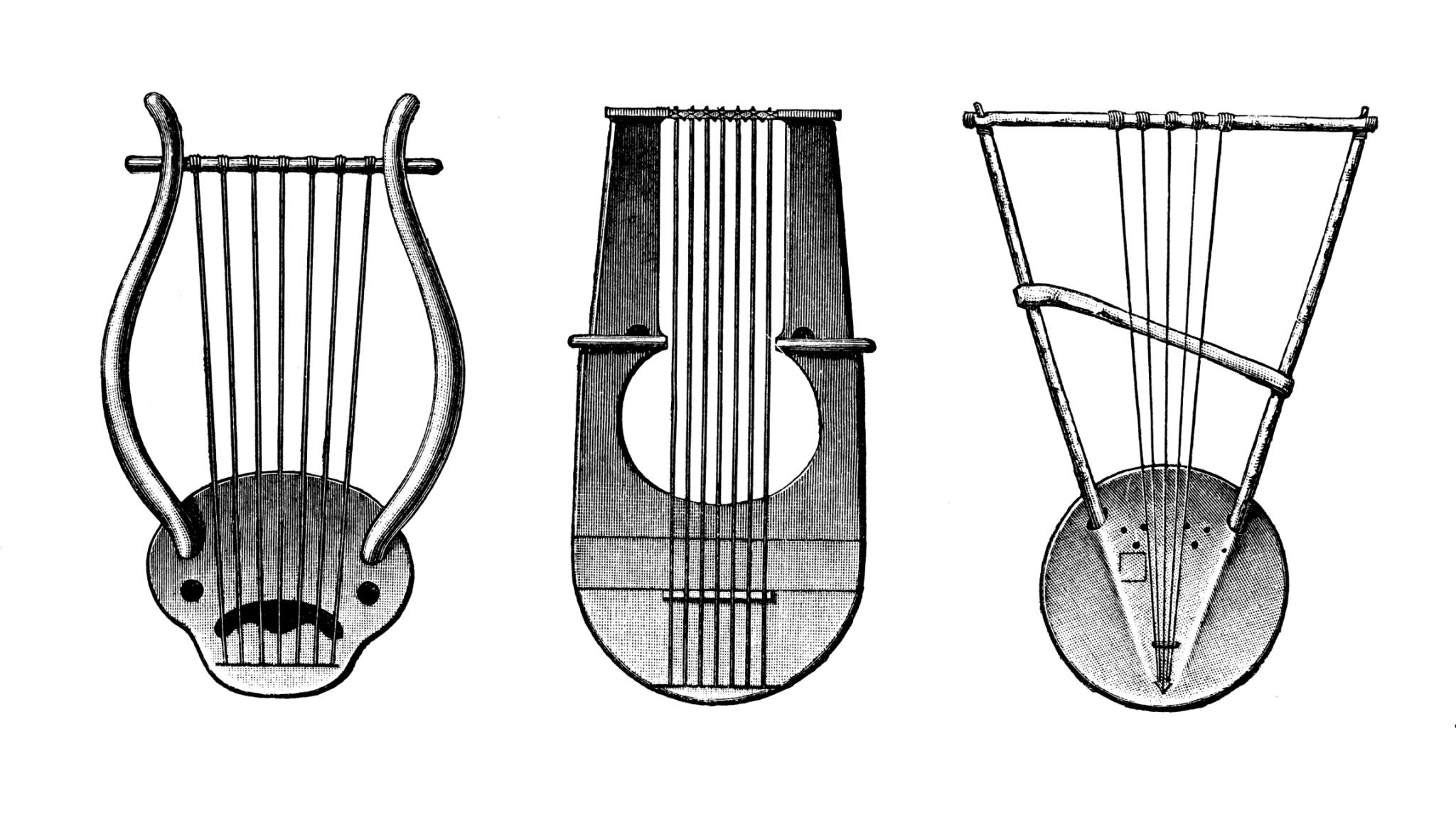
Music (mousikē) was a core element of ancient Greek education, theater, and religious festivals. To build the instruments that accompanied these events, Greek craftsmen combined advanced woodworking, organic materials, and precise geometric principles. They categorized their instruments into two primary families: stringed instruments like the lyre and kithara, and wind instruments like the aulos.
Acoustic Materials and Structural Assembly
The creation of a classic chelys lyre was an ingenious process that transformed natural materials into a resonant soundbox. Craftsmen salvaged the hollowed-out carapace of a land tortoise to form the base of the instrument.
They stretched a taut membrane of dried ox hide over the open shell opening, securing it with wooden pegs to form the soundboard. Two curved wooden arms, often carved from durable cornel or maple wood, were inserted into the shell and joined at the top by a horizontal wooden crossbar (zygon).
The strings were crafted from processed sheep gut, which was soaked, twisted, and dried to maximize tensile strength. Instead of mechanical tuning pegs, the Greeks wrapped the top of each string around the crossbar using a roll of sheep's wool mixed with sticky resin; musicians tuned the instrument by sliding this sticky wool bundle to adjust the string tension.
For wind instruments like the aulos (a double-piped reed instrument), makers bored precise holes into hollowed segments of deer bone, ivory, or seasoned reed, matching the finger placement to specific mathematical ratios discovered by Pythagoras to produce the distinct Greek musical modes.
The Importance of Salt in Greek Economy and Trade
Salt (hals) was one of the most vital strategic commodities in the ancient Mediterranean world. In an era without refrigeration, salt was not a luxury seasoning; it was an absolute biological necessity and the primary technology for preserving perishable food, making it an essential driver of regional trade networks, state revenue, and imperial expansions.
Salt Pan Extraction and Commodities Processing
The Greeks harvested salt through solar evaporation along shallow coastal lowlands, building networks of artificial square evaporation basins known as salt pans (halopēgia). The prominent salt production hubs were situated in the shallow lagoons of Missolonghi, Attica, and the black sea colonies.
During the hot summer months, sea water was channeled into these shallow clay pans, where the sun evaporated the liquid, leaving behind thick crusts of pure white salt crystals that were raked up and packed into woven baskets.
This bulk salt drove the preservation industries of the Greek world. Without it, the vast tons of fish caught in the Black Sea could never have survived the long boat voyages to feed the urban populations of mainland city-states like Athens.
Salt was so economically valuable that it operated as an early form of currency; the Greeks routinely exchanged salt for enslaved labor, giving rise to the phrase "not worth his salt." Recognizing its high value, city-states heavily taxed the transport and sale of salt, using the steady revenue to fund public building projects and maintain active naval fleets.