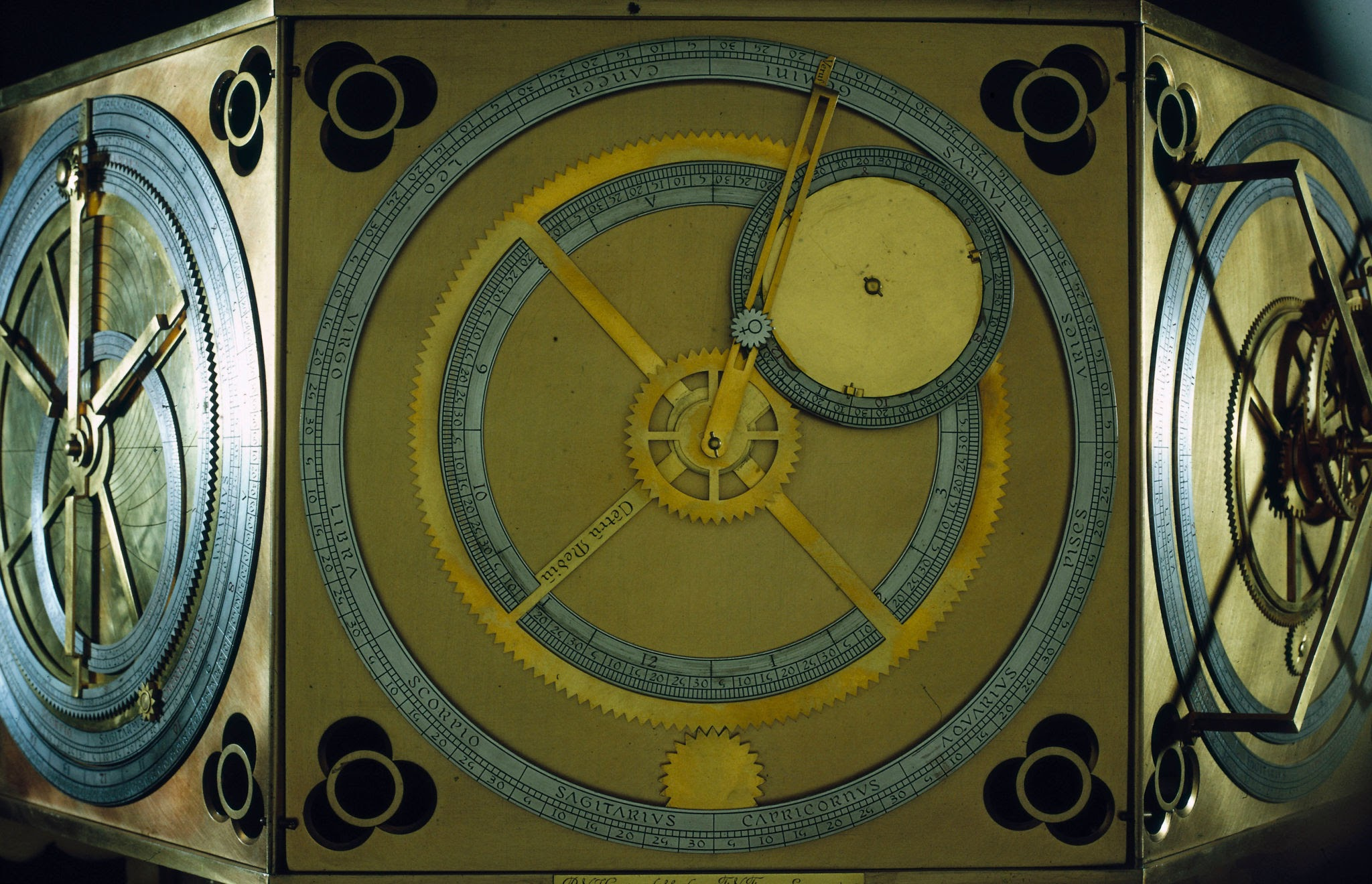
Ancient Greek astronomy (astronomia) marked a revolutionary shift from purely recording star movements to building mathematical, geometric models of the universe. By treating the night sky as a predictable system governed by physical laws, Greek astronomers developed ideas and technologies that shaped Islamic, medieval European, and early modern scientific thought for well over a thousand years.
Ptolemaic Systems, Instrument Engineering, and Islamic Preservation
The ultimate expression of Greek mathematical astronomy was compiled by Claudius Ptolemy in the 2nd century CE within his massive treatise, the Mathematical Syntaxis (known to later history as the Almagest). Ptolemy synthesized centuries of Greek observations—including Hipparchus’ discovery of the precession of the equinoxes and early star catalogs—into a comprehensive geocentric model.
Using complex circles called epicycles and deferents, this model predicted the paths of the sun, moon, and planets with remarkable mathematical accuracy.
This advanced knowledge base was directly preserved, translated, and expanded upon during the Islamic Golden Age. Scholars in Baghdad, Damascus, and Córdoba translated the Almagest into Arabic, building massive observatories to refine Ptolemy's coordinates and improving upon the astrolabe—an portable Greek observational computer used for navigation and timekeeping.
When these Arabic texts were later translated into Latin during the 12th century, they formed the core curriculum of Europe's first universities. Even when Nicolaus Copernicus proposed his revolutionary heliocentric model in 1543, he relied directly on the mathematical tools, star observations, and geometric framework established centuries earlier by the astronomers of ancient Greece.