How Ancient Greeks Built the Lightning-Fast Chariots That Dominated Myth, Sport, and War
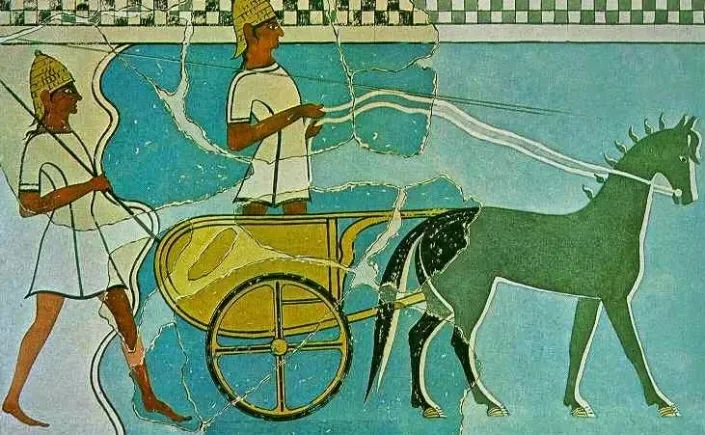
The Greek chariot is one of the most recognizable vehicles of the ancient world.
It appears in the Iliad.
It races through Olympic competition.
It carries heroes.
It appears in pottery, sculpture, and mythology.
But the real chariot was not a massive armored vehicle.
It was a carefully engineered lightweight machine built for speed.
Its design depended on woodworking, leatherworking, metalworking, wheel construction, and animal power.
The Basic Structure
A Greek chariot generally consisted of several major components:
A lightweight body.
A floor platform.
Side structures.
A front rail.
A pole or drawbar.
A pair of wheels.
Harnessing equipment.
The vehicle had to remain light.
A heavy chariot would be difficult for horses to pull quickly.
At the same time, it had to be strong enough to survive rough ground and sudden movement.
The Two-Wheeled Design
Most ancient Greek chariots were associated with two wheels.
This reduced weight.
The wheels were typically constructed using wooden components.
Spokes increased structural efficiency.
A solid wheel would have been heavier.
Spoked wheels allowed engineers to create a lighter rotating structure.
Woodworking
The chariot maker needed carefully selected wood.
Different components required different properties.
A pole needed strength.
A wheel needed resilience.
The frame needed to withstand stress.
Ancient craftspeople therefore possessed extensive knowledge of materials.
The Wheel
The wheel was one of the most important technological components.
A poorly constructed wheel could break.
A damaged wheel could overturn the chariot.
The maker needed to create:
A central hub.
Spokes.
A rim.
These components had to work together while rotating around an axle.
The wheel represents a sophisticated engineering solution.
Leather and Binding
Not every part of the chariot was rigid.
Leather could be used in harnessing and binding.
Flexible materials helped connect the vehicle with the horses.
The effectiveness of the chariot depended on the entire system.
A perfect wooden frame was useless without reliable harness equipment.
The Horses
Most Greek chariots were pulled by horses arranged in pairs.
The animals had to work together.
They needed compatible movement.
The driver controlled them through reins.
Coordination was essential.
One panicked horse could endanger the entire vehicle.
Chariots in Homeric Warfare
The Iliad presents chariots as important elements of heroic warfare.
However, Homeric battle practices should not automatically be treated as direct descriptions of every historical Greek military period.
The epic tradition reflects a complex mixture of memory, poetic convention, and heroic imagination.
In many scenes, warriors use chariots for transportation to and from battle rather than fighting continuously from the moving vehicle.
This differs from the image of chariots used as later-style shock weapons.
Chariots and Greek Warfare
By the classical period, Greek warfare relied heavily on infantry formations.
Chariots played a far smaller battlefield role than they did in some earlier or neighboring military traditions.
Cavalry and infantry became more important.
Yet chariots remained culturally significant.
Chariot Racing
Greek chariots achieved their greatest public visibility in sport.
Chariot racing became one of the most prestigious and dangerous events in ancient athletic competition.
The races required:
Skilled drivers.
Powerful horses.
Wealthy owners.
Crashes could be catastrophic.
The turning points of the track were especially dangerous.
The Olympic Games
Chariot racing became a major Olympic event.
Interestingly, victory was generally credited to the owner of the horses rather than exclusively to the driver.
This allowed wealthy individuals—including, in some cases, women who could own teams—to achieve Olympic recognition without personally driving the chariot.
The Chariot as a Symbol
Even after its military importance declined, the chariot remained powerful in Greek imagination.
It represented:
Heroism.
Speed.
Wealth.
Victory.
Divine power.
The sun god Helios could be imagined traveling across the sky in a chariot.
Victorious athletes became associated with the prestige of the racing team.
The vehicle became more than transportation.
It became mythology in motion.
Ancient Engineering on Two Wheels
The Greek chariot demonstrates how advanced ancient engineering could emerge from apparently simple materials.
Wood.
Leather.
Metal.
Rope.
A pair of horses.
Yet when carefully designed and assembled, these materials created a machine capable of extraordinary speed.
The chariot maker had to understand structure.
The wheelwright had to understand rotation.
The driver had to understand animals.
The owner had to finance the entire enterprise.
And together, these elements created one of the most iconic technologies of the ancient world.