The Ancient Greek Fortresses Designed to Survive Armies, Fire, and Years of War
Ancient Greek warfare was not only about open-field battles.
Cities needed to survive attacks.
This made fortification one of the most important forms of ancient military engineering.
Greek fortresses and city walls evolved over centuries.
Early defensive systems could rely heavily on natural terrain.
Later walls became increasingly sophisticated.
They incorporated:
Towers.
Gates.
Bastions.
Battlements.
Defensive roads.
Strong masonry.
Choosing the Location
The first defense was geography.
A fortress might be placed on:
A hill.
A rocky outcrop.
A mountain pass.
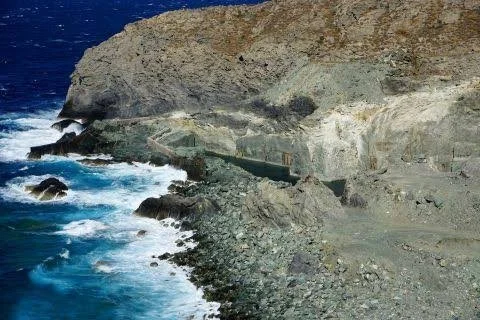
A coastal promontory.
Natural elevation forced attackers to climb.
Steep terrain reduced the effectiveness of siege equipment.
Massive Stone Walls
Greek walls could be constructed from enormous blocks.
Some earlier masonry traditions used irregular stones.
Later systems could employ carefully fitted blocks.
The goal was structural stability.
A thick wall could absorb impacts from attackers.
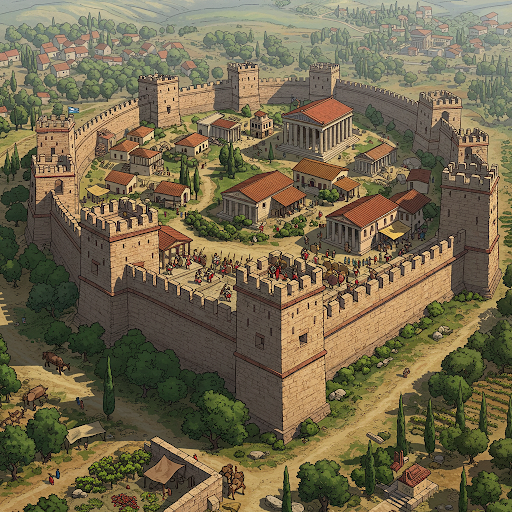
Towers
Towers extended the defensive capability of walls.
They allowed defenders to observe the surrounding landscape.
They also provided positions from which weapons could be used against attackers approaching the walls.
The shape and spacing of towers varied.
Gates Were Vulnerable
The entrance was one of the weakest points of a fortress.
Attackers knew this.
Defenders therefore developed complex approaches.
A gate might be positioned so that attackers could not approach directly.
Walls could create narrow corridors.
Defenders could attack from above or from the sides.
The Acropolis
Many Greek cities possessed elevated fortified areas.
The acropolis could function as:
A religious center.
A refuge.
A military stronghold.
Athens is the most famous example.
But the concept existed across the Greek world.
Siege Warfare
Attackers could attempt to:
Storm walls.
Break gates.
Scale fortifications.
Starve defenders.
The last method could be extremely effective.
A strong fortress was useless if its population ran out of food or water.
Water and Food
Defensive planning therefore involved logistics.
A fortress needed:
Wells.
Cisterns.
Storage facilities.
Grain supplies.
Water was particularly important.
A siege could last for weeks or months.
The Psychological Dimension
Fortifications were also psychological weapons.
A massive wall communicated:
This city will not surrender easily.
Attackers had to calculate the cost.
A strong fortress could discourage an assault before it began.
Why Greek Fortresses Matter
Greek defensive architecture demonstrates that military engineering was not merely about making walls tall.
It involved:
Geography.
Geometry.
Logistics.
Human psychology.
Construction technology.
The best fortress was not necessarily the largest.
It was the one that forced an attacker to fight on the defender's terms.