Why Ancient Greek Soldiers Locked Shields Together—and How Their Formations Changed Warfare
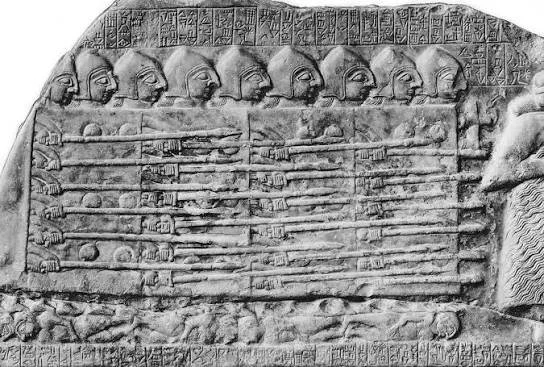
The image of Greek hoplites advancing with shields overlapping is one of the most recognizable scenes in ancient warfare.
But the famous phalanx was not simply a tightly packed wall of men.
It was a complex military system based on equipment, discipline, social organization, terrain, and collective movement.
Understanding the phalanx reveals how Greek warfare depended on cooperation.
The Hoplite
A hoplite was a heavily equipped infantryman.
His equipment could include:
A large round shield.
Spear.
Sword.
Helmet.
Body armor or protective clothing.
The large shield, called an aspis, was especially important.
It protected much of the soldier's body.
Why the Shield Was So Important
The shield was carried on the left arm.
This created a tactical relationship between neighboring soldiers.
A soldier could partly protect the man beside him while protecting himself.
This encouraged close formation.
The unit became stronger through cooperation.
The Phalanx
The phalanx was a formation in which infantry stood in organized ranks.
Its effectiveness depended on:
Discipline.
Cohesion.
Training.
Terrain.
Command.
A formation that broke apart could become vulnerable.
Was the Phalanx an Unbreakable Wall?
No.
Popular representations often make the phalanx seem almost invincible.
In reality, it had weaknesses.
It could struggle when:
Terrain was uneven.
Formations became disorganized.
Flanks were attacked.
Soldiers lost cohesion.
Command failed.
The phalanx was powerful under favorable conditions.
The Importance of the Flank
The front of a formation was heavily protected.
The sides were more vulnerable.
This made battlefield positioning crucial.
Commanders attempted to protect their flanks using:
Cavalry.
Terrain.
Other infantry units.
The Psychological Meaning
The formation also communicated courage.
A soldier could not easily retreat without affecting others.
The system encouraged collective responsibility.
This was closely connected with Greek ideas about citizenship.
In some city-states, military service was tied to political participation and social status.
The Spartan Myth
Sparta became famous for military discipline.
Its reputation has sometimes been exaggerated.
Spartan military organization was indeed distinctive, but Greek warfare varied significantly across city-states.
Athenians, Corinthians, Thebans, and others developed their own military traditions.
The Theban Innovation
The Thebans demonstrated that the traditional phalanx could be reorganized.
Under Epaminondas, Theban forces used unusual depth and concentration.
At the Battle of Leuctra in 371 BCE, Theban tactics helped defeat Spartan forces.
This demonstrated that formation was not a fixed formula.
It could be redesigned.
Philip II and the Macedonian Phalanx
Philip II of Macedon transformed Greek-style infantry warfare.
His soldiers used longer sarissas, creating a distinctive Macedonian phalanx.
But Macedonian warfare was not simply a larger Greek phalanx.
It combined:
Infantry.
Cavalry.
Light troops.
Siege forces.
This combined-arms approach became extremely effective.
Alexander's Army
Alexander the Great inherited and expanded this system.
His victories demonstrated the importance of coordination.
Infantry fixed the enemy.
Cavalry could exploit weaknesses.
Light troops supported the main force.
The battle became a coordinated system rather than a simple collision of two masses of soldiers.
The Hidden Meaning
The deepest meaning of Greek battle formations was social.
The soldier was not simply an individual warrior.
He was part of a collective.
The formation communicated:
Your survival depends partly on the man beside you.
That principle shaped Greek military culture for centuries.