The Greek Water Engineers Who Built Systems Centuries Ahead of Their Time
Ancient Greek civilization depended heavily on water engineering.
Cities needed reliable supplies for:
Drinking.
Agriculture.
Bathing.
Industry.
Religious rituals.
Greek engineers developed methods for moving, storing, lifting, and controlling water.
Their achievements became especially impressive during the Hellenistic period, when Greek-speaking engineers developed increasingly sophisticated mechanical and hydraulic technologies.
Water and Urban Civilization
A city cannot survive without water.
Natural springs were ideal.
But not every settlement had enough water nearby.
Engineers therefore had to transport water from elsewhere.
This required understanding:
Elevation.
Pressure.
Channels.
Flow.
Storage.
Aqueducts
Greek and Hellenistic communities constructed channels and conduits to move water.
Some systems relied on gravity.
Water naturally flows downhill.
If the source was higher than the destination, engineers could exploit the slope.
Underground Channels
Not every aqueduct was an open channel.
Some water systems passed through underground conduits.
This protected water from contamination and evaporation.
The Tunnel of Eupalinos
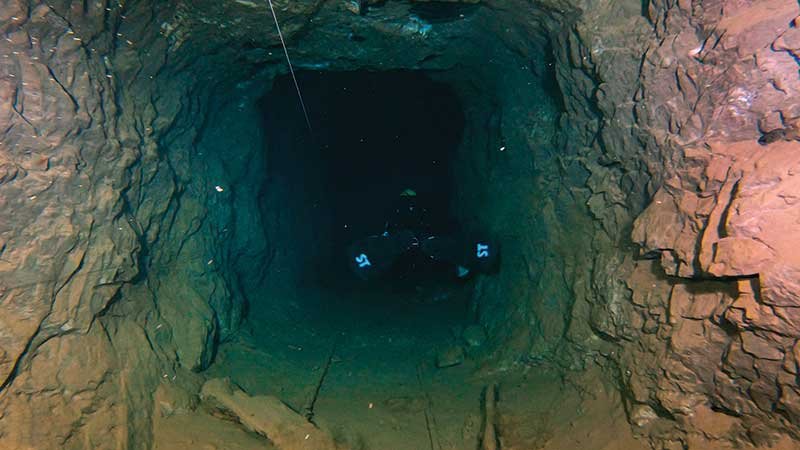
One of the greatest examples is the Tunnel of Eupalinos on Samos.
Constructed in the sixth century BCE, the tunnel carried water through a mountain.
Its construction required remarkable surveying.
Workers approached the tunnel from both ends.
The two excavation paths eventually met.
The project demonstrates advanced knowledge of geometry and practical engineering.
Water-Lifting Machines
Greek engineers also developed machines for lifting water.
One example is the Archimedes screw, traditionally associated with Archimedes.
A rotating helical mechanism could move water upward.
This was useful for:
Irrigation.
Drainage.
Construction.
Ctesibius and Hydraulic Machines
Ctesibius developed devices involving air and water pressure.
His work included pumps and water clocks.
The technology demonstrates an understanding of fluids as controllable physical forces.
The Force of Water
Hydraulic engineering required practical experimentation.
Engineers had to understand that:
Water seeks lower levels.
Pressure changes with depth.
Flow depends on openings and channels.
Pipes can carry water under pressure.
They did not possess modern fluid mechanics.
But they could observe and exploit these principles.
Water in Religion
Water also had religious importance.
Springs could be sacred.
Ritual washing could be required.
Sanctuaries could incorporate fountains and basins.
Engineering and religion therefore sometimes overlapped.
Why Greek Hydraulic Engineering Matters
The Greek achievement was not one single invention.
It was a tradition of experimentation.
Water became something engineers could:
Measure.
Direct.
Store.
Lift.
Control.
The ancient engineer looked at a river, spring, or reservoir and saw more than water.
They saw a machine waiting to be designed.