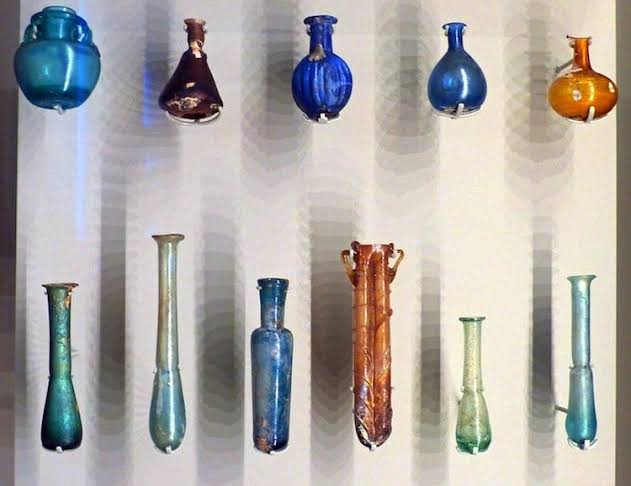
Glassmaking in the ancient Mediterranean was a sophisticated craft that developed over many centuries. Although the most famous early centers of glass production were not exclusively Greek, Greek communities participated extensively in the use, decoration, trade, and development of glass objects.
The phrase “lost Greek art” should therefore be understood carefully. There was no single Greek method of colored glassmaking that disappeared completely. Instead, colored-glass production involved a collection of technologies shared and developed across Egypt, the Levant, the Aegean, and later the wider Roman world.
Ancient artisans could produce glass in remarkable colors by manipulating mineral ingredients and firing conditions.
What Is Glass?
Glass is produced by heating silica-rich materials with substances that lower the melting temperature.
Typical ancient ingredients included:
silica from sand;
soda or other fluxes;
lime-containing materials;
and coloring agents.
When heated sufficiently, these materials formed a molten or semi-molten substance that could be shaped.
Where Did Ancient Glassmaking Begin?
Some of the earliest known glassmaking traditions developed in the Near East and Egypt during the second millennium BCE.
The technology spread widely through Mediterranean networks.
Greek communities became important consumers and producers of glass objects, especially during later periods.
Adding Color
The color of glass depends heavily on its chemical composition.
Ancient artisans could intentionally introduce metallic compounds to produce different colors.
For example, copper could contribute to:
blue;
green;
or red effects depending on chemical conditions.
Cobalt could produce deep blue.
Manganese could contribute to purple or help reduce unwanted coloration.
Iron could create green, brown, or yellowish tones.
Why Color Was Difficult
Producing consistent colors required control over:
raw materials;
furnace temperature;
oxygen availability;
and cooling.
Ancient artisans did not have modern chemical instruments.
Instead, they relied on practical knowledge passed between generations.
Mosaic Glass
One of the most sophisticated techniques was mosaic glass.
Artisans could create rods or bundles of differently colored glass.
These were assembled into patterns.
The resulting composite was heated and stretched.
When sliced into cross-sections, the rods revealed repeated patterns.
These pieces could then be incorporated into vessels or decorative objects.
Core-Formed Glass
Another early technique involved winding molten glass around a temporary core.
The core was usually made from a mixture that could later be removed.
This allowed artisans to create small vessels.
Colored threads could be added to create decorative patterns.
Glass Beads
Beads were among the most widespread ancient glass products.
They could be:
monochrome;
multicolored;
striped;
patterned;
or shaped into intricate forms.
Beads were valuable because they could function as:
jewelry;
status markers;
trade goods;
and ritual objects.
Glass as a Luxury Material
Early glass was relatively expensive.
Its bright colors and translucent appearance made it attractive to wealthy consumers.
Glass objects could imitate:
gemstones;
precious stones;
and other luxury materials.
This allowed artisans to create visually impressive objects without using enormous quantities of rare gemstones.
Greek Trade Networks
Greek merchants and communities participated in Mediterranean trade networks that circulated glass.
Objects could move between:
Egypt;
the Levant;
Cyprus;
Greece;
Italy;
and North Africa.
Glass therefore provides archaeological evidence for long-distance commercial connections.
The Hellenistic Period
Following the conquests of Alexander the Great, the Hellenistic world became increasingly interconnected.
Major cities such as Alexandria became centers of:
manufacturing;
trade;
scientific activity;
and artistic exchange.
Glassmaking techniques circulated across these interconnected regions.
The Roman Revolution
The Roman period brought major changes to glass production.
The invention and widespread adoption of glassblowing transformed the industry.
Instead of slowly forming glass around a core, artisans could blow molten glass into shapes.
This made production faster and allowed larger and more varied vessels to be created.
Why Some Techniques Disappeared
Ancient technologies sometimes disappeared not because they were forgotten entirely, but because economic conditions changed.
A technique could become less common when:
a cheaper method appeared;
new raw materials became available;
consumer preferences changed;
or political and trade networks shifted.
This is why calling an ancient craft “lost” can be misleading.
Technologies often evolve rather than simply disappear.
Archaeological Evidence
Researchers study ancient glass through:
chemical analysis;
microscopic examination;
furnace remains;
manufacturing waste;
and finished objects.
Chemical analysis can sometimes identify where raw materials originated.
This allows researchers to reconstruct ancient trade networks.
Why Colored Glass Matters
Ancient colored glass demonstrates the combination of:
chemistry;
craftsmanship;
artistic design;
and long-distance trade.
Its production required practical scientific knowledge even though ancient artisans did not possess modern chemistry.
Conclusion
The ancient Greek world participated in a sophisticated Mediterranean tradition of colored-glass production.
Artisans learned how to manipulate minerals, heat, oxygen conditions, and shaping techniques to produce objects in vivid colors.
Rather than a single lost Greek invention, colored glass represents a shared technological tradition that developed across the ancient Mediterranean.