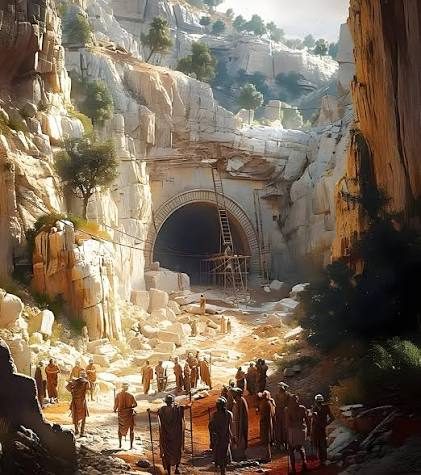
Ancient Greek engineers constructed tunnels for some of the most demanding infrastructure projects of the ancient Mediterranean.
Their tunnels were used for:
water supply;
drainage;
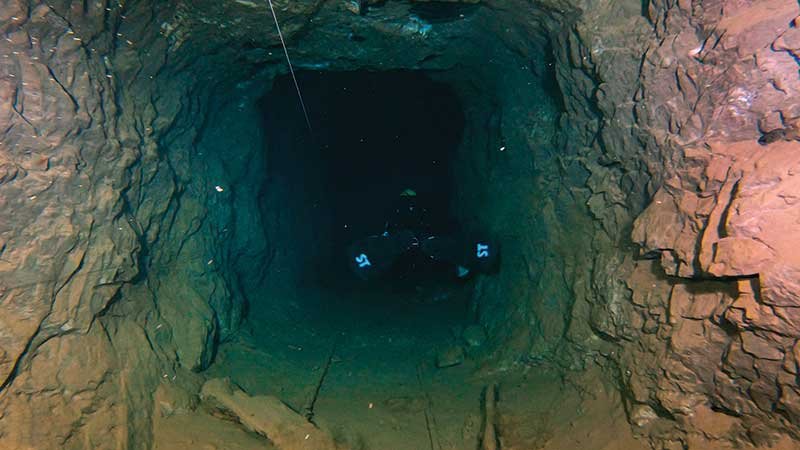
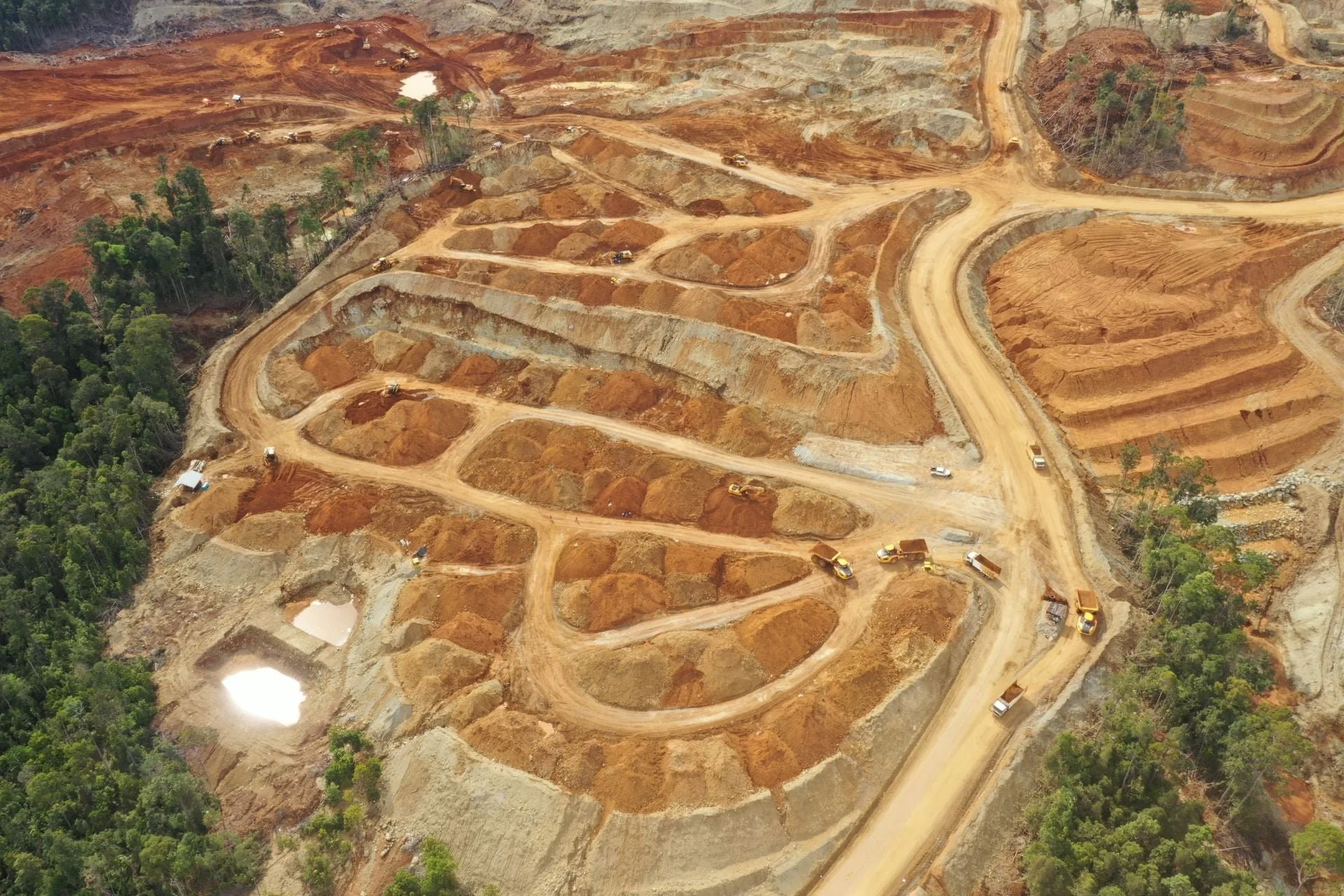
mining;
transportation;
and occasionally military purposes.
The most famous example is the Tunnel of Eupalinos on the island of Samos.
Constructed in the sixth century BCE, it demonstrates an extraordinary level of surveying, geometry, and engineering.
The Tunnel of Eupalinos
The Tunnel of Eupalinos was built to transport water into the ancient city of Samos.
Instead of constructing a channel entirely above ground, engineers created a tunnel through Mount Kastro.
The tunnel is approximately one kilometer long.
Why Build a Tunnel?
A tunnel could protect a water supply from enemy attack.
If an aqueduct or channel ran visibly across the landscape, an enemy could potentially locate and destroy it.
A tunnel concealed the route.
This made the water system more secure.
Excavating From Both Ends
The most impressive feature is that the tunnel was excavated from both ends.
Workers began from opposite sides of the mountain.
Eventually, the two teams met underground.
This required accurate surveying.
A significant directional error could have caused the two tunnels to miss one another.
Geometry
Ancient Greek mathematics played an important role.
Surveyors could use:
straight lines;
angles;
proportional reasoning;
and measurements of distance
to determine the direction of the tunnel.
The achievement is especially remarkable because engineers lacked modern:
compasses;
lasers;
GPS;
and electronic surveying equipment.
Measuring Direction
Ancient surveyors could establish directions using:
sighting instruments;
stakes;
ropes;
geometric relationships;
and observations of the landscape.
Even small errors accumulated over long distances.
Maintaining the Gradient
Water must flow downhill.
Therefore, the tunnel's vertical alignment was crucial.
If one section was too high, water could stop flowing.
If the gradient was too steep, erosion could damage the channel.
Engineers had to maintain a controlled slope.
The Water Channel
The tunnel contained a narrower water channel within the larger excavated passage.
This allowed workers to access the system while ensuring that water could move toward the city.
The engineering therefore combined:
excavation;
hydraulic design;
surveying;
and maintenance access.
Quarrying the Rock
Workers used tools made primarily from:
iron;
bronze;
and stone.
Rock could be broken through repeated hammering and chiseling.
This was extremely labor-intensive.
Ventilation
Long underground construction required ventilation.
Fresh air could enter through entrances and shafts.
Some ancient tunnels also included vertical shafts that allowed workers to access the excavation from above.
These shafts could serve several purposes:
ventilation;
removing excavated material;
and improving access.
Ancient Mining Tunnels
Greek communities also developed extensive mining systems.
Silver mining at Laurion in Attica required underground tunnels and shafts.
Mining engineers needed to locate ore while maintaining structural stability.
The Dangers of Mining
Underground workers faced serious risks.
These included:
cave-ins;
poor ventilation;
flooding;
darkness;
and physical exhaustion.
Mining was often performed by highly vulnerable labor populations, including enslaved people.
The Mathematics Behind the Engineering
Greek geometry developed in an intellectual environment that increasingly valued mathematical proof.
Although practical engineering did not always require formal mathematical theory, mathematical concepts could help solve:
distances;
angles;
areas;
volumes;
and slopes.
The relationship between theoretical mathematics and practical engineering is one of the fascinating features of ancient Greek civilization.
Why the Tunnel of Eupalinos Matters
The tunnel demonstrates that ancient engineers were capable of coordinating a large workforce around a technically difficult project.
Its survival allows researchers to reconstruct ancient surveying techniques and construction methods.
Conclusion
The “secrets” of Greek tunnel builders were not magical.
They were based on:
careful observation;
geometry;
surveying;
practical experience;
organized labor;
and detailed knowledge of rock and water.
The Tunnel of Eupalinos demonstrates that ancient engineers could solve complex three-dimensional problems using surprisingly simple tools.
How Greek Merchants Spread Culture Across the Mediterranean
Greek merchants played an important role in the cultural transformation of the ancient Mediterranean.
Their ships carried more than commercial goods.
They also transported:
languages;
artistic styles;
religious ideas;
technologies;
agricultural practices;
and social customs.
Greek cultural influence spread through a combination of trade, migration, colonization, political expansion, and cultural exchange.
The Mediterranean as a Network
The Mediterranean Sea connected communities across enormous distances.
Ships could travel between:
mainland Greece;
the Aegean islands;
Anatolia;
Egypt;
Italy;
Sicily;
North Africa;
and the western Mediterranean.
Maritime trade was often more efficient than transporting heavy goods over land.
What Did Greek Merchants Trade?
Greek merchants transported commodities such as:
olive oil;
wine;
pottery;
textiles;
metal goods;
and luxury products.
They also imported:
grain;
timber;
metals;
spices;
and other materials.
Pottery as Cultural Evidence
Greek pottery is one of the clearest archaeological indicators of Mediterranean trade.
Greek vessels have been discovered across the Mediterranean and Black Sea.
Their distribution demonstrates the enormous geographic reach of Greek commercial networks.
Olive Oil and Wine
Olive oil and wine were particularly important.
Both could be stored and transported in ceramic containers.
Their movement spread not only products but also the agricultural systems associated with them.
Greek settlers established vineyards and olive groves in new regions where environmental conditions allowed.
Greek Colonization
Greek cultural expansion was also closely connected with colonization.
From the eighth century BCE onward, Greek communities established settlements across:
southern Italy;
Sicily;
the Black Sea;
North Africa;
and parts of the western Mediterranean.
These settlements became new centers of Greek language and culture.
Colonies Were Not Isolated
Greek colonies interacted extensively with local populations.
They exchanged:
goods;
technologies;
religious traditions;
and artistic styles.
Cultural influence therefore moved in both directions.
The result was often a hybrid culture rather than a simple replacement of local traditions.
Alphabetic Writing
One of the most important examples of cultural exchange involved writing.
The Greek alphabet developed partly through adaptation of the Phoenician writing system.
Greek scribes modified the system and introduced letters representing vowel sounds.
The Greek alphabet later influenced:
Latin;
Cyrillic;
and numerous modern writing systems.
This demonstrates that cultural exchange was not a one-way process.
Religious Exchange
Greek religious ideas also traveled.
Colonists established sanctuaries dedicated to Greek gods.
However, Greek deities were often identified with local gods.
This process is known as syncretism.
Different cultures could interpret one another's religious traditions through their own beliefs.
Artistic Influence
Greek artistic styles spread widely.
Greek sculpture and pottery influenced local artists in:
Italy;
Anatolia;
Egypt;
and the Black Sea region.
Local artists frequently adapted Greek techniques rather than simply copying them.
The Role of Merchants
Merchants were important intermediaries.
They interacted with people who spoke different languages and followed different customs.
Commercial relationships created opportunities for cultural exchange.
A merchant carrying pottery could also introduce:
new artistic styles;
new foods;
new words;
and new technologies.
Greek and Indigenous Communities
Archaeological evidence frequently shows mixtures of Greek and local traditions.
A settlement might contain:
Greek-style pottery;
indigenous burial practices;
local religious symbols;
and imported goods.
This demonstrates that cultural exchange was complex.
The Black Sea
Greek merchants and settlers established extensive networks around the Black Sea.
The region provided access to:
grain;
fish;
timber;
metals;
and other resources.
Black Sea colonies became major centers of exchange.
Alexandria and the Hellenistic World
After Alexander the Great's conquests, Greek language and culture spread even farther.
The Hellenistic world connected Greece with:
Egypt;
Syria;
Mesopotamia;
Persia;
and Central Asia.
Greek became an important language of administration, education, and commerce.
Conclusion
Greek merchants helped transform the Mediterranean into a deeply interconnected cultural world.
Their ships carried commodities, but the movement of goods also carried ideas.
Through trade and colonization, Greek language, artistic traditions, religious concepts, and technologies reached distant communities—while Greek societies themselves absorbed influences from the cultures they encountered.
Mediterranean cultural history was therefore not simply the story of Greek expansion.
It was a story of continuous exchange.