The Forgotten Goddess Who Ruled the Heart of Every Greek Home
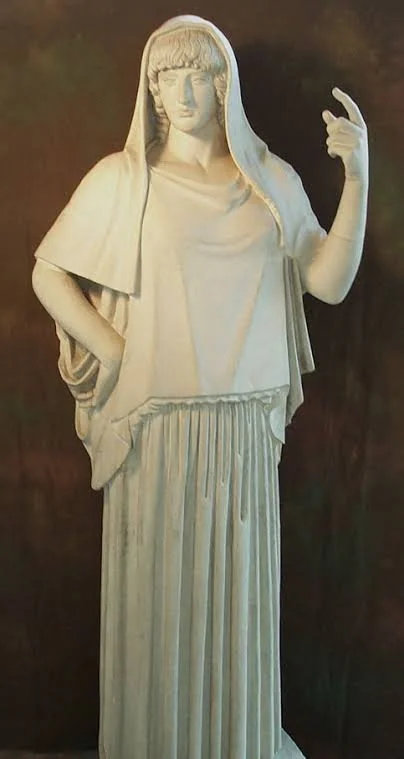
Among the famous gods of ancient Greece, Hestia is surprisingly easy to overlook.
Zeus ruled the heavens.
Poseidon ruled the sea.
Athena represented wisdom and strategic warfare.
Ares embodied violent conflict.
Aphrodite represented love and desire.
Apollo was associated with music, prophecy, healing, and the Sun in later tradition.
Yet Hestia governed something much closer to ordinary human life:
the hearth.
The hearth was the physical center of the ancient Greek household. It provided heat, light, cooking, and a place around which family life could be organized. Because of this practical importance, Hestia represented much more than fire.
She represented home itself.
Who Was Hestia?
Hestia was traditionally the daughter of Cronus and Rhea and therefore one of the first-generation Olympian gods.
Her siblings included:
Zeus.
Poseidon.
Hades.
Hera.
Demeter.
According to mythological tradition, Hestia was swallowed by Cronus along with several of her siblings because he feared that his children would overthrow him.
Zeus eventually forced Cronus to release them.
Hestia consequently belonged to the generation of gods who preceded the familiar Olympian order.
The Goddess Who Never Married
One of Hestia's most distinctive characteristics was her virginity.
She was traditionally described as one of the three virgin goddesses, alongside Athena and Artemis.
According to a myth preserved in later ancient sources, both Poseidon and Apollo desired Hestia.
She rejected them both.
Instead, she swore an oath to remain unmarried.
Zeus granted her the privilege of remaining untouched by marriage.
This was symbolically significant.
Marriage was central to ancient Greek social organization.
Hestia represented a different kind of feminine identity: the woman who remained permanently associated with the household without entering the marital role.
The Hearth Was the Center of the House
The ancient Greek household was known as the oikos.
The oikos included more than a physical building.
It encompassed:
Family members.
Domestic workers and enslaved people.
Property.
Livestock.
Household possessions.
Religious practices.
The hearth was one of the most important physical and symbolic elements within this environment.
It provided heat.
It provided light.
It allowed food to be cooked.
But it also served as a religious focus.
Hestia and Domestic Religion
Ancient Greek religion did not exist only in temples.
Religion was also practiced inside homes.
Households could perform offerings and prayers connected with daily activities.
Hestia's association with the hearth therefore placed her directly within everyday religious life.
A family did not need to travel to a monumental sanctuary to encounter the divine.
The sacred could exist in the center of the home.
The Fire That Connected Generations
A hearth fire represented continuity.
A household existed across generations.
Children were born.
Parents aged.
Family members died.
Yet the household could continue.
The hearth symbolized this continuity.
Fire could be maintained.
Renewed.
Transferred.
Preserved.
In this sense, Hestia represented something deeper than domestic comfort.
She represented permanence.
Hestia and Sacrifice
Hestia's importance extended beyond the home.
Ancient sacrificial rituals could begin or end with offerings associated with the hearth goddess.
The first and last portions of certain sacrifices could be dedicated to Hestia.
This reinforced her symbolic position.
She occupied the beginning and end.
The hearth stood at the center.
Hestia and the Polis
Hestia was not only associated with private households.
Greek communities also maintained public hearths.
The civic hearth symbolized the continuity of the city-state.
Colonies founded by Greek cities could maintain connections with the hearth of their mother city.
Fire therefore became a political symbol.
A flame could represent the community itself.
Why Hestia Was Different From Other Olympians
Greek mythology is full of dramatic conflict.
Gods fight.
Heroes rebel.
Lovers betray one another.
Kings become arrogant.
Monsters are defeated.
Hestia is different.
Her mythology is comparatively quiet.
She does not participate in many dramatic adventures.
That is not because she was unimportant.
It is because her importance was fundamentally structural.
She represented the stable center around which everything else happened.
Why Hestia Eventually Became Less Prominent
Hestia's relatively limited mythology may help explain why she is less famous today.
Myths are easier to remember when they contain dramatic action.
Hestia's role was repetitive and foundational.
She stayed.
She preserved.
She maintained.
She represented continuity.
Her power was therefore quiet rather than spectacular.
The Meaning of Hestia Today
Hestia provides an important reminder about ancient Greek religion.
The Greeks did not worship only gods of war, storms, oceans, and heroic adventures.
They also worshipped the forces that made ordinary life possible.
The fire that cooked dinner.
The warmth that protected a family.
The household that preserved identity.
The community that gathered around a shared center.
Hestia was the goddess of all these things.
She did not need to rule the heavens to be essential.
She ruled the place where ordinary human life began.