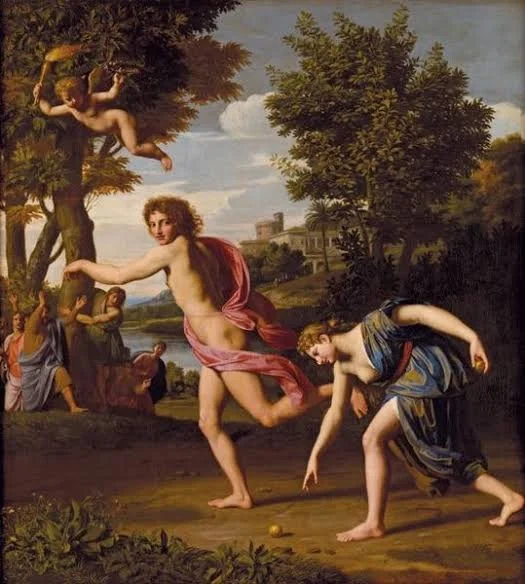
The Greek Heroine Who Could Outrun Every Man—Until Three Golden Apples Changed the Race
Atalanta is one of the most fascinating women in Greek mythology.
She is portrayed as exceptionally fast, independent, skilled with weapons, and determined to control her own destiny.
Unlike many mythological heroines whose stories revolve primarily around marriage, Atalanta is repeatedly associated with athletic competition and heroic adventure.
Her most famous story involves a race against a man who realizes that he cannot defeat her through speed alone.
Instead, he uses strategy.
And three golden apples.
Atalanta the Huntress
Atalanta was associated with hunting and wilderness.
Ancient traditions about her vary.
Different authors and mythological traditions provide different versions of her parentage and early life.
This variation is normal in Greek mythology.
Greek myths were not controlled by one official canon.
The Calydonian Boar Hunt
Atalanta became famous as a participant in the Calydonian Boar Hunt.
The monstrous boar had devastated the land.
Heroes from across Greece gathered to hunt it.
Atalanta participated despite the male-dominated heroic culture surrounding hunting.
She succeeded in wounding the animal first.
This became a major source of conflict.
Why Her Participation Mattered
Atalanta's story challenges assumptions about gender roles in Greek mythology.
She was not portrayed simply as someone's wife or daughter.
She was:
A hunter.
An athlete.
A warrior-like figure.
An independent character.
Her abilities earned her a place among famous heroes.
The Marriage Problem
Eventually, however, Atalanta's story turns toward marriage.
She did not want to marry—or at least did not want to marry on ordinary terms.
She established a challenge.
A potential husband would have to defeat her in a foot race.
If he lost, he would face a severe penalty.
The exact details vary by source.
Why No One Could Beat Her
Atalanta was extraordinarily fast.
Suitors tried.
They failed.
She could outrun them easily.
Her athletic ability made ordinary courtship impossible.
Then came Hippomenes, also known in some traditions as Melanion.
The Golden Apples
Hippomenes understood that he could not defeat Atalanta through speed alone.
He needed divine assistance.
According to the famous version, he received three golden apples from Aphrodite.
The goddess helped him because she wanted the race to succeed.
The Race
The competition began.
Atalanta ran ahead.
Hippomenes threw one golden apple.
Atalanta stopped.
She picked it up.
He threw another.
Again, she stopped.
Then the third.
Each delay allowed Hippomenes to gain ground.
Eventually, he won the race.
Why Did Atalanta Stop?
This is one of the most interesting psychological questions in the story.
Was she curious?
Did she desire the apples?
Was she distracted by their beauty?
Was divine influence involved?
Different interpretations are possible.
The golden apples represent temptation.
Atalanta's greatest strength—her speed—could be overcome not by greater physical power but by exploiting her attention.
Aphrodite's Role
The goddess of love is particularly important.
The race is not simply a sporting event.
It becomes a story about desire.
Atalanta wants independence.
Hippomenes wants marriage.
Aphrodite intervenes.
The golden apples become instruments through which desire changes destiny.
What Happens After the Race?
The story does not necessarily end happily.
In some traditions, Atalanta and Hippomenes later enter a sacred place and engage in sexual activity, provoking divine punishment.
The exact form of the punishment varies.
In one well-known version, they are transformed into lions.
Why Lions?
The transformation reinforces the mythological connection between human desire and divine consequences.
Greek mythology frequently treats violations of sacred boundaries seriously.
The lesson is not simply about romance.
It concerns respect for divine rules.
The Symbolism of the Golden Apples
The apples can represent:
Desire.
Distraction.
Beauty.
Temptation.
Strategy.
The conflict between independence and love.
They are especially powerful because they defeat someone who appears physically unbeatable.
Atalanta's Legacy
Atalanta remains unusual because her defining characteristic is not helplessness.
She is capable.
Fast.
Dangerous.
Independent.
Her story preserves an ancient imagination of a woman who can compete directly with male heroes.
The golden apples do not erase her strength.
They reveal its limitation.
Even the fastest runner can be defeated by a change in strategy.
And that may be the deeper lesson of the myth:
Victory does not always belong to the strongest or fastest person. Sometimes it belongs to the person who understands the opponent—and knows exactly what will make them stop.