The 49 Women Condemned to Fill a Vessel That Could Never Hold Water
Few punishments in Greek mythology are as psychologically disturbing as that of the Danaïdes.
After death, they were condemned to perform a task with no possible end:
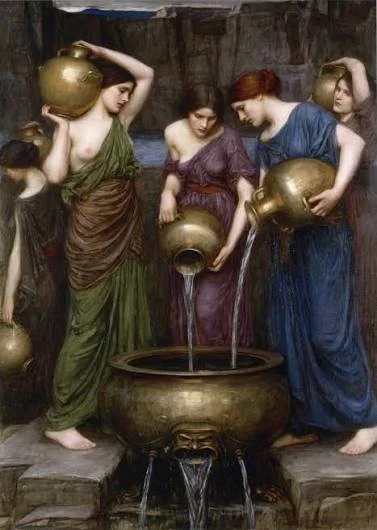
They had to carry water and pour it into vessels that could never be filled.
No matter how much water they added, it disappeared.
The task had to be repeated forever.
The myth became one of antiquity's most powerful images of futile labor.
Who Were the Danaïdes?
The Danaïdes were the fifty daughters of Danaus.
Their father was associated with the ancient kingdom of Argos.
Danaus had a brother named Aegyptus, who had fifty sons.
The two brothers became rivals.
Their children eventually became involved in a disastrous marriage arrangement.
Fifty Brides and Fifty Grooms
The sons of Aegyptus wanted to marry the daughters of Danaus.
Danaus did not trust them.
The marriages were arranged despite the hostility between the two families.
According to the mythology, Danaus and his daughters fled to Argos to escape the unwanted marriages.
The story eventually became a conflict between marriage, family authority, and violence.
The Wedding Night
The most famous version of the story describes Danaus ordering his daughters to kill their husbands.
Almost all obeyed.
The sons of Aegyptus were murdered.
One daughter, Hypermnestra, refused to kill her husband Lynceus.
Her decision distinguished her from her sisters.
Why Did Hypermnestra Refuse?
The myth emphasizes that Lynceus respected her.
Hypermnestra therefore chose not to murder him.
Her act of mercy became central to later traditions.
She was eventually reunited with Lynceus.
Their descendants became associated with the royal lineage of Argos.
The Punishment
The remaining Danaïdes were punished in the afterlife.
Their punishment was extraordinary because it had no natural conclusion.
They carried water.
They poured it into vessels.
The water escaped.
They repeated the process.
Forever.
The Broken Vessel
The vessels are often described as damaged or leaking.
The image is powerful because the women are technically performing the correct action.
They collect water.
They transport it.
They pour it.
But the objective can never be achieved.
The failure is built into the task itself.
The Meaning of Futility
The Danaïdes became a symbol of labor without result.
The myth asks a deeply human question:
What happens when effort has no possibility of success?
The story has therefore survived far beyond its original religious context.
It has become a metaphor for:
Endless bureaucracy.
Repetitive labor.
Impossible tasks.
Punishment.
Hopelessness.
Why Water?
Water was fundamental to Greek life.
It represented:
Life.
Purification.
Agriculture.
Survival.
To be forced to handle water forever without ever possessing it is therefore particularly cruel.
The women are surrounded by something essential but denied the ability to complete their task.
The Story's Relationship With Marriage
The myth is also connected with ancient Greek ideas about marriage.
Marriage was not simply romantic.
It connected families.
Created alliances.
Produced descendants.
Transferred women between households.
The Danaïdes violently reject the marriage arrangement.
Their story therefore explores the tension between:
Family authority.
Marriage.
Female autonomy.
Violence.
Social obligation.
The Myth in Greek Literature
The Danaïdes appear in ancient literary traditions, including the works of Aeschylus.
His Suppliants dramatizes the arrival of Danaus and his daughters at Argos.
The complete ancient trilogy concerning the Danaïdes has not survived, but enough material remains to demonstrate how important the myth was to Greek tragedy.
Why the Danaïdes Still Matter
The image of endlessly filling a leaking vessel is almost universal in its emotional power.
It captures a terrifying possibility:
You can work forever and still accomplish nothing.
The myth transforms that fear into an eternal punishment.
The Danaïdes therefore remain one of Greek mythology's most memorable images of futility, consequence, and endless labor.