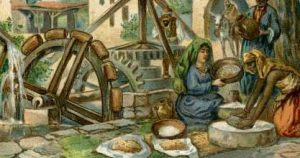
Water was essential to every Greek community, but clean and reliable water could not simply be assumed. Ancient Greeks developed numerous methods for obtaining, transporting, storing, and improving the quality of water.
Their approaches were not equivalent to modern water-treatment systems. They did not possess knowledge of microorganisms, chlorination, or modern filtration technology. Nevertheless, Greek communities developed practical techniques that could reduce visible contamination and improve water quality.
These included:
settling;
filtering;
boiling in certain circumstances;
using ceramic vessels;
controlling water sources;
and constructing sophisticated drainage and water-delivery systems.
Greek thinkers also developed theories about the relationship between water quality and health.
Wells as Primary Water Sources
Many Greek settlements depended heavily on wells.
A well allowed communities to access groundwater below the surface.
The construction of a well required careful consideration of:
geological conditions;
groundwater availability;
settlement location;
and protection from contamination.
Wells could be lined with stone or ceramic materials to stabilize their walls.
Springs
Natural springs were particularly valuable.
Spring water often emerged from underground geological formations and could provide a relatively reliable source.
Communities frequently developed settlements near dependable springs.
Some springs became associated with religious sanctuaries because water was considered spiritually significant.
The Importance of Drainage
Clean water depended partly on controlling dirty water.
Greek cities developed drainage systems designed to remove:
wastewater;
rainwater;
and runoff.
Drainage reduced standing water and helped prevent streets and public spaces from becoming contaminated.
Settling Sediment
One simple method of improving water clarity was allowing sediment to settle.
When muddy water remained undisturbed, heavier particles gradually sank to the bottom.
The clearer water above could then be removed.
This process is called sedimentation.
Although simple, it remains part of modern water-treatment systems.
Ceramic Water Filters
Archaeological evidence from the ancient Mediterranean indicates that porous ceramic materials could be used to improve water quality.
Ceramic vessels could allow water to pass slowly through their walls.
The process could remove some suspended particles.
However, ceramic filtration should not be confused with modern microbiological purification.
A vessel that produces visually clear water does not necessarily eliminate harmful pathogens.
Boiling Water
Ancient Greek physicians recognized that heat could alter the properties of water.
Boiling was possible using ceramic vessels placed over fires.
However, there is limited evidence that Greeks practiced systematic large-scale boiling of drinking water as a standard municipal treatment.
It is therefore more accurate to describe boiling as a possible household technique rather than a universal Greek purification system.
Hippocratic Ideas About Water
The Greek medical tradition contains detailed discussions of water quality.
The Hippocratic work “Airs, Waters, Places” examines how different water sources might affect health.
The text discusses differences between:
spring water;
rainwater;
stagnant water;
and water from various geographical environments.
This demonstrates that Greek physicians recognized relationships between environmental conditions and health even without modern germ theory.
Choosing the Right Water Source
Ancient medical writers recommended attention to the characteristics of water.
Factors such as:
taste;
smell;
clarity;
source;
and seasonal behavior
could influence judgments about whether water was suitable for consumption.
This represented an early form of environmental health observation.
Rainwater Collection
Rainwater could also be collected.
Roofs and specially constructed surfaces could direct rainfall into:
jars;
cisterns;
or underground storage systems.
Cisterns were especially important in areas where rainfall was seasonal.
Cisterns
A cistern is a storage structure designed to collect and preserve water.
Ancient Greek communities constructed cisterns using stone, plaster, and other waterproofing materials.
Some were underground.
Underground storage helped reduce:
evaporation;
temperature fluctuations;
and exposure to contaminants.
Public Water Infrastructure
As Greek cities grew, water management became increasingly complex.
Communities constructed:
channels;
fountains;
cisterns;
reservoirs;
wells;
and aqueduct-like systems.
These structures provided water to populated areas.
Athens and the Water Supply
Athens depended on multiple water sources.
Wells and springs were supplemented by water infrastructure that developed over time.
The city's increasing population placed pressure on available resources.
Water management therefore became an important part of urban planning.
Religious Purification
Water also had a ritual dimension.
Greeks used water for purification before certain religious ceremonies.
This was not the same as drinking-water sanitation.
Instead, ritual purification involved washing or sprinkling with water to prepare individuals for religious activity.
Health Versus Ritual
It is important not to confuse:
ritual cleanliness
with
microbiological cleanliness.
Ancient Greeks understood purity through cultural and religious frameworks, while modern sanitation is based on scientific knowledge of microorganisms and disease transmission.
Nevertheless, both systems demonstrate that water was associated with health, cleanliness, and social order.
Why Water Management Mattered
Water systems supported:
population growth;
agriculture;
sanitation;
craft production;
religious ceremonies;
and everyday household activity.
A city's ability to control water could therefore influence its economic and political development.
Conclusion
Ancient Greek water purification was not a single standardized technology.
Instead, Greek communities used a combination of practical methods for finding, transporting, storing, and improving water.
Their wells, cisterns, drainage systems, settling techniques, and observations about water quality demonstrate an impressive understanding of environmental management.
Although they lacked modern microbiology, Greek physicians and engineers recognized that different water sources could have different effects on human health—a significant step in the long history of environmental medicine.