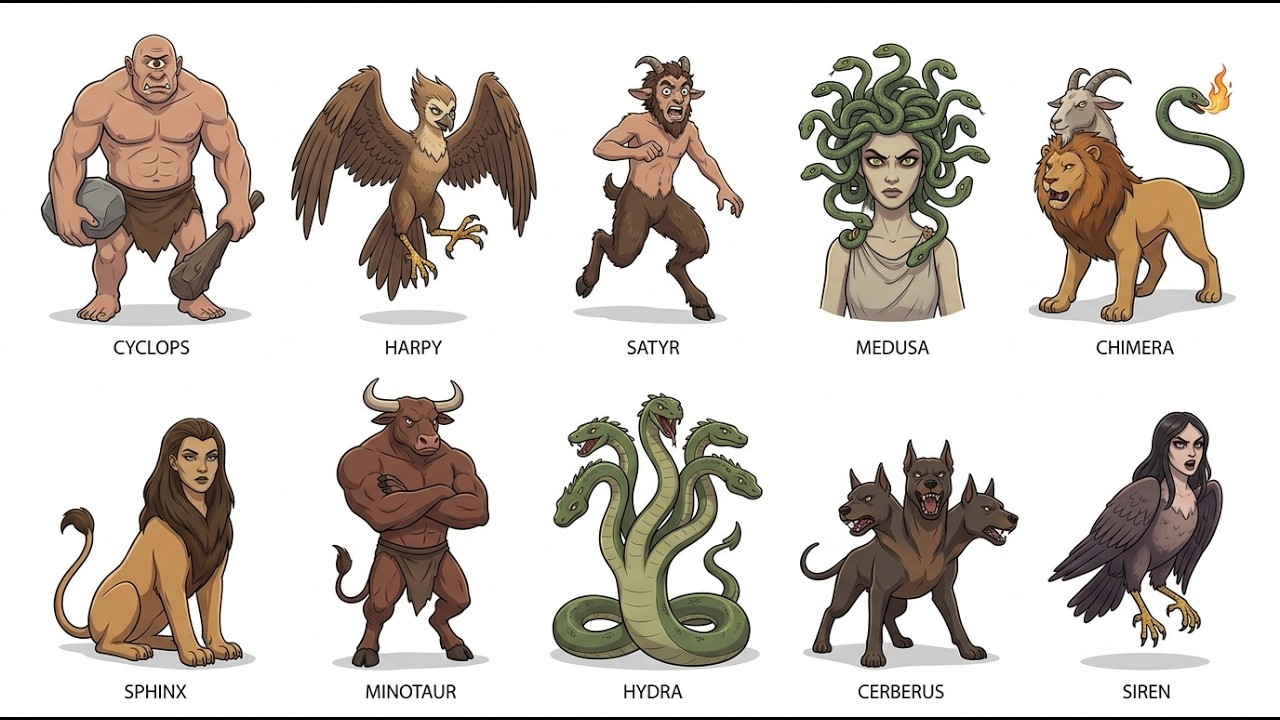
Greek mythology contains an enormous collection of monsters.
Some lived in forests and mountains.
Others guarded treasures.
Some attacked travelers.
Others represented forces that heroes needed to overcome.
These creatures helped Greek storytellers transform natural fears and human anxieties into memorable characters.
The Minotaur
The Minotaur was one of the most famous monsters.
It possessed the body of a man and the head of a bull.
According to mythology, it lived inside the Labyrinth at Knossos on Crete.
King Minos had the Labyrinth constructed to contain the creature.
The Athenian hero Theseus eventually entered the maze.
Ariadne gave Theseus a thread that allowed him to find his way back.
Theseus killed the Minotaur and escaped.
The Cyclopes
Cyclopes were enormous one-eyed beings.
Different Greek traditions portray them differently.
In Homer's Odyssey, Polyphemus is a savage shepherd and son of Poseidon.
In Hesiod's Theogony, the Cyclopes are supernatural beings associated with Zeus's thunderbolt and the weapons of the gods.
This shows that Greek mythology did not always have a single fixed version of every creature.
The Hydra
The Lernaean Hydra was a multi-headed serpent defeated by Heracles.
Its heads could regenerate when cut.
Heracles needed assistance to defeat it.
The Hydra became a symbol of a problem that becomes more complicated when attacked carelessly.
The Nemean Lion
Another monster associated with Heracles was the Nemean Lion.
Its hide was supposedly resistant to weapons.
Heracles eventually strangled it and later used its own claws to cut through its hide.
The Chimera
The Chimera was a composite creature traditionally described as having features of multiple animals.
It was associated with fire and destruction.
The hero Bellerophon defeated it while riding Pegasus.
Medusa
Medusa was one of the Gorgons.
Her gaze could turn people to stone.
Perseus avoided looking directly at her by using a reflective surface.
He eventually cut off her head.
Her severed head became a powerful supernatural object.
Cerberus
Cerberus was the multi-headed dog guarding the entrance to the Underworld.
Heracles was eventually ordered to bring Cerberus back to the world of the living as one of his labors.
Conclusion
Greek monsters were more than simple villains.
They represented danger, chaos, wilderness, death, and forces beyond human control.
Heroes became heroes partly because they confronted these terrifying creatures.
The monsters of Greek mythology therefore helped define the heroic ideals of courage, intelligence, endurance, and determination.