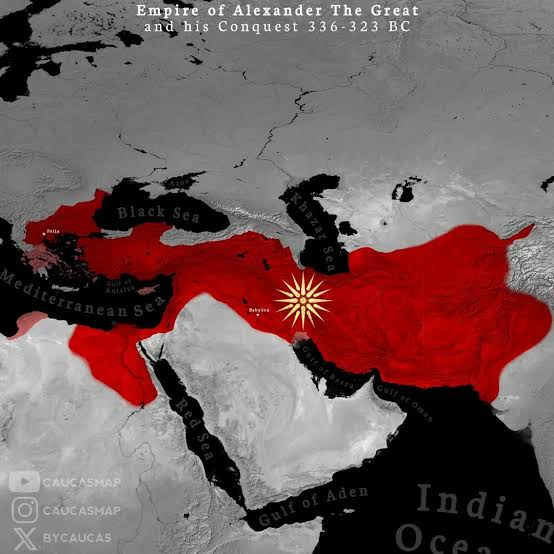
Alexander the Great created one of the largest empires of the ancient world.
His armies conquered territory stretching from Greece and Egypt through Persia and deep into Central Asia.
But Alexander died unexpectedly in 323 BCE at the age of only thirty-two.
His empire immediately faced a fundamental problem:
Who would rule it?
The Succession Crisis
Alexander left no adult heir capable of immediately taking control.
His half-brother Philip III Arrhidaeus was king in name, while Alexander's son, Alexander IV, was born after his father's death.
Real power therefore fell into the hands of Alexander's generals.
These commanders became known as the Diadochi, or successors.
The Wars of the Successors
The generals fought a series of wars for control.
The empire gradually fragmented.
Major territories came under the control of powerful commanders.
Ptolemy established a dynasty in Egypt.
Seleucus and his successors controlled enormous territories in Asia.
Antigonus and his successors became major rulers in Macedonia.
The Hellenistic World
Although Alexander's political empire fragmented, his conquests produced a new cultural environment.
Greek language and institutions spread across the eastern Mediterranean and Near East.
Greek cities were founded or expanded.
Local populations interacted with Greek settlers and administrators.
This period became known as the Hellenistic Age.
Alexandria
Alexandria in Egypt became one of the greatest intellectual centers of the ancient world.
The city attracted scholars, scientists, philosophers, writers, and artists.
The famous Library of Alexandria became a symbol of Hellenistic scholarship.
Greek and Local Cultures
Hellenistic culture was not simply Greek culture replacing everything else.
Persian, Egyptian, Syrian, Jewish, Anatolian, and Central Asian traditions continued to influence society.
Religions and artistic styles frequently blended.
Warfare and Kingship
The successor kingdoms remained highly militarized.
Large professional armies supported royal governments.
Kings competed for territory, prestige, and strategic advantage.
The political world created by Alexander therefore remained unstable.
Rome Enters the Hellenistic World
Eventually, Rome became increasingly involved in eastern Mediterranean affairs.
Macedon was defeated by Rome in the second century BCE.
The Seleucid kingdom was progressively weakened.
Egypt survived longer but was eventually incorporated into the Roman world after the defeat and death of Cleopatra VII and Mark Antony.
Conclusion
Alexander's empire did not survive as a single political state.
Instead, it became a collection of powerful Hellenistic kingdoms.
The political unity of Alexander's conquests disappeared, but the cultural consequences of his campaigns endured for centuries.
Greek became an important international language.
Greek cities appeared across the eastern Mediterranean and Near East.
Science, philosophy, art, literature, and trade flourished within the interconnected Hellenistic world.
Alexander's empire therefore fell politically—but its cultural influence proved remarkably durable.