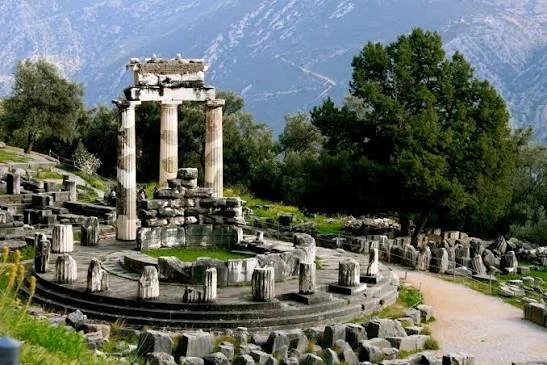
High on the slopes of Mount Parnassus stands one of the most remarkable sacred landscapes of the ancient Mediterranean.
Delphi was the sanctuary of Apollo and the home of the famous Delphic oracle.
For centuries, Greek cities and individuals traveled to this mountainous sanctuary seeking divine guidance. Kings consulted the oracle before major decisions. Cities displayed their wealth through monumental treasuries. Pilgrims traveled long distances to participate in religious rituals.
To ancient Greeks, Delphi was more than a temple.
It was the omphalos, the symbolic "navel" or center of the world.
The Sacred Geography of Delphi
Delphi's geography is essential to its identity.
The sanctuary sits between dramatic rocky formations known as the Phaedriades, on the southern slopes of Mount Parnassus.
The landscape is steep and visually imposing.
UNESCO emphasizes the close relationship between Delphi's architecture and its natural environment.
The mountains were not merely a backdrop.
They helped create the sense that the sanctuary occupied a special location between the human and divine worlds.
The Myth of the Omphalos
According to Greek mythology, Zeus attempted to determine the center of the world.
He released two eagles from opposite ends of the earth.
They eventually met at Delphi.
The site consequently became associated with the omphalos, or navel of the world.
An omphalos stone was preserved at the sanctuary and became one of the site's most powerful symbols.
The idea should not be interpreted as ancient Greek geography in the modern scientific sense.
It was a religious and symbolic claim.
Delphi represented a sacred center.
Apollo at Delphi
The sanctuary became closely associated with Apollo.
Greek mythology connected Apollo with prophecy, music, healing, archery, and order.
According to myth, Apollo defeated the serpent Python at Delphi and established his sanctuary there.
The story symbolized the transformation of the sacred landscape and the establishment of Apollo's cult.
Historical archaeology provides a more complex picture.
Evidence indicates occupation at Delphi before the Classical period, including Mycenaean remains. UNESCO notes that the sanctuary and oracle developed significantly during the eighth century BCE and grew in influence during the sixth century BCE.
The Oracle
The most famous person associated with Delphi was the Pythia.
She served as the priestess through whom Apollo was believed to communicate.
Individuals and political communities approached the oracle with questions.
The process involved ritual preparation and consultation.
Ancient accounts suggest that the Pythia entered a special state during prophetic sessions, although precisely how her prophetic experience worked remains debated.
Popular modern explanations sometimes claim that intoxicating gases or geological vapors caused the oracle's altered state.
The evidence for specific chemical explanations remains debated, and ancient descriptions do not provide a modern scientific account.
What is clear is that the oracle became an enormously influential institution.
Political Influence
Delphi was religious, but it was also deeply connected to politics.
Greek city-states did not exist in isolation.
They competed, formed alliances, fought wars, established colonies, and negotiated religious relationships.
A respected oracle could therefore have political importance.
UNESCO notes that Delphi's oracle became connected with major aspects of Greek political history and that several Sacred Wars were fought over control and influence associated with the sanctuary.
This demonstrates how closely religion and politics were intertwined in the ancient Greek world.
The Sacred Way
One of the best ways to understand Delphi is to imagine approaching the sanctuary as an ancient pilgrim.
The Sacred Way wound upward through the sanctuary.
Along the route stood monuments, offerings, and treasuries.
The visitor gradually encountered increasingly impressive displays of religious devotion and civic wealth.
The journey itself was therefore part of the experience.
The Treasuries
Greek city-states constructed treasuries at Delphi.
These buildings housed offerings and demonstrated the wealth and importance of their communities.
The Treasury of the Athenians is among the best-known examples.
The treasuries also reveal something important about ancient Greek identity.
The Greek world was divided into independent communities.
There was no unified Greek nation-state in the modern sense.
At Delphi, however, these communities participated in a shared religious culture.
The sanctuary could therefore function as a place where political rivals participated in a common religious environment.
The Temple of Apollo
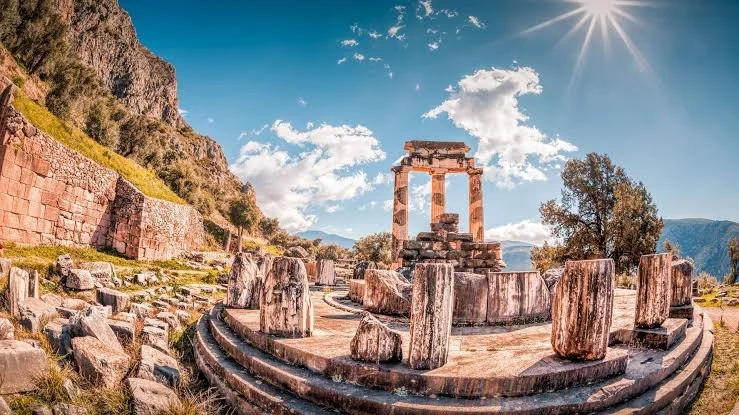
At the center of the sanctuary stood the Temple of Apollo.
The temple was repeatedly damaged and rebuilt over the centuries.
The surviving ruins belong primarily to the later phases of the sanctuary.
Yet even in ruined form, the temple remains the symbolic heart of Delphi.
This was the location associated with the oracle and the god whose authority attracted visitors from across the Greek world and beyond.
The Theater
Higher on the slope stands the ancient theater.
From here, the visitor can look across the sanctuary and the surrounding mountains.
The theater hosted performances associated with festivals honoring Apollo.
It demonstrates that religious life at Delphi included music, drama, ceremony, and public celebration.
The Stadium
Even higher is the stadium.
The site hosted the Pythian Games, which were held every four years.
These games included athletic and cultural competitions.
They were part of a broader Greek tradition in which sanctuaries became centers of athletic festivals.
Delphi therefore connected religion, athletics, artistic competition, politics, and prestige.
Delphi and the Wider Greek World
The sanctuary's importance extended far beyond mainland Greece.
Visitors and offerings came from different parts of the Mediterranean.
The sanctuary accumulated objects reflecting broad networks of contact.
This makes Delphi an archaeological record of connectivity.
The site reveals that ancient Greek culture was not confined to one city.
It was distributed through networks of sanctuaries, colonies, trade routes, political alliances, and religious traditions.
The Oracle and Decision-Making
Why did people consult an oracle?
Ancient societies faced uncertainty just as modern societies do.
People had to decide:
whether to establish colonies;
whether to wage war;
how to respond to political crises;
how to handle religious matters;
how to interpret disasters;
how to navigate uncertain futures.
The oracle provided a culturally legitimate framework for decision-making.
Its answers were sometimes ambiguous.
This ambiguity could allow different groups to interpret the prophecy according to their circumstances.
Delphi and Greek Philosophy
Delphi also became associated with Greek philosophical culture.
The famous maxim "Know thyself" was traditionally associated with the Delphic sanctuary.
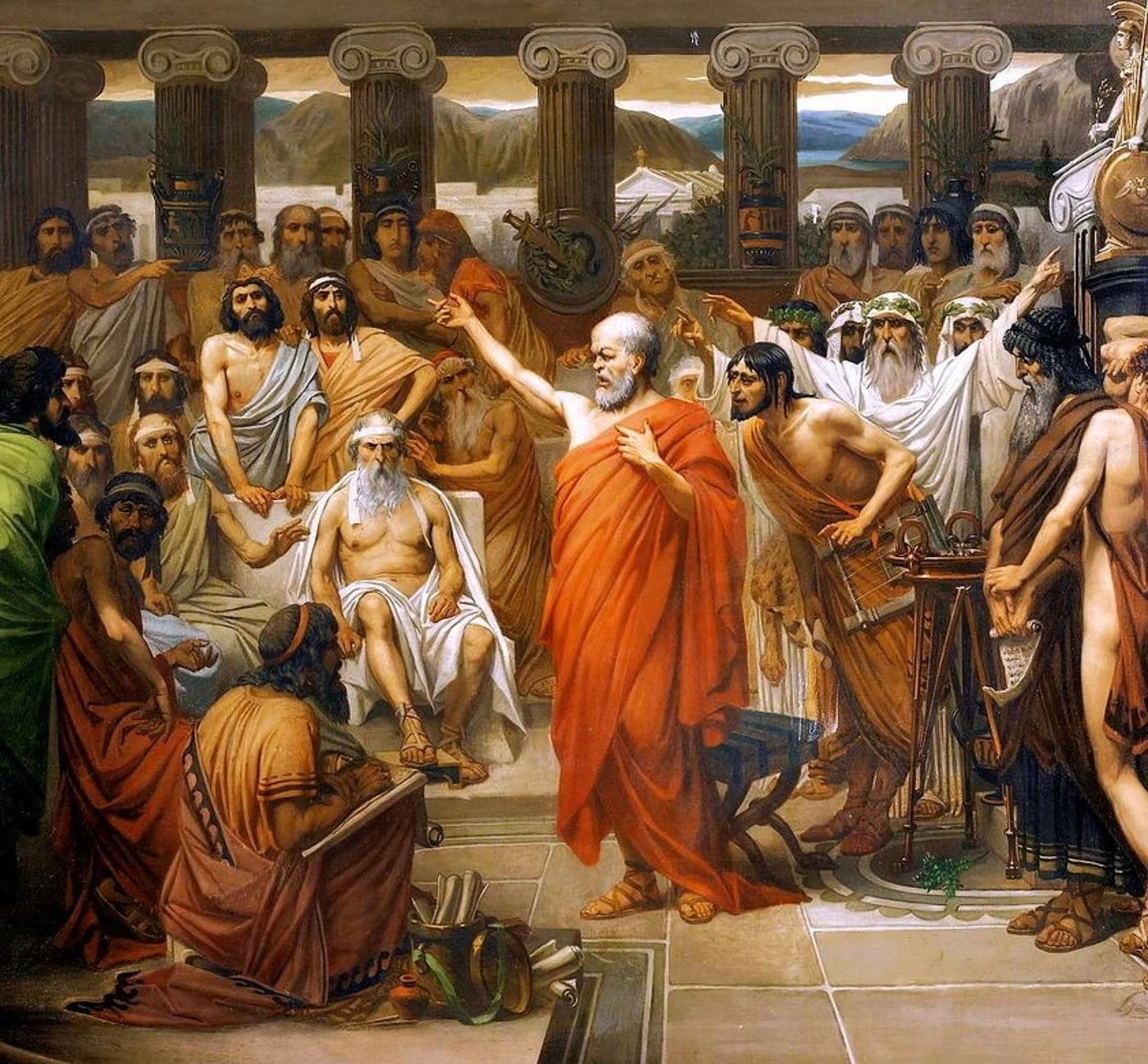
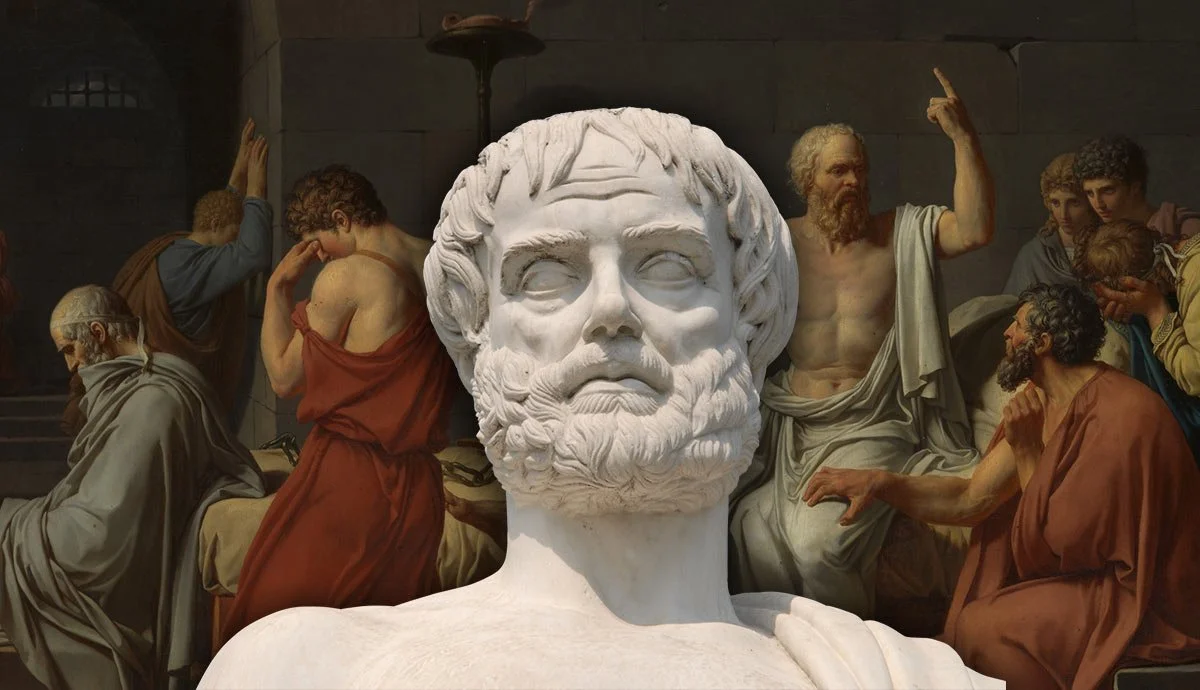
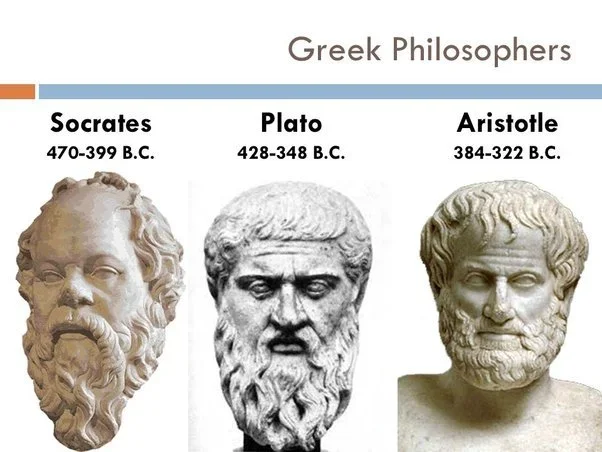
Socrates' philosophical career is later connected with the Delphic oracle through Plato's Apology, where Socrates discusses a statement that no one was wiser than he was.
Socrates interpreted this not as proof that he possessed great knowledge but as an indication of his awareness of his own ignorance.
Thus Delphi became connected not only with prophecy but with philosophical reflection on knowledge and human limitation.
Visiting Delphi Today
Modern visitors encounter an archaeological site dramatically integrated into the mountains.
The ruins include:
the Temple of Apollo;
the Sacred Way;
treasuries;
theater;
stadium;
monuments;
archaeological museum.
The museum is particularly important because many sculptures and artifacts are easier to understand when seen together with the sanctuary.
The landscape should also be treated as part of the site.
Take time to look outward.
The physical environment helps explain why ancient Greeks considered Delphi extraordinary.
Conclusion
Delphi was not merely an ancient fortune-telling center.
It was a religious sanctuary, political meeting point, athletic center, artistic venue, architectural showcase, and symbolic center of the Greek world.
Its importance came from the combination of mythology, geography, ritual, political authority, and cultural prestige.
For ancient visitors, Delphi represented a place where human beings could approach the divine.
For modern visitors, it provides something different but equally valuable: a chance to understand how ancient Greek communities organized their ideas about uncertainty, authority, religion, and the relationship between humanity and the larger cosmos.