More than 11,000 feet below the surface of the Mediterranean Sea exists an environment utterly alien yet eerily familiar to us humans: a lake. But this is unlike any lake that resides above the ocean's surface. Filled with a dark, magnesium chloride-rich brine, it is so salty that it is completely inhospitable to life, and so dense that its surface is clearly distinct from the surrounding saltwater. When disturbed, the brine even produces recognizable waves that wash up on the shoreline. This is Lake Hephaestus.
An international team of researchers originally discovered Lake Hephaestus back in 2013, but they just described it last Friday in a paper published to the journal Scientific Reports. Named for the Greek god of blacksmiths, fire, and volcanoes who was exiled as a child to the deep ocean, Hephaestus lies within a 10-kilometer-long fracture in the ocean floor near Greece. The lake is as deep as 500 feet and long and narrow – roughly 4,000 meters long and 1,000 meters wide at its widest.
Two other briney lakes, called Kryos and Discovery, exist nearby, but Hephaestus is unique for how old it is. Roughly 700 years old, it is surprisingly young, and likely formed when tectonic activity disturbed the seabed, allowing the brine below to seep through vents or cracks in the ocean floor. Hephaestus is the youngest lake of its kind on Earth, the researchers say.
Within Hephaestus' concentrated magnesium chloride brine, no life can survive, but the three-meter-deep interface zone between the brine and the seawater is another story. Though extremely salty and disruptive to hydrogen bonding between water molecules, the zone hosts life. Sampling the region, the scientists found signs of a unique community of microbes distinct from those occupying the uncontaminated saltwater a couple meters above. They believe the microbes are previously uncharacterized "hyperhalophiles," uniquely adapted to dwell in unfathomably salty conditions.
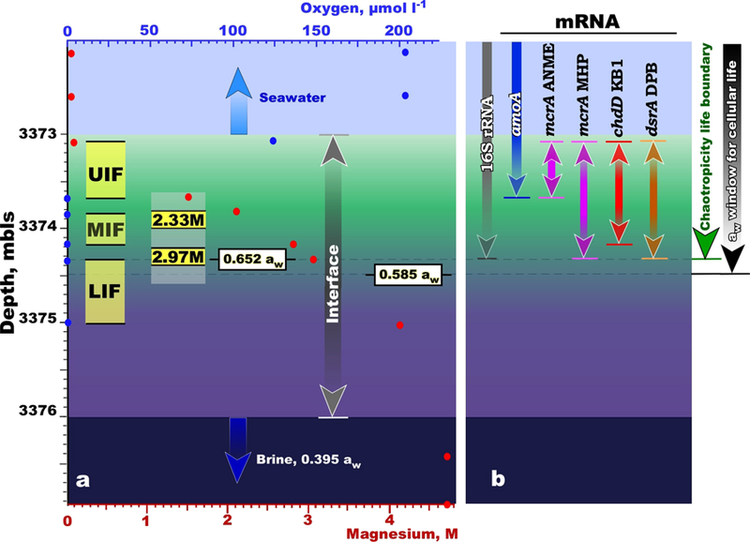
A profile of the interface zone between Lake Hephaestus' brine and the normal seawater of the Mediterranean.
La Cono et al. / Scientific Reports
Turning their attention from the bottom of the Mediterranean sea to the recently discovered subglacial lake on Mars, the researchers say their results offer hope for finding microbes on the Red Planet. Early estimates suggest that Mars' subglacial lake is nowhere near as salty as the interface region above Lake Hephaestus, where microbes were found to exist. Temperature could be the downfall of potential Martian microbes, however. The Martian poles can be as cold as −153 °C, which is 168 °C colder than Hephaestus' brine.
Having found life at one of the most alien locations on Earth, the researchers can't wait to find out if Mars could support life as well.
Source: Nature - realclearscience