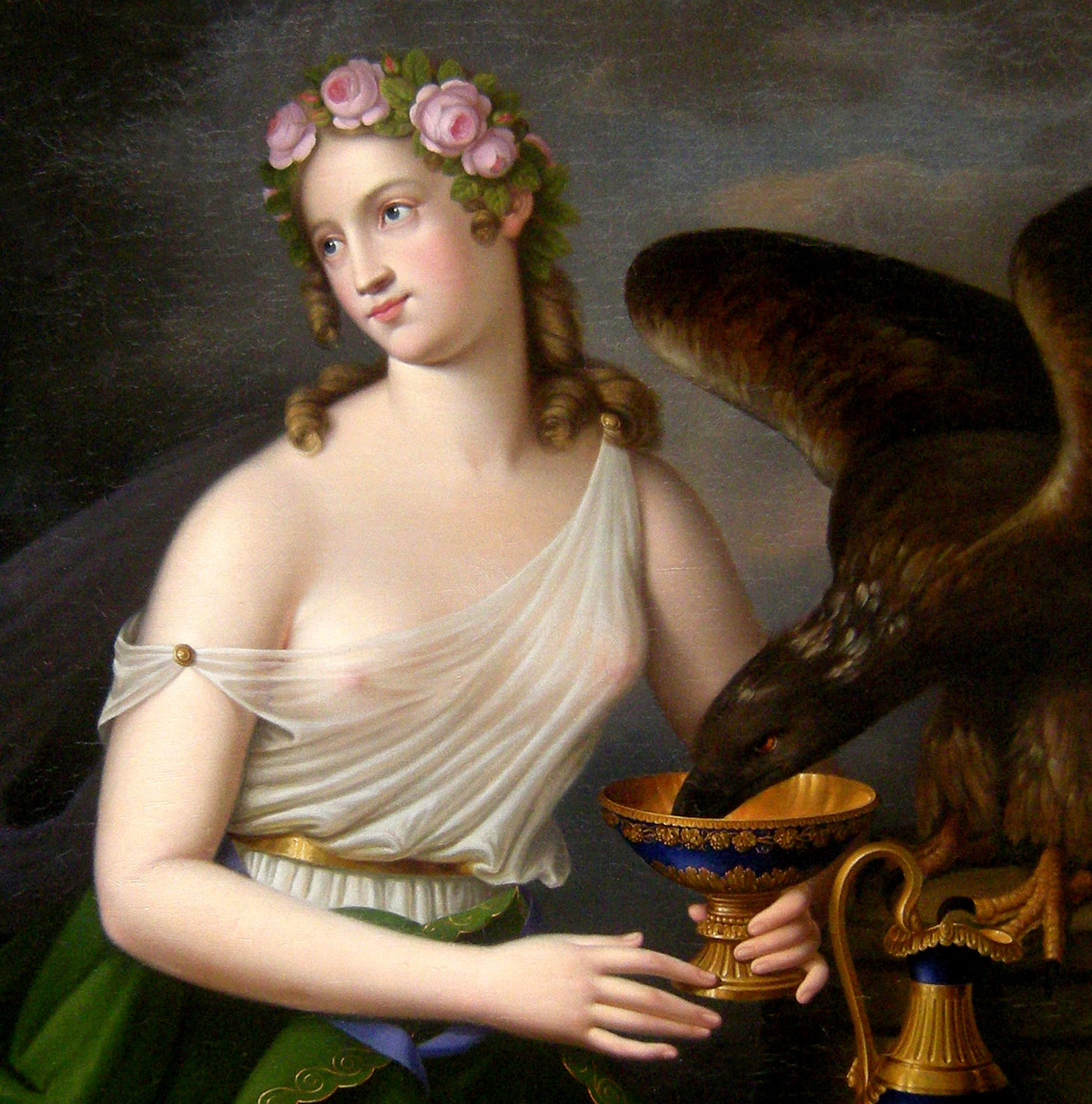
Hebe occupies a distinctive position within Greek mythology as the divine personification of youth and, in early traditions, the cupbearer of the Olympian gods. Although she is not as widely remembered as Athena, Hera, or Aphrodite, Hebe's role provides important insight into how the ancient Greeks understood youth, immortality, divine banquets, and the organization of the Olympian household.
The name Hebe is associated with youth itself. Unlike a goddess who simply possesses eternal youth, Hebe personifies the state of being young and vigorous.
Daughter of Zeus and Hera
Hebe was traditionally regarded as the daughter of Zeus and Hera.
Her position within the divine family was therefore exceptionally prestigious.
She belonged to the younger generation of Olympian gods and was closely associated with the household of Zeus.
The Cupbearer of Olympus
One of Hebe's most famous responsibilities was serving as cupbearer during divine banquets.
She provided the gods with nectar, the divine drink associated with immortality.
The role of cupbearer was not merely practical.
In the ancient Greek world, serving food and drink could carry important social and ceremonial significance.
Nectar and Immortality
Greek mythology distinguishes between ordinary human food and the nourishment of the gods.
The gods consumed:
nectar;
ambrosia;
and other divine substances.
These were connected with their immortality.
Hebe's role therefore placed her directly within the rituals that maintained divine existence.
Ganymede
Later mythology increasingly associates the role of divine cupbearer with Ganymede, a beautiful Trojan youth whom Zeus brought to Olympus.
Ganymede eventually became the better-known male cupbearer of the gods.
This did not erase Hebe's earlier association with the position.
Instead, it reflects the evolving traditions surrounding the Olympian household.
Hebe and Youth
Hebe's most important symbolic function is her connection with eternal youth.
The Greeks understood youth as a period characterized by:
physical strength;
beauty;
fertility;
energy;
and potential.
Because the gods possessed immortality, Hebe represented the perpetual renewal of these qualities.
Marriage to Heracles
One of the most important myths involving Hebe concerns her marriage to Heracles.
After Heracles completed his earthly life and was granted immortality, he was welcomed among the gods.
He eventually married Hebe.
This union is symbolically significant.
Heracles had transformed from mortal hero into immortal divine figure.
His marriage to the goddess of youth reinforces his transition into eternal existence.
Hebe and the Restoration of Youth
Some traditions associate Hebe with the ability to restore youth.
This association fits her identity as the embodiment of youthful vitality.
Hebe in Ancient Art
Hebe was represented as a beautiful young woman.
Artists sometimes depicted her:
carrying a cup;
serving nectar;
standing beside Zeus and Hera;
or accompanying Heracles.
Cultural Significance
The mythological concept of Hebe reflects an important human desire: the wish to preserve youth indefinitely.
Ancient Greek literature frequently contrasts:
youth and old age;
beauty and decay;
strength and weakness;
immortality and mortality.
Hebe stands on the immortal side of this contrast.
Conclusion
The Role of Hebe: The Cupbearer of the Gods demonstrates how Greek mythology personified abstract human experiences.
Hebe represents youth itself.
Her role in the divine banquet connects youth with vitality and immortality, while her marriage to Heracles symbolizes the transformation of a mortal hero into an immortal member of the divine community.