Introduction
Kythera occupies a strategic position between the southern Peloponnese and Crete. Its location made the island an important point along maritime routes connecting the Aegean with the eastern Mediterranean.
The title Submerged Minoan Harbors Off Kythera Reefs suggests the possibility of ancient harbor installations now hidden beneath coastal waters.
The Minoan civilization of Crete maintained extensive maritime connections during the Bronze Age, and Kythera played an important role in contact between Crete and the Greek mainland. However, specific submerged Minoan harbors near Kythera's reefs should not be treated as confirmed discoveries without archaeological evidence.
Kythera and Bronze Age Maritime Networks
Kythera lies along a natural maritime corridor between Crete and the Peloponnese.
Its position made it useful for vessels traveling between different parts of the Aegean.
During the Bronze Age, maritime movement supported the exchange of pottery, metals, agricultural products, and cultural practices.
The island's location helps explain why it became important within wider Aegean networks.
Minoan Influence Beyond Crete
Minoan influence extended beyond the island of Crete.
Archaeological evidence from several Aegean locations demonstrates contact with Minoan communities.
This influence could involve imported pottery, architectural practices, artistic motifs, and commercial relationships.
Kythera is particularly relevant because of its position between Crete and mainland Greece.
The island's Bronze Age archaeological record provides evidence of connections with the Minoan world.
What Was an Ancient Harbor?
Ancient harbors were not necessarily monumental structures.
Some consisted of sheltered natural bays where boats could anchor.
Others included built quays, breakwaters, storage areas, landing platforms, and facilities for loading cargo.
The type of harbor depended on local geography, maritime traffic, and the resources available to the community.
A natural anchorage with imported pottery should not automatically be classified as a constructed Minoan harbor.
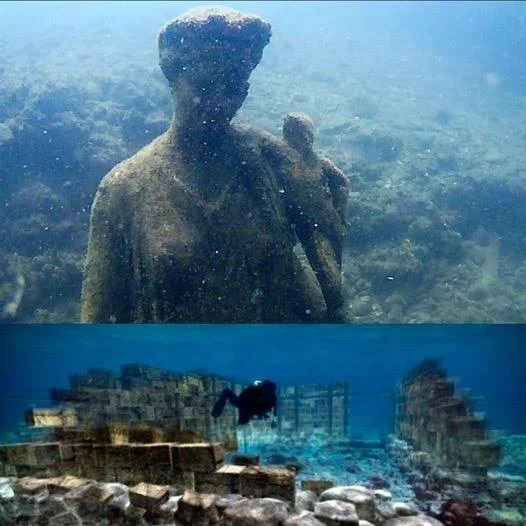
Why Harbor Remains Become Submerged
Coastal landscapes change over thousands of years.
Relative sea-level changes can submerge ancient shorelines.
Tectonic movement may cause land to rise or sink.
Sediment accumulation can also transform the shape of bays and coastal entrances.
A former landing area may therefore lie beneath modern water or sediment.
These processes are particularly important when investigating ancient maritime sites in tectonically active parts of the Mediterranean.
Archaeological Evidence for a Minoan Harbor
To identify a submerged harbor as Minoan, researchers would need several types of evidence.
Potential indicators include:
Bronze Age pottery in secure underwater contexts
Built harbor structures
Ancient shoreline features
Storage or loading installations
Shipwreck remains and associated cargo
Dating evidence from securely excavated deposits
The combination of evidence is essential.
A single Minoan-style ceramic fragment found underwater might have been transported from another location.
Underwater Survey Technology
Modern underwater archaeology uses several technologies to investigate submerged landscapes.
Multibeam sonar can create detailed maps of the seabed.
Side-scan sonar can help identify objects and structures on the seafloor.
Underwater photogrammetry produces three-dimensional models from overlapping photographs.
Diver surveys and remotely operated vehicles can examine selected features more closely.
Sediment sampling may also reveal buried structures or ancient environmental conditions.
The Relationship Between Kythera and Crete
Kythera's position made it an important intermediary between different cultural zones.
People, goods, and ideas could move between Crete, the Peloponnese, and other Aegean islands.
The island's Bronze Age remains demonstrate that maritime connections were not limited to direct voyages between major centers.
Smaller islands could provide stopping points, exchange locations, and access to local resources.
Environmental and Conservation Concerns
Underwater archaeological sites are vulnerable to disturbance from anchoring, fishing equipment, construction, and uncontrolled diving.
Marine organisms and changing sediment conditions can also affect exposed remains.
A confirmed harbor site would require mapping, documentation, and appropriate protection.
Public interpretation could use digital reconstructions and virtual displays to make the site accessible without increasing physical disturbance.
Conclusion
Submerged Minoan Harbors Off Kythera Reefs offer a fascinating subject for exploring Bronze Age maritime activity in the southern Aegean.
Kythera's importance within networks connecting Crete and mainland Greece is well supported by its geographical position and archaeological history.
The existence of particular submerged Minoan harbor installations near its reefs, however, requires direct archaeological verification.
If such sites were documented, they could help reveal how ancient communities used natural anchorages, constructed coastal facilities, and organized maritime movement across the Aegean.