Introduction
Pieria, in northern Greece, stretches from the coast of the Thermaic Gulf toward the foothills and mountain landscapes of Mount Olympus and the Pierian Mountains.
Its geographical position connected prehistoric communities with agricultural plains, mountain resources, and routes leading toward Macedonia and Thessaly.
The title Bronze Age Axes in Pieria Foothill Hoards explores the possibility of discovering groups of bronze axes deliberately deposited in the region's foothills.
Bronze Age metal hoards are known from different parts of Europe and the eastern Mediterranean. They provide important evidence about metallurgy, exchange, social organization, and ritual behavior. However, specific undiscovered axe hoards in Pieria require archaeological confirmation.
Pieria During the Bronze Age
The Bronze Age in northern Greece was characterized by the development of agricultural settlements, specialized crafts, and expanding exchange networks.
Communities used a variety of stone, bone, and metal tools.
Bronze technology gradually became increasingly important for producing weapons, tools, ornaments, and other objects.
Pieria's location between the coast and mountainous interior created opportunities for contact between different communities.
Bronze Axes and Their Functions
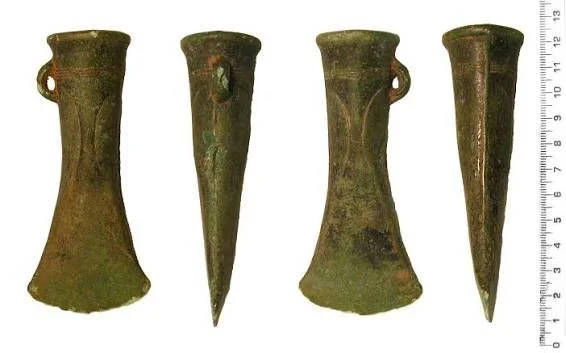
Bronze axes were important tools during the Bronze Age.
They could be used for woodworking, construction, land clearance, and other practical activities.
Some axe forms were also associated with warfare or ceremonial display.
Their design varied according to their intended function, manufacturing tradition, and chronological period.
Archaeologists distinguish between different types through features such as blade shape, socket construction, shaft attachment, and decorative details.
What Is a Bronze Hoard?
An archaeological hoard is a group of objects deposited together.
Bronze hoards may contain axes, spearheads, swords, ornaments, ingots, and fragments of metal.
Some appear to have been stored for later use.
Others may have been deposited as ritual offerings or hidden during periods of danger.
The reason for depositing a hoard cannot be determined from the objects alone.
Its location, arrangement, associated materials, and historical setting are all important.
Why Axes Were Deposited Together
There are several possible explanations for bronze axe hoards.
A metalworker might have stored finished objects or raw materials.
A trader could have concealed valuable metal goods.
A community might have deposited objects as part of a ritual.
Some hoards may have been hidden during conflict and never recovered.
Researchers avoid assigning one explanation to every deposit because different hoards can represent very different activities.
Bronze Metallurgy
Bronze is primarily an alloy of copper and tin, although ancient metal compositions varied.
The production of bronze objects required access to raw materials, specialized knowledge, and controlled heating.
Metalworkers shaped objects through casting, hammering, and finishing techniques.
The distribution of bronze axes can therefore provide clues about technological knowledge and exchange networks.
Scientific Analysis of Bronze Axes
Modern analytical techniques help researchers investigate prehistoric metalwork.
X-ray fluorescence can identify elements present in an object's surface.
More specialized laboratory methods may provide additional information about metal composition.
Researchers can also examine casting seams, hammer marks, repairs, and wear.
Such evidence can help distinguish objects produced in different workshops or using different manufacturing traditions.
Pieria's Position in Prehistoric Exchange
Northern Greece was connected to wider Balkan and Aegean networks.
Metal objects, raw materials, pottery, and other goods circulated between settlements.
Mountain routes provided access to inland communities, while coastal routes connected the region with maritime trade.
A bronze axe discovered in Pieria might therefore represent local production, imported goods, or an object manufactured using techniques shared across several regions.
Archaeological Survey in the Foothills
The search for prehistoric hoards requires systematic investigation.
Researchers may use landscape survey, geological mapping, remote sensing, and controlled excavation.
When a metal object is detected, its precise position and surrounding sediment must be recorded.
The use of metal detectors by unauthorized collectors can destroy archaeological context and damage the scientific value of a find.
Conservation of Bronze Objects
Bronze objects can develop corrosion products during burial.
Some corrosion layers are stable, while others indicate continuing deterioration.
Conservators examine the object's condition before selecting appropriate treatment.
Cleaning must be controlled because aggressive removal of corrosion can destroy surface details and manufacturing evidence.
Stable storage conditions help preserve the artifact for future research.
Conclusion
Bronze Age Axes in Pieria Foothill Hoards provide an opportunity to explore the relationship between metalworking, resource exchange, and prehistoric communities in northern Greece.
Bronze tools and hoard deposits are well established features of Bronze Age archaeology.
The specific presence of axe hoards in Pieria's foothills requires direct archaeological documentation.
If such deposits were securely identified, they could help researchers understand how communities in the region acquired metal, organized production, stored valuable objects, and participated in wider networks connecting the Balkans with the Aegean world.