Introduction
Delphi was one of the most important religious centers of ancient Greece. Its sanctuary of Apollo attracted visitors, political representatives, and worshippers from across the Greek world.
The sanctuary's landscape contained numerous monuments and dedications, including tripods, statues, treasuries, and inscribed offerings.
The title Archaic Tripod Bases in Delphi Satellite Shrines explores the possibility of identifying additional tripod supports or foundations at smaller sanctuaries associated with the wider Delphic religious landscape.
Tripods are well documented in ancient Greek ritual and commemorative practices. However, specific undiscovered tripod bases at satellite shrines around Delphi require archaeological confirmation.
Delphi During the Archaic Period
The Archaic period, approximately 700–480 BCE, was an era of major cultural and political development in Greece.
Delphi became increasingly influential as a sanctuary and oracle.
Communities consulted Apollo's oracle before important decisions involving colonization, warfare, political reform, and religious affairs.
The sanctuary also became a place where city-states displayed wealth and prestige through monumental offerings.
The Importance of Tripods
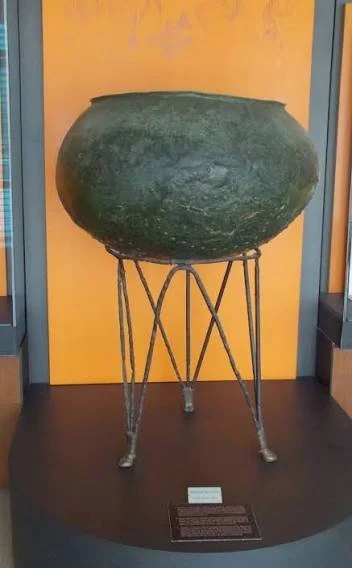
A tripod is a three-legged stand that could support a vessel or other object.
In ancient Greece, tripods had practical, ceremonial, and symbolic functions.
They could be associated with cooking, ritual offerings, religious ceremonies, and victory celebrations.
Bronze tripods were especially prestigious objects.
Their dedication at sanctuaries could express gratitude to a deity or commemorate an important achievement.
Tripods as Religious Dedications
Tripods were frequently dedicated in sacred spaces.
Some were offered by individuals, while others represented collective gifts from communities or political authorities.
A tripod could be displayed as a visible demonstration of wealth and religious devotion.
The object itself might also carry inscriptions identifying its donor or commemorating the circumstances of its dedication.
What Is a Tripod Base?
A tripod base is the supporting structure or archaeological foundation associated with a tripod or related monument.
Not every tripod stood on a separate stone base.
Some were freestanding, while others could be placed on platforms or incorporated into larger commemorative arrangements.
Archaeologists must therefore distinguish between an actual tripod support and an unrelated architectural block.
Delphi's Wider Sacred Landscape
The sanctuary of Apollo was not the only sacred space in the region.
The surrounding landscape contained additional religious locations, routes, and cult sites.
Smaller shrines could serve local communities, travelers, and people moving through the mountainous terrain.
Their relationship with the main sanctuary is important for understanding how religious activity extended beyond the central monumental area.
Archaeological Identification
Researchers identifying tripod bases would examine their dimensions, construction, tool marks, and relationship with surrounding structures.
Inscriptions could provide particularly valuable evidence.
Metal fragments, attachment points, and surviving decorative elements might also help establish the original function of a base.
Dating would require comparison with securely dated objects and the archaeological layers in which the remains were found.
Dedications and Political Competition
The dedication of valuable objects at Delphi could carry political significance.
City-states sometimes used monumental offerings to demonstrate military success, wealth, and prestige.
A tripod could therefore communicate more than religious gratitude.
Its size, material, inscription, and placement might reveal how a community wished to be remembered by visitors from across Greece.
Digital Reconstruction
Three-dimensional scanning could help document surviving tripod supports and architectural fragments.
Digital reconstruction might show how a complete tripod looked when displayed in an ancient sanctuary.
Such models could also demonstrate the relationship between individual monuments and the surrounding sacred landscape.
Researchers would need to distinguish original measurements from reconstructed elements.
Conclusion
Archaic Tripod Bases in Delphi Satellite Shrines provide a promising subject for studying religious dedications and the spread of sacred activity throughout the Delphic landscape.
The use of tripods in ancient Greek ritual and commemorative practices is well established.
The presence of particular additional tripod bases at smaller Delphi shrines requires archaeological verification.
If confirmed, such remains could reveal how individuals and communities expressed religious devotion beyond the main sanctuary and how monumental offerings helped shape the sacred geography of ancient Phocis.