Introduction
Amphipolis, located in the region of eastern Macedonia near the Strymon River, was one of the most significant ancient settlements in northern Greece.
Its strategic position connected the Balkan interior with the Aegean coast and important mineral resources.
The title Hellenistic Terracotta from Amphipolis Extension suggests the possibility of identifying additional terracotta objects in areas beyond the best-known archaeological remains of the ancient city.
Terracotta objects are common and valuable archaeological finds from the Hellenistic world. However, a specific newly identified extension of Amphipolis containing an assemblage of Hellenistic terracotta requires direct archaeological confirmation.
Amphipolis and Its Historical Importance
Amphipolis was founded by Athens in 437 BCE near the Strymon River.
Its location made it important for controlling regional trade routes and access to resources in the surrounding territory.
The city later became part of the Macedonian kingdom and remained significant during the Hellenistic period.
Its history reflects the political and economic transformations of northern Greece.
The Hellenistic Period
The Hellenistic period began after Alexander the Great's death in 323 BCE.
Greek cultural influence expanded across a large geographical area.
Cities developed new architectural forms, artistic traditions, and commercial relationships.
Amphipolis participated in this wider world through its regional position and political importance.
What Is Terracotta?
Terracotta is fired clay used to create objects ranging from architectural decorations to figurines and household items.
Ancient craftspeople shaped clay by hand, with moulds, or using other specialized methods.
After drying, objects were fired to harden them.
Terracotta was relatively affordable and adaptable, making it suitable for a wide range of purposes.
Terracotta Figurines
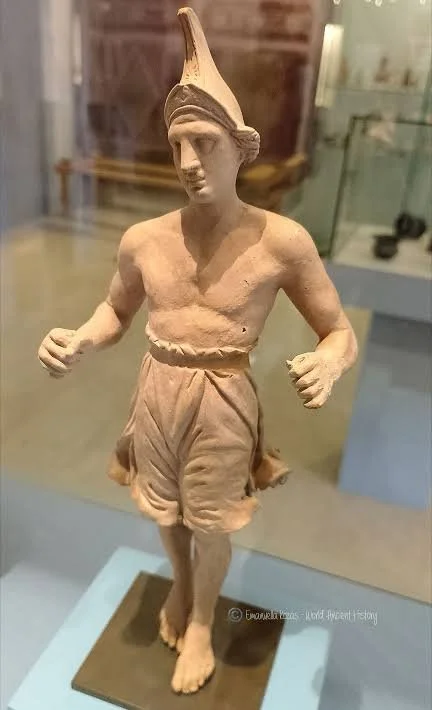
Small terracotta figurines were produced throughout the Greek world.
They could represent deities, humans, animals, theatrical figures, and everyday scenes.
Some were used as votive offerings in sanctuaries.
Others may have served decorative or funerary purposes.
Their interpretation depends on archaeological context, iconography, manufacturing methods, and associated finds.
Architectural Terracotta
Terracotta was also used in buildings.
Architectural elements could include roof tiles, decorative plaques, antefixes, and other components.
Some pieces carried painted or moulded decoration.
The distribution of architectural terracotta can help archaeologists reconstruct buildings that have otherwise disappeared.
Fragments may reveal roof design, decorative programs, and construction techniques.
What Could an Amphipolis Extension Mean?
The word "extension" might refer to an expanded residential area, an industrial quarter, a cemetery, or another zone associated with the ancient settlement.
Ancient cities were not limited to their central monumental buildings.
Their wider territory included houses, workshops, agricultural installations, roads, burial grounds, and smaller religious spaces.
An archaeological extension could therefore reveal how the settlement developed beyond its best-known urban center.
Dating and Classification
Terracotta objects can be dated through several methods.
Researchers examine manufacturing techniques, clay composition, decorative style, and archaeological layers.
Mould-made figurines may be compared with examples from other sites.
Scientific analysis of clay can sometimes help identify possible production regions.
However, similarities in appearance do not automatically prove that objects came from the same workshop.
What Terracotta Can Reveal About Daily Life
Terracotta finds provide information about ancient domestic and religious activity.
Figurines may reveal devotional practices and popular imagery.
Roof tiles and architectural fragments can demonstrate construction methods.
Household objects may indicate food preparation, storage, and other everyday activities.
When studied as an assemblage, these materials help reconstruct the social and economic life of a settlement.
Excavation and Digital Documentation
Archaeologists can document terracotta objects through photography, measured drawings, and three-dimensional scanning.
Digital models preserve details of surface decoration, moulding, and breakage.
Microscopic and chemical analysis may reveal production techniques and clay sources.
A well-documented assemblage can also be compared with material from other Hellenistic centers.
Conclusion
Hellenistic Terracotta from Amphipolis Extension offers a useful subject for understanding the growth and everyday life of an important Macedonian city.
Amphipolis's historical significance and the widespread use of terracotta during the Hellenistic period are well established.
A particular new settlement extension containing a defined terracotta assemblage requires archaeological verification.
If documented, such material could reveal additional information about local workshops, religious practices, domestic architecture, and the economic development of Amphipolis during the Hellenistic age.