The United States has a complex government system. One important tenet of this system is democracy, in which the ultimate power rests with the people. In the case of the United States, that power is exercised indirectly, through elected representatives. Although the U.S. has been a strong proponent of democracy, it did not invent democracy. The Greeks are often credited with pioneering a democratic government that went on to influence the structure of the United States. Read this article that describes how elements of ancient Greek democracy heavily influenced the figures that designed the United States government.
After declaring independence from England in 1776, the founders of the United States possessed a unique opportunity to create a government of their choosing. This was a momentous task, and for guidance they looked to what they deemed the best philosophies and examples of government throughout world history. Along with the Roman model, the democratic model of ancient Greece’s system of self-government greatly influenced how the founding fathers set out to construct the new United States government.
Prior to independence, the east coast of what is today the United States was divided into 13 separate colonies. The founders of the United States decided to keep the country divided into states rather than dissolving the colonial boundaries. They did this so that each region could be governed at a local level, with a national government acting as a dominant authority over all. These 13 colonies would become the first states of the newly established country.
A U.S. state resembles the community structure of an ancient Greek polis, or city-state. A polis was composed of an urban center and the land surrounding it, developments similar to that of the major cities and state capitals in the United States and the rural areas surrounding them. In ancient Greece, some of the main city-states were Athens, Sparta, Corinth, Thebes, and Syracuse. These city-states acted independently for the most part. However, sometimes they engaged in war against each other. They also banded together to defend Greece from foreign invaders.
All Greek city-states had sets of rules by which the people lived in observance and laws they were required to obey. In ancient Greece the idea of rule of law came from the philosopher Aristotle’s belief in natural law. He claimed the existence of a higher justice in nature—certain essential rights—that superseded the laws written by humans. Aristotle believed that people should align themselves with this natural law and govern by its ethics.
In the United States today, the rule of law is a principle that ensures that all laws are publicly accessible, equally enforced, and independently judged, and that they adhere to international human rights ethics. The rule of law is important because it allows all individuals and institutions (including the government itself) to be held accountable for their actions. By agreeing to follow the rule of law, the United States can prevent abuses of power by leaders who might act as if they are above the law.
Another important ancient Greek concept that influenced the formation of the United States government was the written constitution. Aristotle, or possibly one of his students, compiled and recorded The Constitution of the Athenians and the laws of many other Greek city-states. Having a written constitution creates a common standard as to how people should behave and what rules they must follow. It also establishes clear processes by which people who break the law are judged and those who are harmed as a result can be compensated or given justice.
Like The Constitution of the Athenians, the U.S. Constitution is a vital document. It lays out the government’s structure and how the checks and balances of power within it relate to one another. The U.S. Constitution acts as the supreme law of the country and establishes individual citizens’ rights, such as the right to free speech or the right to a trial by a jury of one’s peers. Today, the U.S. Constitution is still regularly referenced in law as the supreme law of the land and is enforced by the U.S. Supreme Court, the country’s highest court.
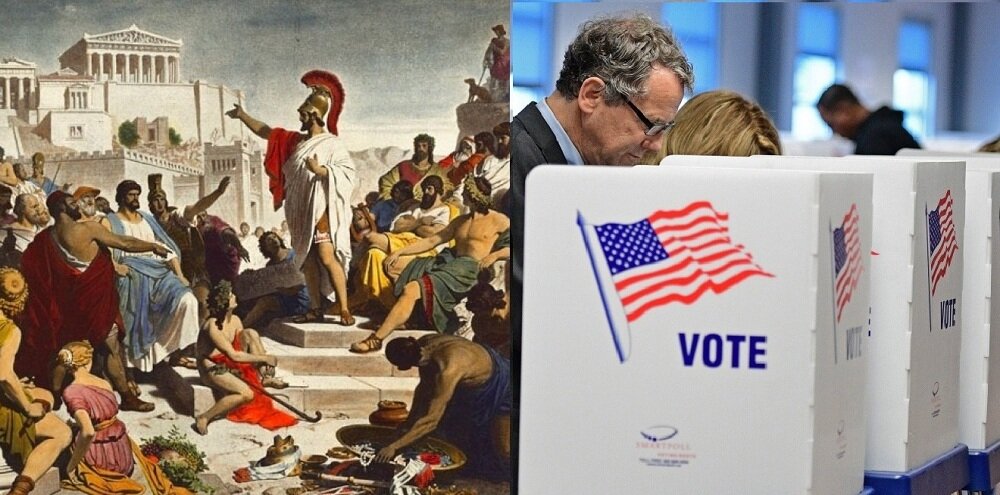
The original U.S. voting system had some similarities with that of Athens. In Athens, every citizen could speak his mind and vote at a large assembly that met to create laws. Citizens were elected to special councils to serve as organizers, decision-makers, and judges. However, the only people considered citizens in Athens were males over the age of 18. Women, slaves, and conquered peoples could not vote in the assembly or be chosen to serve on councils.
The founders of the United States similarly believed that only certain people should be allowed to vote and elect officials. They chose to structure the United States as a representative democracy. This means that citizens elect officials, such as senators and representatives, who vote on behalf of the citizens they represent in Congress. It also means that instead of each individual citizen voting for president directly, a body called the Electoral College officially casts the votes of each state for president. As in Athens, when the United States was founded only white, landowning men were allowed to vote. Over time, however, all U.S. citizens over the age of 18 who have not been convicted of a felony have gained the right to vote.
The principles behind the ancient Greeks’ democratic system of government are still in use today. The United States and many other countries throughout the modern world have adopted democratic governments to give a voice to their people. Democracy provides citizens the opportunity to elect officials to represent them. It also allows citizens to choose to elect a different person to represent them if they are dissatisfied with their current elected officials. Today, democracy and the rule of law provide people around the world with a means of protecting their human rights and holding each other accountable as equals under the law.
Source: nationalgeographic