By Susan Doktor
From monuments to manuscripts, many precious Greek antiquities have been lost through the ages. But Greek cuisine—in all its herbaceous, olive-kissed glory—has, thankfully, survived the millennia and continues to delight food enthusiasts who visit our shores. It also opens a window into Greek history, culture, agriculture, and the Greek economy. Learning a bit about Greek food can enrich your Greek travel experience in more ways than one!
Culinary historians credit Archestratus, a writer and social commentator who lived somewhere around 350, B.C., with being the world’s first food critic. Archestratus was from Syracuse, now located in modern Sicily. Sicily was colonized by the Greeks in the 8th century BC and Greek influence in Sicilian cuisine is easy to spot to this day. Achestratus wasn’t a chef himself. He was more of a philosopher who wrote about enjoying the good life, which to his mind included eating a lot of properly-prepared fish, the most abundant source of protein in Ancient Greece:
“But if you go to the prosperous land of Ambracia and happen to see the boar-fish, buy it! Even if it costs its weight in gold, don’t leave without it, lest the dread vengeance of the deathless ones breathe down on you; for this fish is the flower of nectar…”
Eating fish during ancient times, Archestratus noted, was not without risk. In the case of Rhodian dogfish (also known as the thresher shark), the droll critic allows that while it’s dangerous to eat, it’s so delicious, you should eat it anyway, then “patiently await your fate.” You can still enjoy dogfish in Greece to this day, but be sure you have a good travel insurance policy—one that covers you for medical expenses!
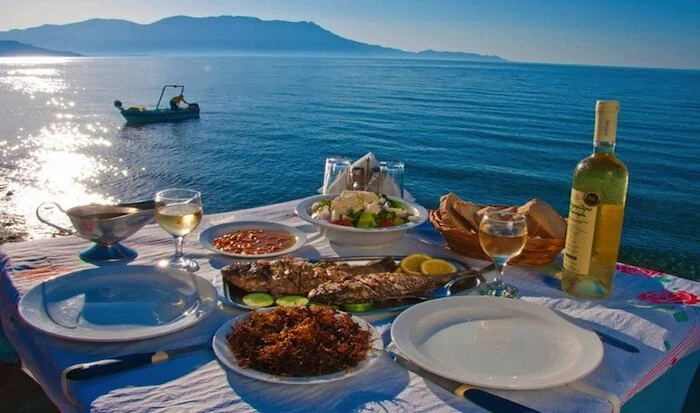
With more than 15,000 kilometers of coastline—taking both the mainland and islands into account— fish remains a mainstay of the Greek diet. It’s also an anchor of the Greek economy. Among agricultural exports, only olive oil surpasses fish. Greece ranks third globally as an olive oil producer. By some accounts, there are over 170 million olive trees in Greece today. Amazingly, scientists at the University of Crete have located one tree they estimate to be 4,000 years old. Some trees dating back to the 13th century are still producing fruit.
The Greek philosopher Homer called olive oil “liquid gold.” The product is so central to Greek cuisine that there’s a special Greek word and category for foods that are cooked in olive oil: lathera. Lathera dishes are nearly always vegetarian. A generous bowl of lathera probably meets the recommended daily requirement for fruits and veggies. Peas, green beans, and legumes are some of the most popular lathera ingredients. The dish reflects an ancient tenet of Greek cuisine that survives to this day: simple cooking is highly valued. But simplicity is not to be confused with scarcity or frugality. The gastronomical lifestyle and a culture of social eating, as epitomized by the symposia of the Classical age, is alive and well in Greece today. It’s one of the high points of traveling in Greece.
One of the joys of dining in Greece is sampling the delightful array of traditional dips and sauces that anchor Greek cuisine. Most guests are familiar with hummus, a staple Mediterranean dish made from garbanzo beans and sesame seed paste that was one of the first products to penetrate mainstream supermarkets outside the region. Hummus recipes are as numerous as the chefs who create them, and range from thick and pasty to silken and liquid-like. Tzatziki, traditionally made from yogurt, cucumber, olive oil, lemon, and herbs, is popular as a dip and as a condiment, but when you visit Greece, make it a point to sample a cold tzatziki soup as a refreshing appetizer. Avgolemono is another sauce that sometimes morphs into soup, though it’s also served with stuffed grape leaves and stuffed cabbage (dolmades).
To turn a common phrase, the way to a country’s heart is through your stomach. Many travelers report that dining in Greece is both inspirational and transformational and has changed their approach to cooking at home. We hope you’ll take the time to fully explore the breadth of Greek cuisine when you visit. Τὸ δεῖπνον ἐστ' ἐπεσκευασμένον! That’s the Greek way of saying bon appetit.
Author Bio:
Susan Doktor is a journalist, cookbook author, and avid home chef who hails from New York City. She writes on a wide range of topics, including travel, food, and wine. Follow her on Twitter @branddoktor.