An Unprecedented Phenomenon – Seismologists Dimitris Papanikolaou and Kostas Papazachos Discuss Seismic Activity and Its Duration
We are not witnessing the formation of a new volcanic crater. Both Kameni and Kolumbo are not involved in the current seismic activity, clarify seismologists Dimitris Papanikolaou and Kostas Papazachos in their statements to "K". The earthquakes in Santorini are an unprecedented phenomenon, they explain, emphasizing that they are constantly analyzing data. They conclude that the seismic sequence, with periods of intensification and decline, may last for months.
What exactly are magmatic processes?
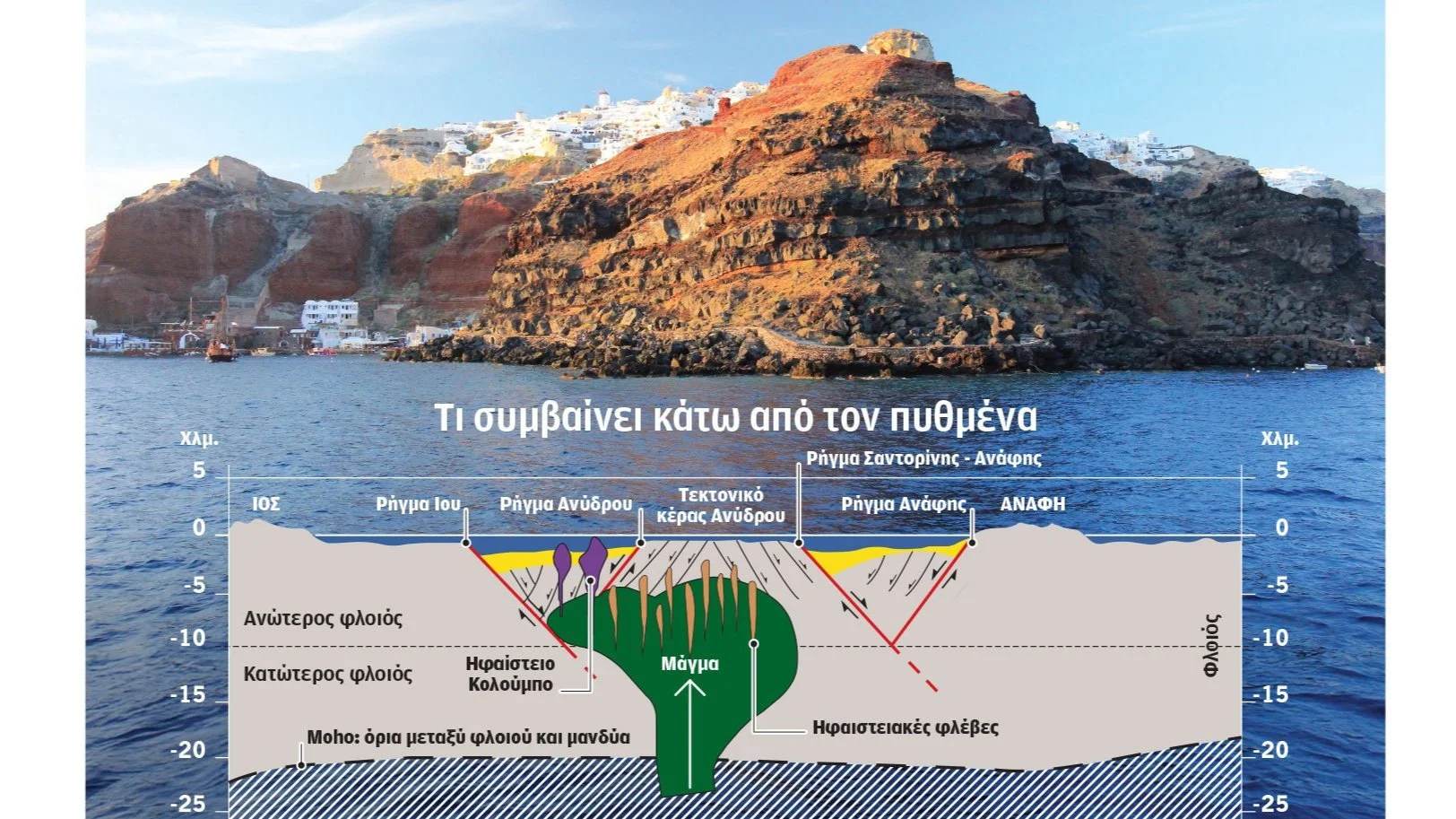
Dimitris Papanikolaou: It is the movement of magma, which starts at a depth of 120 kilometers, rises into the crust at depths of less than 20 kilometers, and attempts to reach the surface. However, very little of it usually reaches the surface to form volcanoes. The likelihood of a new volcano forming is very rare.
Kostas Papazachos: Imagine that we are like an egg. The shell we live on is the Aegean crust, and inside the egg white, there are many points with hot material trying to reach the surface. In some specific locations, it has succeeded, forming volcanoes. However, in other places, the shell is thick and strong, preventing the hot material from easily finding a way through.
Is there a possibility of a new volcanic crater forming?
D.P.: The likelihood of seeing a volcanic eruption does not exist at this time. Both volcanoes are calm. There was a small activity in the fall, which has ended. As for magmatic intrusion, it occurs at depths greater than 5 kilometers. It impacts the earthquakes we experience, which are around 4 to 5 on the Richter scale, and has the potential to activate the largest fault in the region, the Anydros fault, which could produce an earthquake of up to 6 Richter—if it is indeed activated—but nothing beyond that.
Speculation about a new volcano is science fiction, like Star Wars. Some people confuse magmatic processes with magma reaching the surface and forming a volcano. In the area beneath the islet of Anydros, where these magma intrusions have been detected, there is no volcano above. Kolumbo is more than 10 kilometers away from the area currently experiencing increased activity, and Kameni is 15-20 kilometers away. So, anyone linking Kolumbo and Kameni to this process is making a big mistake.
K.P.: Absolutely not. The earthquakes occur at great depths. There is a large unbroken section that cannot easily fracture. The earthquakes we are experiencing are a combination of magmatic and tectonic processes.
However, you mentioned that magmatic processes are related to the earthquakes.
D.P.: This is an unprecedented phenomenon; we have never experienced it before. We have never before observed such magma intrusion that we can measure and monitor as we do now in this area. We have had numerous volcanic earthquakes in the past, including in 2011 and last fall. Tectonic earthquakes occur in Greece all the time. What we are dealing with now is a different phenomenon under study, linked to magma intrusion, which is why we refer to it as tectono-magmatism. Otherwise, we would call it tectono-volcanism.
K.P.: Based on seismic tomography data, at a depth of about 8-10 kilometers near Anydros, there is a section of magmatic material. It has been triggered by an unknown cause and is pressing against the crust. However, that does not mean it will necessarily break through, as the crust of Anydros consists of thick and very hard rock. The magma stimulation is interacting with the tectonic forces in the area. Essentially, the magma is pressing against the faults, causing them to fracture. The scientific committee is analyzing data and not making guesses. We are certain from extensive evidence that this is what is happening beneath Anydros. The pressure from below is causing movement, uplift, and changes in the inclination of the land.
Have any ground deformations been observed? Can you explain what this means?
D.P.: We have recorded a caldera uplift of up to 4 centimeters. In 2011, when a similar event occurred, the uplift was 50 centimeters, which was concerning. At that time, the phenomenon was prolonged and intense, but it did not lead to a volcanic eruption. The difference is significant—50 centimeters then, 4 centimeters now. That shows how much less significant this event is. All of this would be concerning if we still had earthquakes occurring beneath the caldera, as we did for two to three months. But now, we do not.
K.P.: We have observed some deformation in the Santorini region, and we are trying to understand its cause and potential consequences. It is as if an invisible hand is stretching the island. This is linked to the seismic activity in Anydros. We do not yet know how it will evolve. It is still very early to tell.
Where do things currently stand?
D.P.: Right now, the main question is how much longer the magma pressure will continue generating these small-to-moderate earthquakes of around 5 Richter. This process may last for a while, showing periods of quiet before resuming. If the Anydros fault, which is next to the already broken faults, also fractures, it could produce an earthquake of 6 or even 6.1 Richter.
K.P.: We know that these earthquakes result from a combination of tectonic and magmatic activity. This phenomenon will continue for a significant period, with fluctuations in intensity, but the probability of a very strong earthquake is decreasing. However, we do not know if a neighboring fault is mature enough to trigger a larger earthquake. We have considered these possibilities, but ultimately, Greece’s national policy does not rely on earthquake prediction.