Introduction
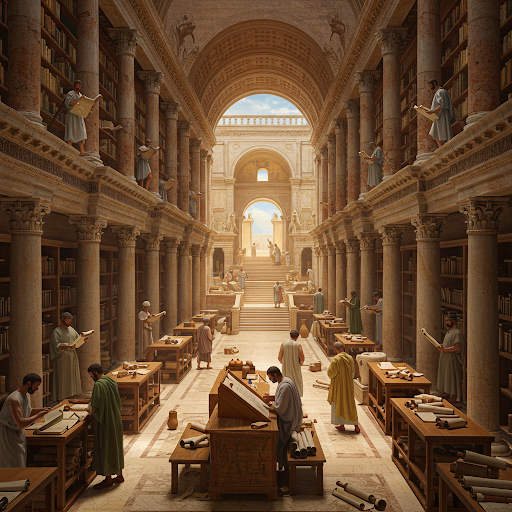
Ancient Greek libraries were not merely collections of texts but intellectual hubs that shaped the advancement of science, philosophy, and literature. Among the most renowned were the Library of Alexandria and the Library of Pergamon, each serving as a beacon of knowledge in the Hellenistic world. These institutions housed vast collections of scrolls, attracted great scholars, and played a crucial role in preserving and disseminating knowledge.
The Library of Alexandria
Foundation and Purpose
The Library of Alexandria, established in the early 3rd century BCE under the rule of Ptolemy I Soter and expanded by his successor Ptolemy II Philadelphus, was the most famous library of antiquity. Situated in the Egyptian city of Alexandria, it aimed to collect all the world’s knowledge, making it a center for scholarly activity.
Collections and Scholarship
The library is estimated to have housed between 40,000 to 400,000 scrolls, covering a vast range of subjects including mathematics, medicine, astronomy, literature, and philosophy. Works by Homer, Aristotle, and Euclid, among others, were preserved and studied within its halls. Scholars such as Eratosthenes, who calculated the Earth's circumference, and Hipparchus, who developed early astronomical theories, conducted groundbreaking research there.
Decline and Destruction
The exact cause of the library’s destruction remains debated, with theories ranging from accidental fires during Julius Caesar’s siege of Alexandria (48 BCE) to later conflicts in the Roman and Byzantine periods. Despite its loss, the intellectual legacy of Alexandria endured, influencing generations of thinkers.
The Library of Pergamon
Foundation and Rivalry with Alexandria
The Library of Pergamon, founded in the 2nd century BCE under the Attalid dynasty in what is now modern-day Turkey, rivaled Alexandria in prestige. King Eumenes II expanded the library’s holdings, reportedly amassing around 200,000 scrolls. A significant rivalry between the two libraries led to innovations such as the development of parchment (pergamenta) as an alternative to Egyptian papyrus.
Scholarly Contributions
Pergamon became a center for literary and scientific study, particularly in medicine and philosophy. The library was associated with figures like Galen, who made significant contributions to medical science, and Crates of Mallus, a scholar of grammar and literary criticism.
Legacy and Influence
The Library of Pergamon was eventually absorbed into the holdings of Alexandria when Mark Antony gifted its collection to Cleopatra in the 1st century BCE. However, Pergamon’s contributions to textual preservation and academic inquiry continued to influence learning in the Roman and Byzantine worlds.
Conclusion
The libraries of Alexandria and Pergamon were monumental institutions that shaped the intellectual landscape of the ancient world. Through their vast collections and renowned scholars, they laid the foundation for future advancements in science, philosophy, and literature. Their legacies remain a testament to the enduring power of knowledge and the quest for enlightenment.