The myth of Phaethon is one of the most spectacular and devastating stories of youth, identity, and the catastrophic consequences of overreaching. It serves as a literal "crash course" in the responsibility that comes with power.
1. The Quest for Legitimacy
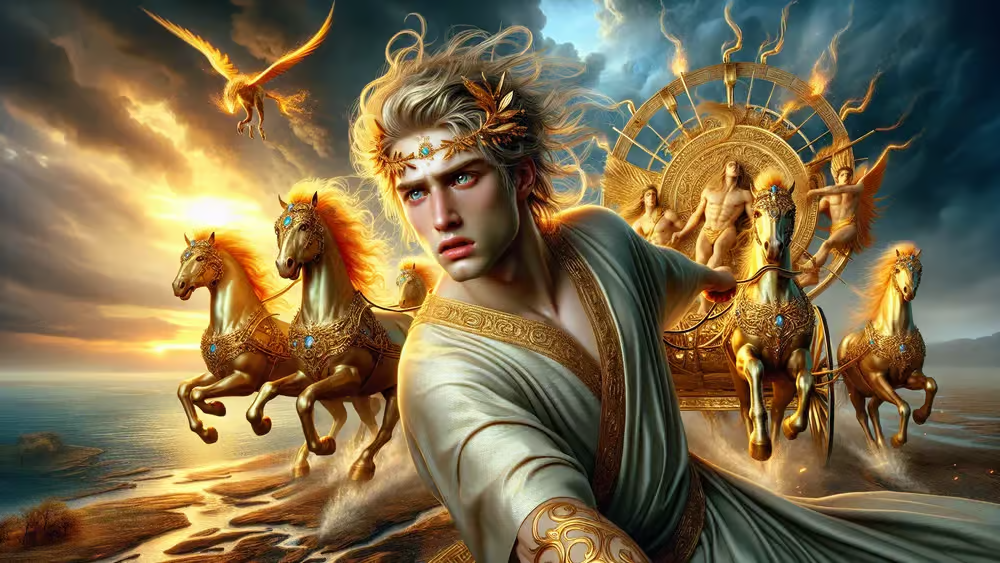
Phaethon was the son of Clymene, a mortal woman, and Helios, the god of the Sun. After being mocked by his peers who didn't believe his father was a god, Phaethon traveled to the ends of the earth to the Palace of the Sun to seek the truth.
The Divine Promise: Helios, moved by his son's journey, swore an unbreakable oath by the River Styx to grant Phaethon any one wish he desired to prove his parentage.
The Fatal Request: Phaethon asked for the one thing Helios feared most: to drive the Sun Chariot across the sky for a single day.
2. The Warnings of Helios
Helios was horrified. He explained that even Zeus, the king of the gods, could not control the four fire-breathing horses (Pyrios, Aeos, Aethon, and Phlegon).
The Steep Path: The ascent is too steep for comfort, the midday height is dizzying, and the descent requires a steady hand to avoid crashing into the sea.
The Celestial Beasts: Helios warned him of the terrifying constellations he would have to pass—the horns of the Bull (Taurus), the sting of the Scorpion (Scorpio), and the jaws of the Lion (Leo).
3. The Out-of-Control Flight
Despite his father’s pleas, Phaethon took the reins. As soon as the chariot left the gates of Dawn, the horses realized the hand on the reins was light and inexperienced.
The Loss of Control: The horses bolted from the established path. When the chariot flew too high, the earth froze. When it dipped too low, the results were apocalyptic.
Environmental Impact: According to the myth, this "crash" created the Sahara Desert by scorching the green lands of Africa and turned the skin of the Ethiopians dark from the intense heat. The great rivers—the Nile, the Danube, and the Rhine—began to boil and dry up.
4. The Lightning Bolt of Zeus
As the Earth Goddess (Gaia) cried out in agony that the world was being consumed by fire, Zeus realized he had to intervene to save the universe.
The Final Strike: To stop the destruction, Zeus hurled a thunderbolt at the chariot. The vehicle shattered, and Phaethon, his golden hair on fire, fell like a shooting star into the River Eridanus.
The Mourning Sisters: Phaethon's sisters, the Heliades, were so consumed by grief that they stayed on the riverbanks until they turned into poplar trees, and their tears became amber.
5. The Moral: Know Thy Limits
The myth is the ultimate warning against presumption. It teaches that some "thrones" are not meant for those who haven't earned the strength to sit in them.
Ambition vs. Ability: Phaethon’s tragedy wasn't that he was evil, but that he was impatient. He wanted the glory of the godhead without the discipline of a god.
The Styx Oath: The story also serves as a warning about the danger of making promises before knowing the cost—Helios was trapped by his own words, forced to watch his son die because of a "blank check" oath.
Phaethon’s name has survived in modern English through the word "phaeton," a type of light, open, four-wheeled carriage—a somewhat ironic tribute to a driver who famously couldn't stay on the road.