The myth of Niobe stands as the ultimate Greek cautionary tale regarding hubris (excessive pride) and the terrifying scale of divine retribution. While many myths involve a single punishment, Niobe’s story is a visceral depiction of total loss, where a mother’s boast leads to the systematic destruction of her entire legacy.
1. The Boast of the Mother
Niobe was the Queen of Thebes and the daughter of Tantalus (a king famously punished in the Underworld). She was wealthy, powerful, and, most importantly, blessed with fourteen children—seven sons and seven daughters, known as the Niobids.
The Insult to Leto: During a festival held in honor of the goddess Leto (the mother of Apollo and Artemis), Niobe publicly mocked the goddess. She argued that she was more deserving of worship because she had fourteen beautiful children, whereas Leto had only two.
The Claim to Superiority: Niobe’s pride wasn't just in her numbers; she believed her fertility and her lineage made her superior to the divine.
2. The Swiftness of Apollo and Artemis
Leto, offended by the mortal's arrogance, called upon her twin children to defend her honor. Apollo and Artemis descended from Olympus to Thebes with their silver bows.
The Slaughter of the Sons: Apollo targeted the seven sons as they were practicing athletics on the plain outside the city. He struck them down one by one with his arrows.
The Slaughter of the Daughters: Despite the death of her sons, Niobe’s grief did not immediately turn to humility. Artemis then targeted the seven daughters within the palace walls.
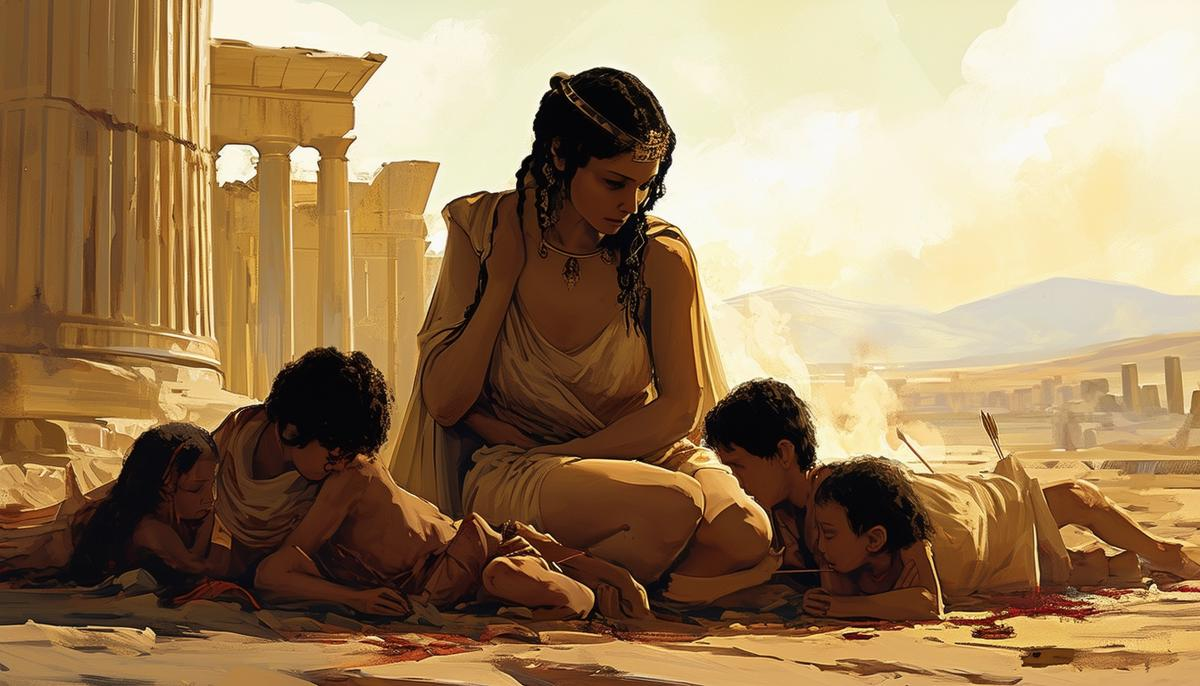
The "Final" Plea: Legend says that as the youngest daughter remained, Niobe shielded the girl with her own body, crying, "Leave me but this one, the littlest of all!" But the arrow had already been released.
3. The Nine Days of Silence
The horror of the myth extends beyond the killing itself. The people of Thebes were turned to stone by Zeus, leaving no one to bury the dead.
Unburied Dead: For nine days, the bodies of the fourteen children lay in the sun. On the tenth day, the gods themselves, perhaps moved by a late-coming pity or a desire for closure, finally buried the Niobids.
4. The Weeping Rock
In the aftermath, Niobe fled back to her homeland in Lydia (modern-day Turkey), to Mount Sipylus. She was so consumed by grief that she became immobile.
Metamorphosis: Zeus, seeing that her tears would never stop, turned her into a rock formation.
The Eternal Tear: Even as stone, her grief remained. The rock, which resembles a woman's face, features a natural spring that seeps through the porous limestone. To observers, it looks as though the stone face is perpetually weeping.
5. Artistic Legacy and Psychology
The "Niobe" theme has been a powerful subject in art, from the Hellenistic Niobid Group sculptures to the paintings of the Renaissance.
Symbol of Grief: In Western literature, Niobe became the archetype of the bereaved mother. Shakespeare’s Hamlet famously describes his mother as being "like Niobe, all tears."
The Scale of Justice: The myth is often criticized for the "over-the-top" nature of the punishment. It highlights a recurring theme in Greek myth: the gods do not care about "proportional" justice. Any slight against their honor is met with total annihilation.
6. The Historical Connection
Archaeologists and geologists have identified the "Weeping Rock" on Mount Sipylus. While the "face" is a result of natural erosion and the "tears" are the result of rainwater filtering through the stone, the fact that the Greeks built a massive myth around this specific landmark shows how they used the physical landscape to anchor their moral and religious teachings.
Niobe’s story suggests that the greatest height of human happiness—the pride in one's children—is also the point of greatest vulnerability.