The myth of Narcissus is one of the most enduring psychological metaphors in human history. Found most famously in Ovid’s Metamorphoses, it explores the transition from self-admiration to self-destruction, serving as a warning that an obsession with one’s own image leads to a disconnection from reality and the "death" of the soul.
1. The Prophecy of Tiresias
The story begins with a prophecy. When Narcissus was born, his mother asked the blind seer Tiresias if her son would live a long life. Tiresias’s answer was cryptic: "Only if he never knows himself."
In the context of the myth, "knowing oneself" did not mean wisdom; it meant seeing his own physical reflection. For Narcissus, ignorance of his own beauty was the only thing keeping him alive.
2. The Rejected Echo
Narcissus grew into a youth of such extraordinary beauty that he was pursued by many, but he possessed a "cold pride" and rejected every suitor. Among them was the nymph Echo.
The Curse of Echo: Echo had been punished by Hera to only be able to repeat the last words spoken to her.
The Rejection: When she tried to embrace Narcissus, he cruelly spurned her. Devastated, Echo faded away until only her voice remained—a haunting reminder of the dangers of unrequited love and the inability to communicate one's own identity.
3. The Reflection in the Pool
The goddess Nemesis (Divine Retribution) heard the prayers of those Narcissus had hurt and decided to punish him. She led him to a clear, undisturbed pool on Mount Helicon.
The Fatal Gaze: As Narcissus leaned down to drink, he saw his own reflection for the first time. He did not realize it was an image; he thought it was a beautiful water spirit.
The Paralyzing Love: He fell deeply in love with the reflection. Every time he tried to kiss or embrace the figure, the water rippled and the image vanished. He was trapped in a paradox: he could see the object of his desire, but he could never touch it.
4. The Metamorphosis
Narcissus eventually realized that he was pining for himself. He understood that he was both the lover and the beloved, and that this love could never be consummated.
Wasting Away: Unable to pull himself away from the pool, Narcissus stopped eating and drinking. He withered away in grief.
The Narcissus Flower: At the moment of his death, his body disappeared. In its place grew a flower with a gold center and white petals—the Narcissus (or Daffodil). The flower’s heavy head often bows toward the water, eternally mimicking the youth’s downward gaze.
5. Psychological Legacy: From Myth to Narcissism
In the late 19th and early 20th centuries, psychologists like Havelock Ellis and Sigmund Freud adopted the myth to describe a specific personality disorder.
Narcissistic Personality Disorder (NPD): In modern psychology, this is characterized by a long-term pattern of exaggerated self-importance, a lack of empathy for others, and a deep need for admiration.
The "Reflection" Trap: Much like the mythical youth, the psychological narcissist is often in love with an idealized false image of themselves, which they must constantly protect, leading to fragile self-esteem and social isolation.
6. Artistic Interpretations
The image of Narcissus at the pool has been a favorite subject for artists like Caravaggio and Salvador Dalí.
Caravaggio’s Narcissus: This painting emphasizes the "loop" of the reflection, where the arms of Narcissus and his reflection form a circle, symbolizing the "closed circuit" of self-obsession.
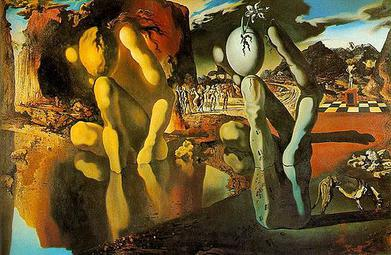
Dalí’s "Metamorphosis of Narcissus": This surrealist interpretation shows Narcissus transforming into a stone hand holding an egg from which a narcissus flower sprouts, blending the biological and the psychological.
The myth suggests that while self-awareness is generally a virtue, a "reflection" is not the "self." Narcissus died because he mistook a two-dimensional image for a three-dimensional reality.
Since we live in an era of "digital mirrors"—social media profiles and selfies—do you think the prophecy of Tiresias has become a modern reality, where "knowing our image" too well has started to threaten our connection to our actual lives?