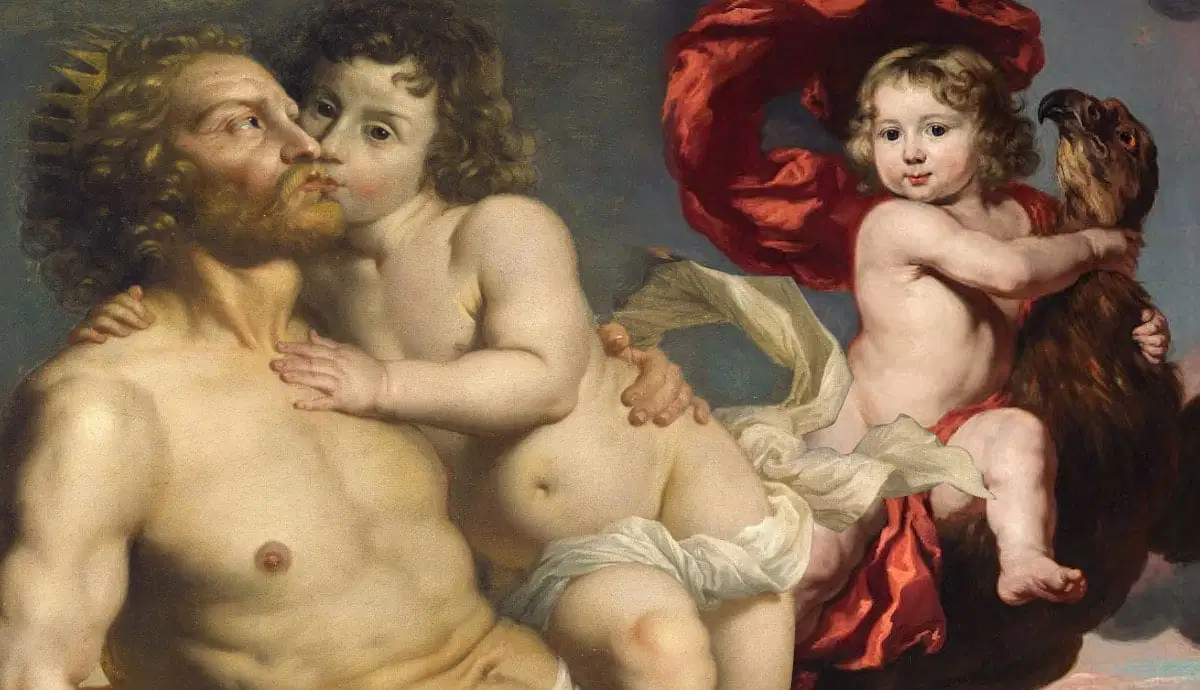
The myth of Ganymede is a unique narrative in the Greek tradition, representing the transition from mortality to divinity through the lens of beauty and divine service. It is one of the few stories where a mortal is brought to Olympus not as a hero or a victim of punishment, but as a beloved fixture of the celestial court.
1. The Prince of Troy
Ganymede was a divine-looking youth, the son of King Tros (the namesake of Troy). According to Homer, he was the "loveliest of mortals," a description that eventually caught the eye of Zeus, the King of the Gods.
The Setting: Ganymede was often depicted tending his father’s flocks on the slopes of Mount Ida, a location frequently associated with divine encounters and the judgment of beauty.
2. The Abduction: The Eagle of Zeus
In the most famous version of the myth, Zeus transformed himself into a massive eagle (or sent his sacred eagle) to snatch the boy from the mountainside.
The Ascent: The eagle swept down and carried Ganymede up to the heights of Mount Olympus.
The Father’s Grief: To compensate King Tros for the loss of his son, Zeus sent Hermes to deliver a gift: a pair of immortal, wind-swift horses and a golden vine fashioned by Hephaestus. Hermes assured the king that his son would now be immortal, free from the ravages of old age.
3. The Cupbearer to the Gods
Once on Olympus, Ganymede was appointed as the official Cupbearer, a role previously held by Hebe, the goddess of youth.
The Divine Nectar: His primary duty was to pour ambrosia and nectar—the food and drink of the gods—during their eternal banquets.
The Jealousy of Hera: Ganymede's presence and the favor Zeus showed him famously provoked the jealousy of Hera. She resented the youth both for his beauty and for displacing her daughter, Hebe, from her traditional role.
4. The Constellation: Aquarius
To ensure Ganymede’s memory would be eternal, Zeus placed him among the stars. He is traditionally associated with the constellation Aquarius, the "Water Bearer."
Symbolism of the Urn: Aquarius is often depicted as a man pouring water from an urn. In the Greek interpretation, this represents Ganymede pouring the "water of life" or nectar for the heavens, a symbol of the vital forces that sustain the universe.
The Eagle (Aquila): Nearby in the sky sits the constellation Aquila, representing the eagle that carried him to the heavens.
5. Artistic and Symbolic Legacy
The myth of Ganymede has been a major theme in Western art for centuries, evolving in meaning through different eras:
The Renaissance: Artists like Michelangelo and Cellini used the abduction as an allegory for the "ascent of the soul" toward the divine, where the eagle represents the intellect or spiritual longing lifting humanity above earthly concerns.
Homoerotic Symbolism: Throughout history, the story has been cited as a primary mythological foundation for the celebration of same-sex beauty and relationships in the ancient world.
The "Ganymede" Moon: In modern science, the name was given to the largest moon of Jupiter (the Roman equivalent of Zeus), keeping the connection between the god and his cupbearer alive in our mapping of the solar system.
6. Contrast with Other Myths
Unlike the story of Phaethon (who reached for the sun and fell) or Narcissus (who looked inward and died), Ganymede’s story is one of external elevation. He didn't seek the gods; the gods sought him. It highlights the Greek belief that extreme beauty was a divine quality that belonged more to the heavens than to the earth.
The story suggests that the divine and the mortal are separated by a thin veil, and occasionally, that veil is pierced by an eagle’s wings.