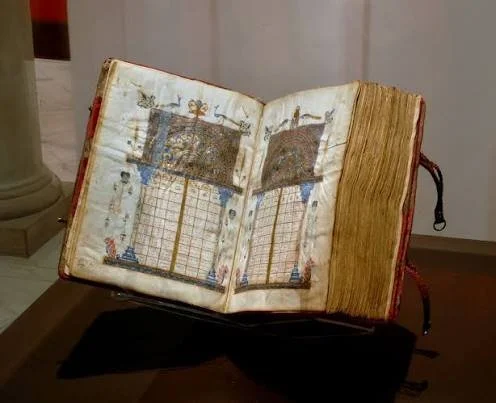
A significant manuscript, the oldest surviving copy of Claudius Ptolemy’s Geography, was recently brought out from the Vatopedi Monastery on Mount Athos and made its debut in Cyprus. It was showcased in the exhibition “Cyprus: Island, History – Memory – Reality” at the Cultural Foundation of the Bank of Cyprus in Nicosia. This exhibition presents life in Cyprus from ancient times to the present day, using modern and interactive methods, with a message of the island’s unwavering unity.
Focusing on time, place, and people, the exhibition highlights relationships and narratives that reflect Cyprus' history and modern reality, which have shaped the island's unique identity. Yiannis Toumantzis, director of the Bank of Cyprus Cultural Foundation and Cyprus' first Deputy Minister of Culture, explained to Voria that the exhibition offers a deep dive into the history that has shaped Cyprus’ unified island identity. Originally planned to run until June, the exhibition has been extended until early 2026 due to its massive success, as predicted by President of the Republic of Cyprus, Nicos Christodoulides, at the opening ceremony.
When Ptolemy Depicted the Geography of the Known World
The Vatopedi Monastery manuscript (Codex 655), dating from the 13th century, consists of 296 parchment leaves and is part of a rare collection of secular manuscripts preserved in the libraries of Mount Athos monasteries. Undoubtedly, it is one of the most rare and valuable manuscripts kept in Athos.
It contains the Geographia of Claudius Ptolemy, the famous Greek philosopher and geographer who lived in Alexandria from 127-151 AD, along with Geographica by Strabo and Christomathia ex Geographica by Strabo. Many texts in the manuscript are copies of older manuscripts that follow the lost originals.
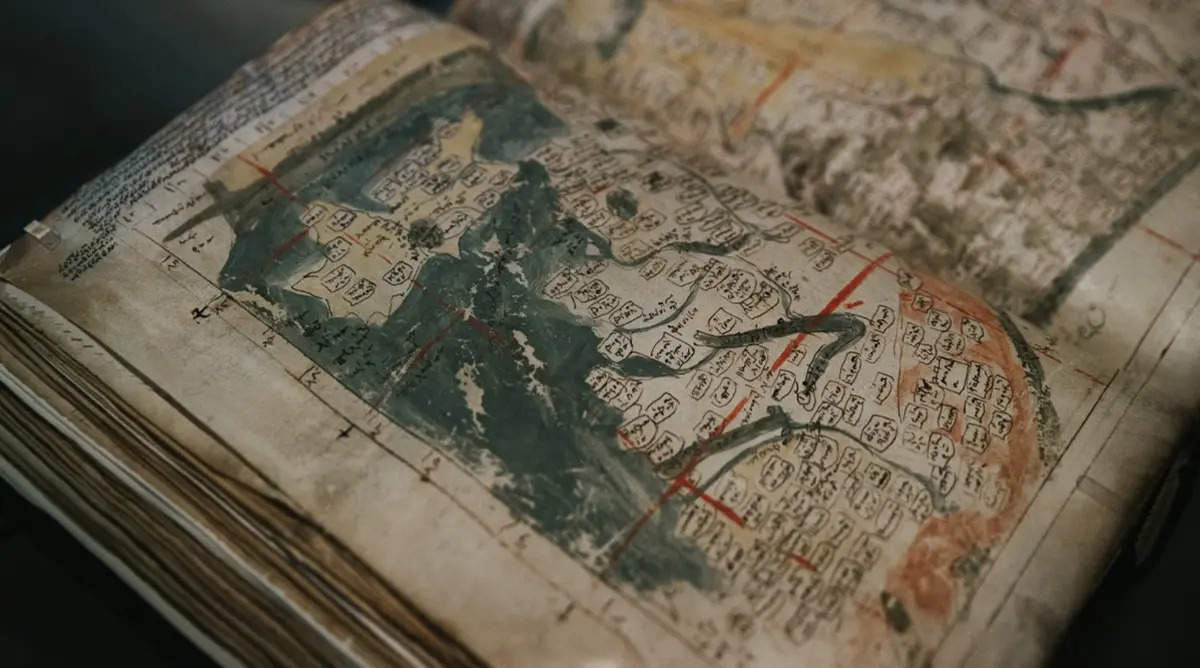
According to Dimitris Liakos, an archaeologist from the Greek Ministry of Culture for Halkidiki and Mount Athos, "The most impressive and significant feature of the codex is the maps from the 8th book of Ptolemy’s Geographia, each depicting one or more countries from the known world of the 2nd century AD. The first map is of the Oikoumene (the inhabited world), followed by 10 maps of Europe, four of Africa, and twelve of Asia. Out of the original 27 double-page maps, 24 are still intact, while three are partially preserved, as later they were separated for various reasons." Ptolemy's Geography gathered the geographical knowledge of his time, enriched with naval descriptions, offering relatively accurate portrayals of Europe, North Africa, the Middle East, and the Arabian Peninsula. Among these is one of the earliest cartographic depictions of the martyr island of Cyprus.
The manuscript was crafted between the late 13th and early 14th century, and its 42 maps are so detailed that one can distinguish mountains, plains, seas, and an array of place names. A second similar manuscript was created in the 15th century for Cardinal Bessarion and is now housed at the Marciana Library in Venice.
The Fascinating History of the Vatopedi Manuscript
This manuscript has a unique history. It was likely created in Constantinople by two scribes and was circulated in "high intellectual circles." After the Fall of Constantinople, the manuscript found its way to Mount Athos. In 1841, Mina Minoyides, a representative of the Greek Enlightenment, obtained seven authentic leaves and sold them to the National Library of Paris. A few years later, in 1853, the paleographer and calligrapher Konstantinos Siminidis sold another 21 leaves to the British Museum. Today, it is known that six more leaves are missing, considered entirely lost.
For Vatopedi Monastery, the manuscript is a historical treasure. During his recent visit to Nicosia, Abbot Ephraim of Vatopedi presented the manuscript, which features one of the earliest depictions of Cyprus. He also showcased other important ecclesiastical, Byzantine, and post-Byzantine treasures, including monumental paintings, portable icons, works of ecclesiastical silver and goldsmithing, manuscripts, and incunabula, all preserved at Vatopedi Monastery on Mount Athos, highlighting its historical ties to Cyprus.
A Five-Act Exhibition
The exhibition at the Cultural Foundation of the Bank of Cyprus is organized into five sections and is part of the celebrations for the 40th anniversary of the Foundation and the 50th anniversary of the Turkish invasion. Through exhibits and rare archival material from the Foundation's collections and private sources, the exhibition traces Cyprus' history from antiquity to the present day. It also explores continuities and discontinuities that have shaped the island’s historical path, some of which have dominated and others have faded from historical memory.
Part of the exhibition is dedicated to the "difficult years" of the Cypriot Republic, from 1963-1964 to the tragic aftermath of the Turkish invasion in 1974. Exhibits include antiquities, folk culture objects, works of contemporary art, historical maps, rare editions, manuscripts, engravings, printed and digital archival materials, and digital applications.
The exhibition is accompanied by a special publication and a series of events related to its theme, including roundtable discussions, experiential educational programs, lectures, guided tours, presentations, and sensory activities designed for people with disabilities, based on the Cultural Foundation's Sensory museum program.