Island archaeology, submerged settlements, and the distinctive art of the prehistoric Cyclades.
The Human Figures of the Cyclades
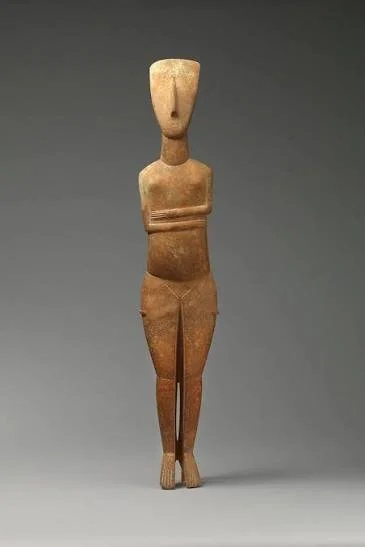
Cycladic marble figurines are among the most recognizable artworks of prehistoric Aegean culture. Many depict simplified human forms, often with folded arms and carefully shaped facial features. Their restrained appearance has attracted the attention of archaeologists, art historians, and modern artists alike.
The idea of finding such figurines on the seabed around Kythnos connects this artistic tradition with underwater archaeology. Kythnos does have documented underwater archaeological remains, including parts of the ancient harbor at Mandraki Bay. The specific claim of Cycladic figurines recovered from its seabed, however, needs independent confirmation. <Cite refs={["turn293243search1"]} />
Marble and Island Craftsmanship
Cycladic figurines were commonly carved from marble, a material available on several islands in the Aegean. Their production required knowledge of stone selection, shaping, smoothing, and finishing.
Although many surviving examples have a familiar folded-arm pose, prehistoric figurines varied in size, form, and detail. Their exact functions remain debated. They may have been associated with burial practices, ritual activity, social identity, or other aspects of life, and a single explanation is unlikely to fit every example.
Why the Seabed Can Preserve Archaeological Evidence
Ancient coastal settlements and harbors can become submerged because of sea-level change, local subsidence, earthquakes, or other geological processes. Underwater sites may preserve walls, building foundations, and objects lost during maritime activity.
Kythnos's ancient harbor research has documented submerged coastal fortifications and marble sculpture from later periods. These finds demonstrate the archaeological value of the seabed, but they do not establish that prehistoric Cycladic figurines have been discovered there. <Cite refs={["turn293243search1"]} />
Identifying a Genuine Figurine
A marble object found underwater must be examined carefully before it is assigned to a prehistoric period. Researchers would study its shape, carving marks, weathering, mineral composition, and archaeological context.
Comparison with securely dated Cycladic figurines could help establish whether it belongs to the same artistic tradition. Provenance is equally important: an object recovered without reliable documentation may be difficult to date or connect to a particular site.
Researchers must also consider modern replicas, later sculptures, and naturally shaped stones that may resemble artifacts.
The Importance of Underwater Documentation
Underwater archaeology records the location and relationship of objects before removal. Photogrammetry, measured drawings, and sediment analysis help reconstruct the environment in which a find was deposited.
Unauthorized recovery can damage both the object and the evidence surrounding it. Archaeological material should be reported to the appropriate heritage authorities rather than removed for private collection.
A Promising Question, Not a Confirmed Discovery
A verified Cycladic figurine from the Kythnos seabed could help researchers investigate prehistoric maritime activity and the distribution of artistic objects across the islands. Until such a find is documented, the specific claim remains unconfirmed. The established underwater archaeology of Kythnos already offers a strong foundation for exploring how coastal landscapes and human history have changed over time.