Bronze weapons, funerary landscapes, and the social world of Mycenaean warriors.
A Weapon Preserved in a Burial Landscape
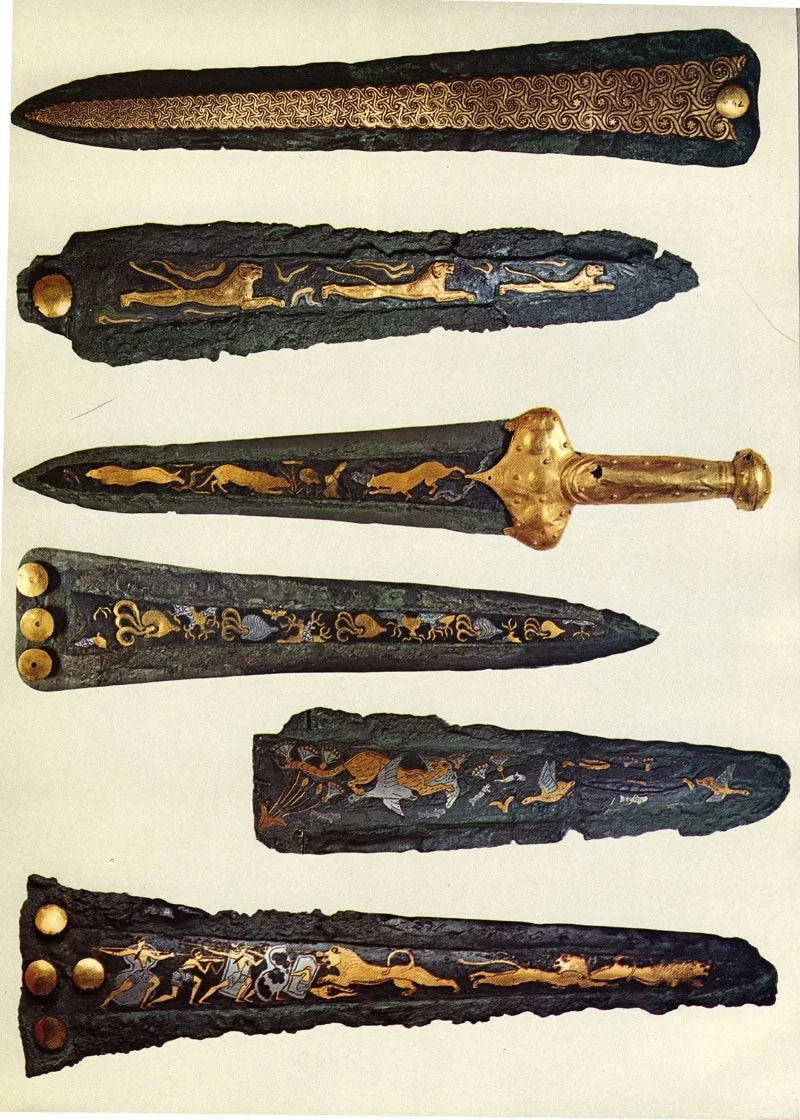
Mycenaean daggers are important archaeological objects because they combine practical craftsmanship with the social meanings attached to weapons. Their forms, decoration, and materials can help researchers investigate metalworking, exchange, warfare, and the ways communities represented status.
The Argolid, in the northeastern Peloponnese, was one of the central regions of Mycenaean civilization. Major centers such as Mycenae and Tiryns preserve evidence of monumental architecture, craft production, and elite burial traditions.
The specific discovery of Mycenaean daggers in a rural tumulus in the Argolid, however, requires confirmation through archaeological documentation. The region's rich Bronze Age history does not establish that a particular mound contains weapons.
Understanding Mycenaean Daggers
Bronze daggers were made by casting and finishing copper-based alloys into forms suitable for cutting and thrusting. Their effectiveness depended on the shape of the blade, its thickness, the quality of the metal, and the construction of the handle.
Some Mycenaean weapons were decorated with elaborate patterns or images. Such decoration can provide evidence about artistic techniques and cultural influences, although not every decorated weapon necessarily belonged to a high-ranking individual.
Researchers can study blade shape, manufacturing marks, metal composition, and traces of wear to investigate how an object was made and used.
What Is a Tumulus?
A tumulus is an earthen mound raised over one or more burials. Such monuments occur in different regions and periods, and their form varies according to local funerary practices.
The presence of a mound alone does not establish its date or cultural affiliation. Archaeologists must examine its construction, burial arrangement, associated objects, and stratigraphic sequence.
A mound may also have been reused or altered long after its original construction. These later activities can complicate the interpretation of artifacts found inside it.
The Argolid's Mycenaean Context
The Argolid contains major Mycenaean centers and extensive burial landscapes. Archaeological investigations have documented tombs containing weapons, jewelry, pottery, seals, and other objects associated with Bronze Age funerary customs.
For example, the Mycenaean necropolis at Palaia Epidaurus has yielded copper weapons and other burial objects, demonstrating the importance of carefully documented funerary assemblages in understanding the wider region. <Cite refs={["turn293243search8"]} />
That evidence provides regional context, but it does not verify daggers from the particular rural tumulus named in this title.
Dating and Examining the Weapons
A reliable investigation would document the dagger's position in the burial, its relationship to human remains, and any associated pottery or ornaments. Radiocarbon dating may help establish the age of suitable organic materials, while stylistic and metallurgical analysis can contribute additional evidence.
Metal analysis can reveal the composition of an alloy, but it does not automatically identify where the ore was mined or where the weapon was manufactured. Such conclusions require comparison with broader archaeological and geological data.
Weapons as Evidence of Society
A dagger could have served as a practical tool, a weapon, a status symbol, or a funerary offering. Its meaning depends on context rather than appearance alone.
The proposed daggers from an Argolid tumulus remain unverified as a specific discovery. If documented, they could contribute to the study of Mycenaean burial customs, metalworking, and social identity. Their historical value would lie in the relationship between the objects, the people buried with them, and the landscape in which the tomb was constructed.