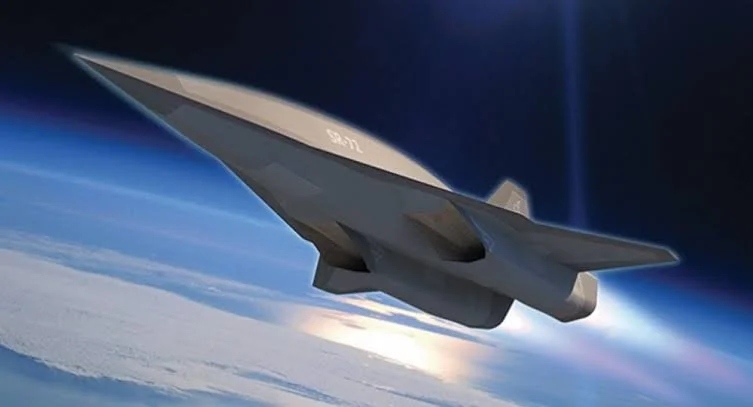
High-speed flight, atmospheric engineering, and the scientific evidence needed to verify advanced aerospace claims.
The Challenge of Hypersonic Flight
Hypersonic flight generally refers to movement at speeds of approximately Mach 5 or higher, meaning at least five times the local speed of sound. At these velocities, the behavior of air around a vehicle creates unusual engineering challenges involving shock waves, heating, pressure, and material performance.
Hypersonic vehicles have been studied for decades in aerospace research. Different designs include powered vehicles and unpowered glide vehicles that are accelerated before following a high-speed trajectory through the atmosphere.
The idea of secret hypersonic gliders operating over the Corinthian Gulf combines advanced aerospace engineering with a recognizable Greek landscape. However, a specific hidden test program in this location should not be presented as established fact without reliable evidence.
How a Hypersonic Glider Works
A hypersonic glide vehicle is generally accelerated to high speed before separating from its booster or launch system. It then travels through the atmosphere along a trajectory shaped by its speed, altitude, aerodynamic properties, and guidance system.
Unlike a conventional aircraft that depends on sustained aerodynamic lift at relatively lower speeds, a hypersonic vehicle encounters intense aerodynamic heating and complex shock-wave interactions. Its shape and materials must be designed to manage these conditions.
Some hypersonic systems use propulsion during part of their flight, while glide vehicles may rely on their initial acceleration and aerodynamic motion. These categories should not be treated as interchangeable.
Why Extreme Speed Creates Extreme Problems
As air flows around a hypersonic vehicle, compression and shock waves can produce very high temperatures. Materials must withstand thermal stress, while the vehicle's structure must remain stable under aerodynamic loads.
Guidance and control are also difficult. The vehicle must respond to changing flight conditions while accounting for communication limitations, sensor performance, and the effects of intense heating on onboard electronics.
Engineers must test these systems using a combination of computational fluid dynamics, wind tunnels, specialized ground facilities, and flight experiments. No single test can establish that a complete vehicle is safe and reliable across every intended condition.
The Corinthian Gulf as a Geographic Reference
The Corinthian Gulf lies between mainland Greece and the Peloponnese. Its surrounding landforms, coastal settlements, and transport connections make it a recognizable geographic setting.
However, the existence of a gulf does not establish that it has hosted hypersonic flight tests. Verifying such an activity would require credible information about the operating organization, test arrangements, flight trajectory, safety measures, and relevant aviation or maritime notices.
Reports of unusual aircraft or distant sounds are not sufficient on their own to identify a hypersonic vehicle. Many different aircraft, atmospheric effects, and other sources can produce observations that are difficult to interpret from the ground.
What Would Count as Evidence?
A credible report would rely on multiple independent sources, such as official test announcements, technical publications, reliable flight documentation, or verifiable statements from the organization responsible.
Researchers would need to distinguish a hypersonic test from a conventional high-speed flight, a ballistic trajectory, or a simulation. They would also need to establish whether the vehicle was a glider, a powered aircraft, or another type of system.
The word “secret” can make a story sound dramatic, but it does not establish that the alleged activity occurred. Technical claims should remain proportionate to the available evidence.
The Future of High-Speed Aerospace
Hypersonic research raises important questions about materials science, propulsion, atmospheric physics, flight safety, and international security. Its scientific challenges are substantial, and progress depends on careful testing and independently evaluated performance.
The proposed secret gliders over the Corinthian Gulf remain unverified. The grounded story is the wider effort to understand extreme-speed flight and the engineering required to operate vehicles in conditions far more demanding than those encountered by ordinary aircraft.