Electric propulsion, ionized gases, and the engineering of spacecraft designed for long journeys.
Propulsion Beyond Chemical Rockets
Spacecraft need propulsion to change their orbits, adjust their trajectories, and reach their intended destinations. Chemical rockets provide high thrust and are essential for launch, but they consume propellant rapidly. Once a spacecraft is in orbit, other propulsion technologies may offer advantages for missions that can tolerate lower thrust over longer periods.
Electric propulsion systems use electrical energy to accelerate charged particles or plasma, producing thrust. They are especially relevant to certain satellite operations and deep-space missions.
The idea of secret plasma thrusters emerging from aerospace hubs in Volos combines a genuine field of space engineering with an unverified local claim. A specific Volos-based program should not be treated as established without documentation from a research institution, company, or relevant space agency.
What Is a Plasma Thruster?
Plasma is a state of matter in which a significant proportion of particles are electrically charged. Electric propulsion systems use electrical or electromagnetic forces to accelerate ions or other charged particles, creating thrust.
Different designs include ion thrusters and Hall-effect thrusters. Although their engineering details differ, both can use electrical energy to accelerate propellant particles to high velocities.
These systems can achieve high specific impulse, meaning they use propellant efficiently relative to the thrust produced. Their drawback is that thrust is generally low compared with chemical rockets, so they are not typically suited to launching a spacecraft from Earth's surface.
A spacecraft using electric propulsion may accelerate gradually over an extended period, making the technology useful for selected orbital maneuvers and interplanetary missions.
The Engineering Challenges
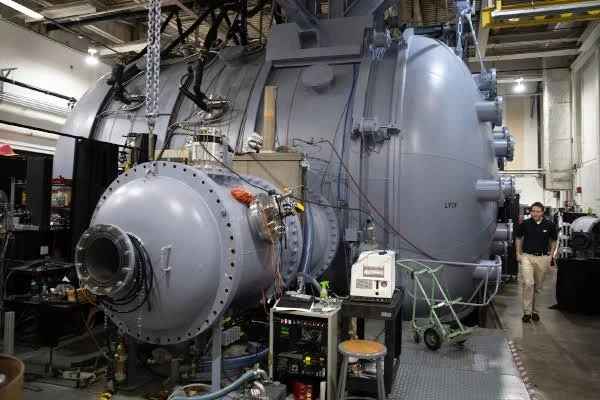
A plasma thruster requires more than a device that produces glowing gas. It needs a power source, propellant storage and delivery, thermal management, control electronics, and components that can withstand the operating environment.
Spacecraft power availability is a major consideration. Solar arrays may support electric propulsion near the Sun, while missions farther away may require other power arrangements.
Engineers must also consider erosion, material degradation, electrical interference, reliability, and the ability to operate for long periods without direct maintenance.
A promising laboratory prototype is only the first stage of development. Space qualification and mission integration require extensive testing.
Volos and Aerospace Research
Volos is a Greek city with an industrial, educational, and technological environment that could support engineering research. Potential contributions to aerospace development might include mechanical design, materials testing, control systems, electronics, simulation, and specialized manufacturing.
However, a general engineering ecosystem is not evidence of a secret plasma-thruster facility. A grounded investigation would identify the company or laboratory, describe its technical work, and establish whether it has built or tested an actual propulsion system.
Research projects may also contribute components to a wider aerospace program without manufacturing complete thrusters themselves. That distinction is important when evaluating claims about local technological capabilities.
How a Breakthrough Would Be Verified
A credible report would include technical specifications, test conditions, measured thrust, power consumption, propellant type, and the duration of operation. Independent evaluation or a peer-reviewed publication could help establish whether the performance claims are meaningful.
Researchers would also compare the design with existing electric propulsion technologies and identify the particular problem it solves. A new device is not necessarily a breakthrough simply because it uses plasma.
The word “secret” should not be used as a substitute for missing evidence. Confidential development is possible in aerospace, but the existence and performance of a specific system still require substantiation before factual claims can be made.
The Future of Electric Spaceflight
Electric propulsion is an established part of modern spacecraft engineering, and continued research may improve efficiency, power handling, reliability, and mission flexibility.
The proposed plasma thrusters from Volos remain unverified as a specific project. The broader opportunity is clear: engineering research, including work on supporting components and simulation, can contribute to the technologies that make future space missions possible.