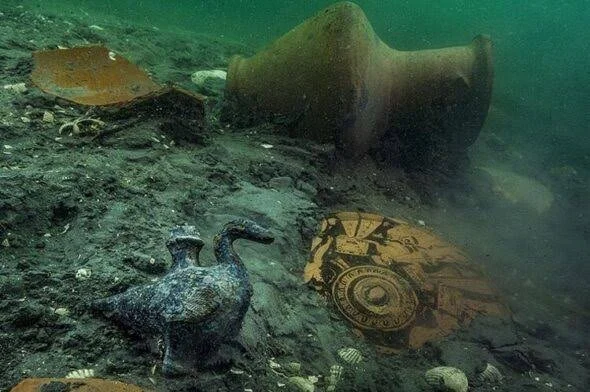
Underwater archaeology, changing coastlines, and the challenge of distinguishing ancient architecture from natural formations.
Sacred Architecture Beneath the Waves
The Saronic Gulf connects the coast of Attica with the Peloponnese and several islands that played important roles in ancient Greek life. Its waters preserve evidence of maritime activity, changing shorelines, and ancient coastal structures.
The possibility of submerged temple foundations among its reefs invites questions about the relationship between ancient religious sites and coastal change. However, a submerged stone platform is not automatically a temple base, and any specific structure must be identified through archaeological evidence.
Research on the western Saronic Gulf has documented submerged coastal constructions and geological indicators associated with past sea levels. These findings show that ancient infrastructure can become submerged through changes in coastal conditions, although they do not confirm a particular group of temple foundations on reefs. <Cite refs={["turn293243search5","turn293243search9"]} />
How Ancient Structures Become Submerged
Coastal buildings can end up underwater for several reasons. Relative sea level can rise, land can subside, and earthquakes can alter the elevation of the coastline. Erosion may also remove supporting material or expose structures that were previously buried.
These processes occur at different rates and can affect nearby locations differently. A building that is submerged today may have stood on dry land, near a tidal zone, or beside an ancient harbor when it was constructed.
Dating the structure and reconstructing the former shoreline are therefore essential to understanding its original function.
What Would Identify a Temple Base?
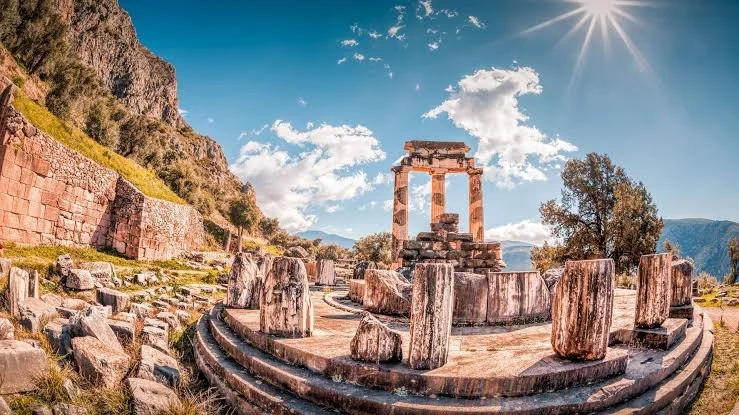
A temple foundation would usually need to be evaluated through its plan, construction technique, dimensions, and relationship to other architectural features. Archaeologists may look for a rectangular platform, column settings, carefully prepared foundations, or evidence of an associated sacred precinct.
Yet these features are not always unique to temples. Harbor installations, retaining walls, houses, and other buildings may share similar construction elements.
Artifacts and inscriptions can help establish a religious association, while geophysical surveys and underwater mapping can reveal the broader arrangement of the site.
The Archaeological Landscape of the Saronic Gulf
Ancient settlements and harbors around the Saronic Gulf were connected by maritime routes. The underwater remains of coastal fortifications, harbor installations, and buildings can help researchers reconstruct how these communities interacted with the sea.
The region also contains archaeological sites with substantial architectural remains on land and evidence of structures extending into submerged areas. For example, research around Kalamianos has documented a major Mycenaean settlement with additional areas now underwater or of uncertain extent. <Cite refs={["turn293243search2"]} />
Such evidence illustrates the importance of examining submerged landscapes as continuations of ancient settlements rather than treating the modern shoreline as a fixed boundary.
Reef, Ruin, or Natural Rock?
Natural geological formations can resemble walls or foundations, particularly when erosion creates regular-looking edges or layered surfaces. Coral and other marine growth can also obscure the original appearance of submerged structures.
Archaeologists therefore combine visual inspection with measurements, detailed mapping, geological analysis, and comparison with known construction techniques. Where appropriate, limited excavation may clarify whether stones were shaped and arranged by people.
Any investigation must also respect underwater heritage laws and protect the site from unauthorized artifact removal.
Reconstructing the Ancient Shoreline
A verified temple foundation in the Saronic Gulf could contribute to the study of ancient religious architecture and coastal change. Establishing its original function would require a careful analysis of the structure, associated finds, and geological history.
The specific temple bases described here remain unverified. The broader archaeological lesson is well established: ancient coastlines were dynamic environments, and some of the buildings that once stood beside the sea now lie beneath it, waiting to be interpreted through careful underwater research.