
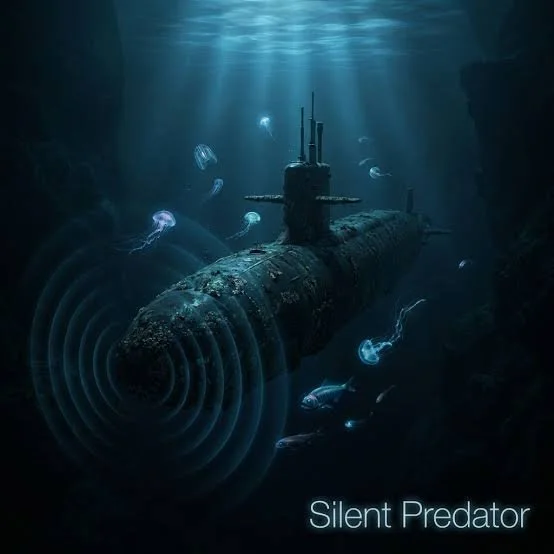
Advanced materials, wave manipulation, and the scientific limits of invisibility beneath the sea.
The Promise of Disappearing Technology
Invisibility has long captured the imagination of scientists, writers, and engineers. Modern research into metamaterials has made some forms of unusual wave manipulation possible, leading to experiments that can alter how electromagnetic waves or sound interact with specific structures.
The idea of lost metamaterial cloaks developed for submarines in the Aegean evokes a secret technology capable of making vessels disappear. There is, however, no basis to claim that a particular lost cloaking system was developed for Aegean submarines without credible documentation.
The scientific subject is still fascinating: how engineered materials can change the propagation of waves, and why turning laboratory demonstrations into practical underwater concealment is extraordinarily difficult.
What Are Metamaterials?
Metamaterials are engineered structures whose behavior depends on their designed geometry and arrangement, rather than only on the chemical properties of their constituent materials. By creating carefully patterned structures, researchers can influence how waves interact with an object.
Some metamaterial research focuses on electromagnetic waves, while other work investigates acoustic waves, including sound in water. The underlying principles and practical constraints differ between these applications.
Certain experimental arrangements have demonstrated forms of wave redirection, reduced scattering, or concealment under limited conditions. These results should not be interpreted as evidence of universal invisibility.
Performance is often constrained by the frequency range, viewing angle, size of the object, material losses, and complexity of the surrounding environment.
Why Underwater Cloaking Is Different
Submarines operate in a medium where sound travels differently from how light travels through air. Sonar systems emit or receive acoustic signals, and their performance depends on factors such as water temperature, salinity, depth, seafloor conditions, and background noise.
A material designed to manipulate visible light would not automatically affect sonar. Acoustic cloaking requires structures that interact with sound waves in appropriate ways, and a solution effective at one frequency may not work across the broad range of conditions encountered at sea.
The size of a submarine also presents a challenge. A practical cloak would need to work around a large, complex structure while remaining durable under pressure, water movement, and changing operating conditions.
Even reducing one type of acoustic reflection would not necessarily eliminate other detectable signals, such as machinery noise, wake effects, or emissions from onboard systems.
What Could “Lost” Technology Mean?
In scientific writing, a lost technology claim requires evidence that the technology once existed and that its records or physical components have subsequently disappeared. Without technical documents, identified researchers, prototypes, or credible historical accounts, the word “lost” can turn speculation into an unsupported assertion.
Research into advanced materials is often published through academic papers, patents, laboratory reports, and conference presentations. Some work may remain commercially confidential, but secrecy alone is not proof of a particular capability.
A responsible investigation would identify the alleged system, establish its intended purpose, and compare the claims with independently demonstrated results.
From Laboratory Demonstrations to Naval Systems
Moving a metamaterial concept from a controlled experiment to an operational submarine would require extensive engineering. Researchers would need to address manufacturing tolerances, structural integrity, environmental durability, integration with the hull, and performance under realistic acoustic conditions.
Testing would also need to establish whether any reduction in detectability was meaningful compared with existing approaches. A material that works for a small test object may not scale effectively to a large vessel.
These engineering challenges are central to the difference between a scientific demonstration and a practical system.
The Real Frontier of Wave Control
Metamaterials remain an important field because they encourage researchers to design how matter interacts with waves. Their potential applications extend beyond military systems to imaging, antennas, acoustics, vibration control, and sensing.
The notion of lost cloaks for Aegean submarines remains unverified. The established science is more nuanced: engineers can manipulate waves under specific conditions, but a reliable, all-purpose invisibility cloak is not a demonstrated consequence of metamaterial research.







