Introduction
The island of Rhodes occupies a significant position in the history of the eastern Mediterranean. Located near the southwestern coast of Anatolia, it served as a meeting point for maritime commerce, military campaigns, religious institutions, and cultural exchange. During the medieval period, Rhodes became particularly important under the Knights Hospitaller, a military religious order that established its headquarters on the island in the early fourteenth century.
Although the Hospitallers are frequently associated with the Knights Templar in popular accounts, the two organizations were distinct. The Templars were suppressed in the early fourteenth century, while the Hospitallers continued operating from Rhodes for centuries. Understanding this distinction is essential when investigating alleged Templar traces in the island's inland landscapes.
The Military Religious Orders in Rhodes
The Knights Templar emerged during the Crusades and developed into an influential religious and military organization. Their activities included protecting pilgrims, participating in military campaigns, and administering properties across Europe and the eastern Mediterranean.
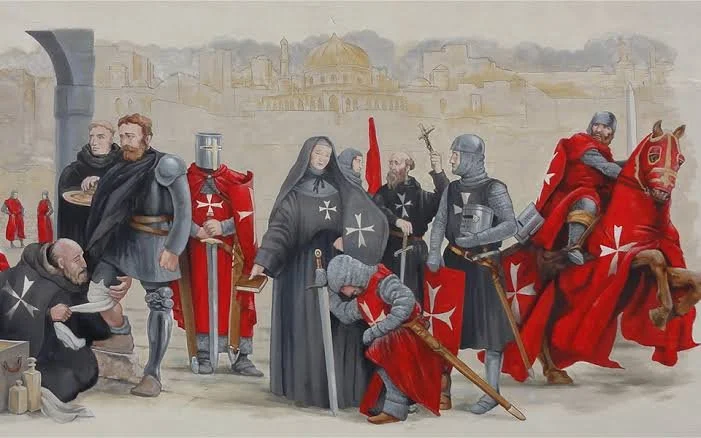
The Knights Hospitaller had a different institutional origin, initially focusing on caring for pilgrims and sick travelers before becoming a military order. After losing their base in the Holy Land, the Hospitallers established themselves on Rhodes in 1309, developing a fortified headquarters and a maritime power that influenced regional politics.
The distinction matters because buildings associated with medieval military orders are sometimes attributed to the Templars without sufficient evidence. A castle, chapel, or fortified farm on Rhodes cannot be identified as Templar simply because it appears medieval or contains religious symbols.
Inland Rhodes and Medieval Fortifications
Rhodes's interior contains hills, agricultural valleys, villages, and strategic routes connecting coastal settlements. Control of these routes was important for moving supplies, communicating with the island's interior, and responding to military threats.
During the Hospitaller period, fortifications and defensive settlements supported a wider system of territorial control. Some sites protected agricultural production, while others provided observation points or defended approaches toward the coast.
Archaeologists studying these places examine construction techniques, masonry, pottery, inscriptions, architectural changes, and documentary references. Such evidence helps distinguish medieval structures from later modifications.
What Would Count as Templar Evidence?
A convincing identification of a Templar site would require more than a cross carved into stone. Crosses were used by many Christian communities, military organizations, and local institutions.
Stronger evidence might include an inscription identifying the order, a reliable medieval document connecting the property to the Templars, or archaeological findings securely associated with their presence.
The historical chronology is also important. Because the Templars were suppressed in the early fourteenth century, a building securely constructed much later would require a different explanation unless evidence demonstrated the reuse of an earlier Templar structure.
Legends, Hidden Chambers, and Popular Imagination
Stories about secret tunnels, concealed treasures, and forgotten Templar strongholds have become common in popular writing about medieval Europe. Such stories can make heritage sites attractive to visitors, but they should not be confused with archaeological findings.
Underground passages may have served drainage, storage, access, or defensive purposes. Their existence alone does not establish a connection with a secret religious order.
Archaeological investigation can evaluate these claims through architectural surveys, ground-penetrating radar where appropriate, archival research, and carefully controlled excavation.
Conservation and Historical Interpretation
Rhodes's medieval heritage attracts substantial tourism, creating opportunities for education as well as risks to fragile structures. Uncontrolled digging, removal of stones, and damage caused by speculative treasure hunting can destroy the evidence needed to understand a site.
Responsible interpretation should acknowledge the island's multiple historical periods, including Byzantine, Hospitaller, Ottoman, and later phases.
Conclusion
The search for Templar traces in inland Rhodes is best approached as a historical and archaeological investigation rather than a hunt for hidden secrets. The island's documented Hospitaller heritage provides a strong foundation for research, while individual claims of Templar occupation must be tested against reliable evidence. By distinguishing the Templars from the Hospitallers and evaluating sites within their historical context, researchers can produce a more accurate understanding of Rhodes's medieval landscape.