Introduction
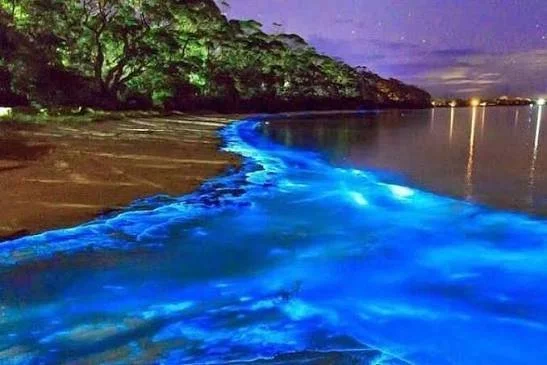
The sea at night can appear almost supernatural when small waves produce flashes of blue-green light. A paddle, a breaking wave, or the movement of a swimmer may create a brief luminous trail that disappears almost as quickly as it appears. This phenomenon is known as marine bioluminescence, the production of light by living organisms through biochemical reactions.
The coastline of Messenia, in the southwestern Peloponnese, contains sheltered bays, sandy beaches, rocky shores, and coastal wetlands. These environments are part of a diverse marine landscape influenced by currents, temperature, freshwater inputs, and seasonal changes in plankton communities.
The phrase “Bioluminescent Lagoons of the Messenian Gulf at Midnight” evokes a specific destination where luminous water might be seen regularly. However, the existence of a consistently glowing lagoon or a famous, scientifically documented bioluminescent site in the Messenian Gulf should not be assumed without location-specific evidence. The underlying phenomenon is real, but its appearance depends on the organisms and environmental conditions present at a given time.
What Makes Seawater Glow?
Bioluminescence occurs when an organism produces light through a chemical reaction. In many marine organisms, the reaction involves a light-emitting molecule called luciferin and an enzyme or related protein system. The precise chemistry varies among organisms.
Dinoflagellates, a group of microscopic plankton, are among the best-known sources of glowing seawater. Some species produce brief flashes when disturbed by waves, currents, or moving objects. These flashes may serve as part of a defensive response, potentially making a small organism's predator more visible to a larger predator.
The light is usually blue or blue-green because these wavelengths travel relatively well through seawater. To a person standing on a dark beach, the combined flashes of many microscopic organisms can make a wave appear to carry a line of light.
Not all plankton blooms glow. Many dinoflagellates are not bioluminescent, and the presence of abundant plankton does not automatically mean that luminous water will appear. Species composition matters as much as total abundance.
Why Coastal Conditions Matter
The visibility of bioluminescence depends on several environmental factors. Water temperature can influence the growth and activity of plankton, while currents and winds determine where organisms accumulate. Nutrient availability affects plankton communities, but nutrient enrichment can also create ecological problems, depending on the organisms involved and the severity of a bloom.
Sheltered water may allow plankton to concentrate under certain conditions, although exposed coastlines can also show bioluminescence. Calm weather is often helpful for observing the phenomenon because it allows people to see individual flashes more clearly. Complete darkness improves visibility, particularly when moonlight and artificial lighting are limited.
The result is highly variable. A beach that glows on one night may show no visible light the following evening. A photograph of a luminous shoreline therefore cannot establish that the phenomenon occurs throughout the year or at every nearby beach.
Messenia's Coastal Environment
Messenia's coastline includes environments that support marine life, from rocky habitats to sandy seabeds and sheltered coastal waters. Its position in the southwestern Peloponnese places it within the broader circulation of the Ionian Sea and the Mediterranean.
To determine whether a particular Messenian site experiences recurring bioluminescence, researchers would need repeated observations. Useful records would include the precise location, date, water temperature, weather conditions, and the identification of organisms in water samples. Photographs and video can document visible flashes, but they may not reveal which species produced them.
Such records would help distinguish an isolated occurrence from a recurring ecological pattern. They would also prevent a striking but unverified report from becoming an exaggerated claim about an entire gulf.
Responsible Nighttime Observation
Anyone hoping to observe marine bioluminescence should prioritize safety and conservation. Beaches, rocky shores, and coastal paths can be hazardous after dark, particularly when waves are strong or the ground is uneven. Visitors should avoid entering unfamiliar water at night.
It is also important not to assume that every glowing patch of water is harmless. The appearance of a bloom alone cannot determine whether the organisms involved produce toxins or whether the water is safe for swimming. Official beach and water-quality guidance should take precedence over photographs or social media reports.
Artificial lighting can reduce visibility, while trampling dunes or disturbing coastal vegetation can damage fragile habitats. Observing from an established public access point is often sufficient.
Conclusion
Bioluminescence offers a remarkable example of how microscopic life can transform a familiar coastline into something visually extraordinary. The phenomenon is scientifically established, and the coastal waters of Messenia provide a compelling setting in which to investigate it.
However, the title's reference to specific bioluminescent lagoons should be understood as a subject for verification rather than proof that a permanent glowing destination exists. Careful observation, ecological sampling, and repeated documentation would be needed to establish the location and frequency of such events. Even without a guaranteed display, the science of marine light reveals the surprising complexity of Mediterranean ecosystems.