Introduction
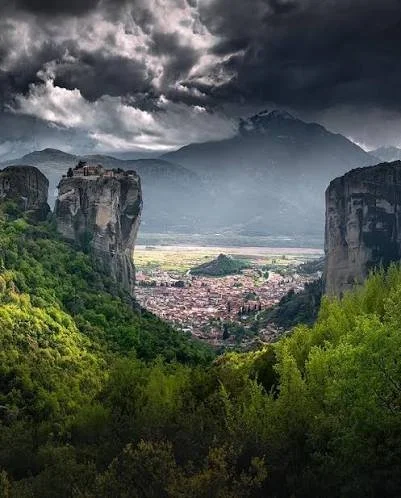
Meteora is one of Greece's most recognizable landscapes. Towering rock pillars rise above the Thessalian plain, and historic monasteries occupy elevated positions on many of these formations. The combination of dramatic geology and religious architecture has helped make the area a major cultural and natural landmark.
The idea of petrified forests beneath Meteora's monastic shadows suggests an additional hidden world: ancient trees transformed into stone and preserved beneath the region's celebrated rock formations. Petrified wood is a real geological phenomenon, and fossil-bearing deposits occur in several parts of the world. However, Meteora's famous pillars are not generally identified as a petrified forest. Their defining geology consists primarily of ancient conglomerates and sandstone deposits shaped by tectonic movement, erosion, and weathering.
Understanding the difference between fossilized wood and the sedimentary rocks of Meteora makes the landscape even more interesting.
How Petrified Wood Forms
Petrified wood forms when plant material becomes buried and mineral-rich water moves through its tissues. Under suitable conditions, minerals may fill the spaces within the wood or gradually replace some of its original components. This process, called permineralization or mineral replacement depending on the precise mechanism, can preserve details of the wood's cellular structure.
The process requires a particular combination of conditions. Burial can limit exposure to oxygen and slow the decomposition of organic material. Groundwater must contain suitable dissolved minerals, and the chemical environment must allow those minerals to accumulate within the plant tissues.
Silica is a common mineral involved in petrified wood, although other minerals may contribute to the final appearance. Depending on the mineral composition and subsequent geological history, petrified wood can display varied colors and patterns.
Petrification is not the instantaneous transformation of a living tree into a stone object. It is a gradual geological process that can occur over long periods, and the preservation of a complete forest requires a suitable combination of burial, mineralization, and later exposure.
The Geological Origins of Meteora
The rock pillars of Meteora are formed largely from conglomerates and sandstone associated with the Pentalophos-Meteora Formation. These sedimentary deposits developed in the geological basin known as the Mesohellenic Trough during the Oligocene and Miocene periods, millions of years before the rise of the modern landscape.
Rivers and related depositional systems transported pebbles, sand, and other material into the basin. Over time, these sediments accumulated, became consolidated into rock, and were subsequently affected by tectonic uplift and erosion.
As softer surrounding material eroded, more resistant rock masses remained as prominent pillars. Rainfall, temperature changes, fractures, and other weathering processes continued to reshape their surfaces. Some formations display cavities known as tafoni, which develop through weathering processes and can create honeycomb-like patterns.
These processes explain Meteora's distinctive appearance without requiring an underlying petrified forest. The rocks preserve a history of ancient sediment transport and changing environments, even where fossilized tree trunks are not present.
Why the Forest Interpretation Can Be Misleading
Sedimentary rocks may contain fossils, plant fragments, or evidence of ancient environments, but not every ancient deposit is a fossil forest. Conglomerates can contain rounded pebbles transported from distant sources, while sandstone records the movement and deposition of sand-sized particles.
A genuine petrified forest would normally be identified through fossilized wood, recognizable tree structures, geological context, and systematic documentation. Researchers would need to establish whether the wood occurs in place, has been transported, or is associated with a particular sedimentary layer.
The term “beneath Meteora's monastic shadows” is therefore best treated as a poetic description, not a verified archaeological or geological discovery. It captures the sense that the region's visible landscape conceals a much longer history, but the specific claim requires evidence.
Protecting a Combined Geological and Cultural Landscape
Meteora demonstrates how geological features can influence human history. High rock pillars offered locations for religious retreat and defense, while caves and natural cavities provided sheltered spaces. Over time, monasteries, paths, and settlements became part of the landscape.
The area is recognized internationally for its geological and cultural significance. The Meteora-Pyli Geopark documents the region's geological sites, including the conglomerate formations, distinctive rock pillars, and weathering features. UNESCO also describes the connection between the rock landscape and the monasteries built above it. <Cite refs={["turn800547search2","turn800547search4"]} />
Responsible exploration should preserve both natural formations and cultural heritage. Visitors should avoid removing rock fragments, climbing restricted surfaces, or disturbing archaeological deposits. Fossil discoveries, if encountered, are most useful when their exact geological context is recorded rather than destroyed through casual collection.
Conclusion
Meteora's extraordinary pillars are the result of ancient sediment deposition, consolidation, uplift, and erosion. Although the title evokes hidden petrified forests, the area's characteristic geology is not itself evidence of such a forest.
The distinction does not diminish Meteora's significance. Its rocks preserve a long record of environmental change, and the monasteries demonstrate how human communities adapted to an unusual geological setting. By separating verified geology from evocative speculation, the landscape can be appreciated both as a natural monument and as a place where Earth's history and human history m